Quick summary
Engaging directly with local culinary traditions—from sub-$2 bowls of Chiang Mai khao soi to authentic €5 Neapolitan pizza—triggers neurological memory pathways that create deeper cultural connections than traditional sightseeing. Plan your trips around regional food markets and hands-on classes, arriving energized by leveraging consolidator fares to secure $6,500+ long-haul business class routes for under $4,000.
A single bite can do what a thousand photographs cannot.
There's real neuroscience behind this. Our olfactory system connects directly to the hippocampus and amygdala — the brain regions governing memory and emotion. That's why a whiff of lemongrass can drag you back to a Chiang Mai market stall at midnight, or a spoonful of broth can feel like remembering something you didn't know you'd forgotten. When you eat somewhere new, you're not just tasting food. You're writing a memory that tends to stick for decades.
This is why serious travelers increasingly build itineraries around food rather than landmarks. It's not a trend. It's just an honest acknowledgment of what actually stays with you.
What culinary travel actually means
It's not restaurant tourism. It's not Michelin-chasing (though there's nothing wrong with that). Culinary travel means treating food as a primary lens — using what people grow, cook, and share as a way of understanding a place on its own terms.
Every destination has a culinary identity shaped by geography, climate, and centuries of trade and migration. The spice routes aren't abstract history; they're in your bowl. When you eat a plate of khao soi in northern Thailand, you're tasting the influence of Yunnanese Muslim traders who moved through that region centuries ago. That's context a museum can't give you.
Food is also one of the most immediate forms of hospitality. When someone invites you to eat — at a market stall, a home kitchen, a roadside cantina — you're being let in. You're not observing a culture. You're briefly inside it.
Research consistently shows that immersive cultural activities, including cooking with locals and eating in non-tourist settings, measurably increase empathy and cross-cultural understanding. That sounds abstract until you've sat on a plastic stool at 7am, eating noodles next to someone who lives there, and realized you've had a better morning than you'd have had at any hotel breakfast.
How to plan a food-first trip
You don't need to be a chef. You need curiosity and a willingness to eat things you can't identify.
Start by deciding what kind of food experience interests you most. The options are wider than most people realize:
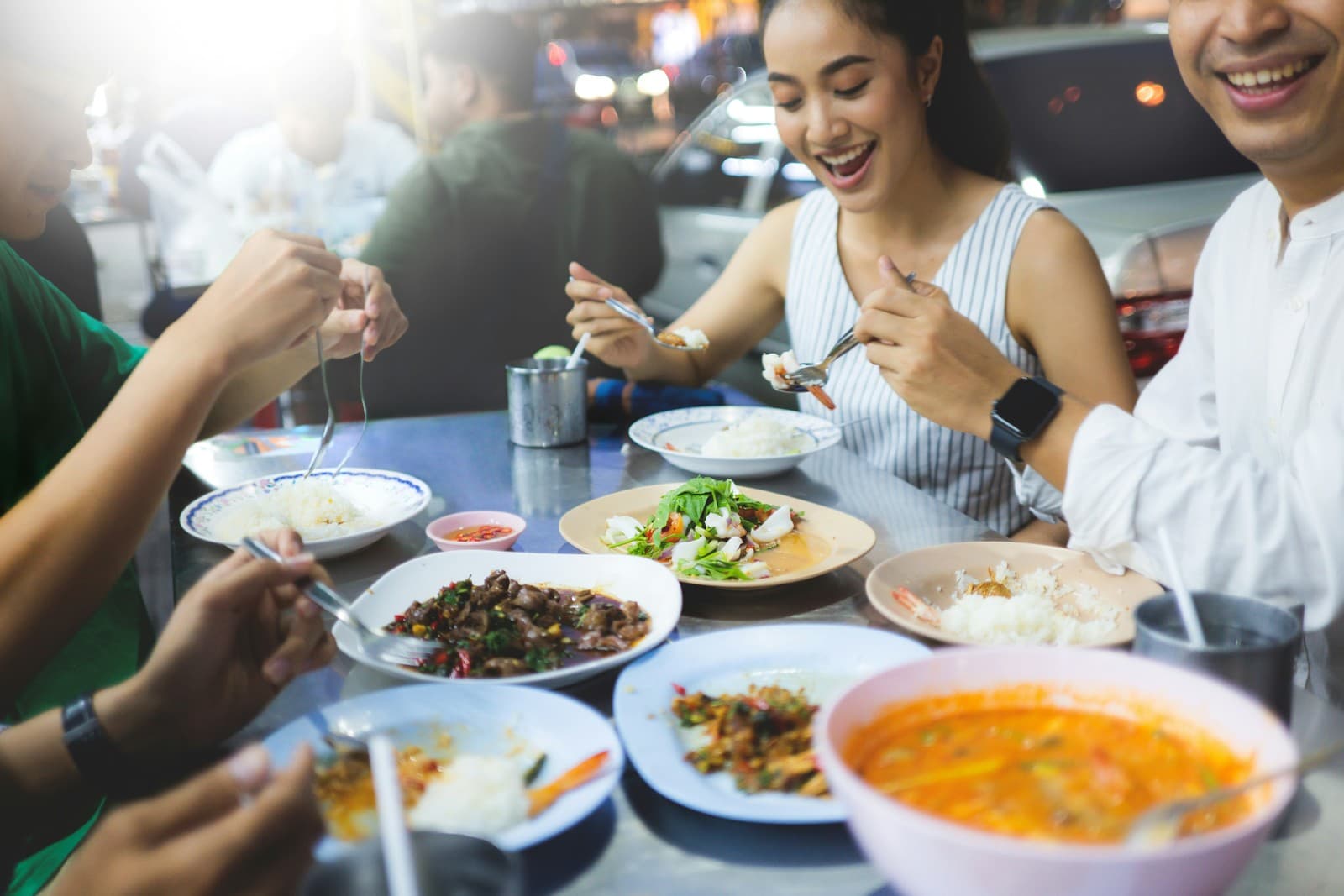
- Street food immersion — night markets, morning congee stalls, taco carts at 11pm; the best food is often the cheapest
- Hands-on cooking classes, ideally ones that begin with a market visit so you understand the ingredients before you cook them
- Farm and producer visits — olive groves in Umbria, cocoa farms in Oaxaca, sake breweries in Niigata
- Dining in locals' homes through platforms like EatWith or through your hotel concierge
- Regional food festivals tied to harvest seasons or specific dishes (truffle fairs, mole festivals, cherry blossom bento traditions)
You don't need to structure your entire trip around food. Adding two or three deliberately chosen food experiences to an existing itinerary is enough to shift how you experience a place. The key is intentionality — deciding in advance that you'll eat one meal per day somewhere unfamiliar, or that you'll take one class, or that you'll spend one morning in a market without a plan.
Local food blogs and neighborhood-specific apps tend to be far more useful than major review platforms, which skew heavily toward tourist-facing restaurants. Ask your hotel's kitchen staff where they eat. That question alone has led me to some of the best meals of my life.
Five destinations that reward food-first travelers
Thailand
Bangkok and Chiang Mai represent two completely different culinary personalities, and both are worth your time.
Bangkok's night markets — Yaowarat Road, Or Tor Kor, the street grids around Silom — are genuinely overwhelming in the best way. Pad thai, grilled pork skewers, mango sticky rice, tom yum that actually clears your sinuses. Meals cost almost nothing and are cooked in front of you by vendors who've been doing this for thirty years.
Chiang Mai's flavor profile is richer and more aromatic, shaped by proximity to Burma and Yunnan. Khao soi — a coconut curry broth over egg noodles, topped with crispy fried noodles and served with pickled mustard greens — is the dish you fly there for. Get it at Khao Soi Khun Yai on Charoenrat Road. It costs less than two dollars. You'll think about it for years.
Cooking classes in Chiang Mai often include a morning at the market, where you'll handle galangal, kaffir lime leaves, and fresh turmeric before touching a wok. Worth every hour.
Must-try: khao soi in Chiang Mai
Italy
Italian food culture resists generalization, which is exactly why it's so rewarding to explore. The food in Naples is not the food in Bologna, which is not the food in Palermo. Each region treats its culinary identity as a point of genuine pride, occasionally bordering on defensiveness.
In Emilia-Romagna, handmade tagliatelle al ragù — not spaghetti bolognese, never call it that — is the benchmark. In Naples, Pizza Margherita at a traditional pizzeria (Sorbillo on Via dei Tribunali is the right call) costs around €5 and tastes like everything pizza in other countries is pretending to be. In Sicily, arancini and cannoli reflect centuries of Arab, Norman, and Spanish influence in a single meal.
Farm stays in Umbria and vineyard tours in Tuscany add depth if you want to understand how wine, olive oil, and cheese actually get made. A quick espresso standing at a bar in any Italian city, for €1, tells you more about Italian daily life than most guided tours.
Must-try: Pizza Margherita in Naples
Japan
Japanese food culture is built on precision, seasonality, and restraint — three qualities that take on new meaning when you eat in context.
Tsukiji Outer Market in Tokyo opens early and rewards people who show up at 6am willing to eat raw scallops for breakfast. Izakayas offer a looser, more convivial food experience: small plates, cold beer, the kind of noise that means people are having a good time. Kaiseki dining in Kyoto — a multi-course progression of seasonal dishes, each one a study in visual and flavor balance — is a formal investment of time and money that pays off completely.
Convenience stores deserve a mention. 7-Eleven and Lawson in Japan sell onigiri, tamago sando, and matcha sweets of a quality that would embarrass many Western cafés. Don't skip them out of misplaced food snobbery.
Must-try: kaiseki dinner in Kyoto
Mexico
Mexico City and Oaxaca are doing different things, and both of them brilliantly.
In Mexico City, tacos al pastor carved off a vertical spit at a street taco stand — ideally at midnight, ideally somewhere around Colonia Roma — is the standard against which all other tacos should be measured. Mercado de la Merced is chaotic and enormous and worth navigating for tamales, fresh juices, and the general education of watching a serious food city at work.
Oaxaca's claim to fame is mole, and it earns it. There are seven distinct moles in Oaxacan cuisine, each with its own spice architecture and preparation. Mole negro, the darkest and most complex, involves dozens of ingredients including dried chilies, chocolate, and charred tortillas. Cooking classes here are exceptional — several local operators run full-day sessions that include a trip to the Tuesday market in Tlacolula.
Must-try: mole negro in Oaxaca
Vietnam
Vietnamese food is about freshness, fragrance, and balance in proportions that most other cuisines don't bother with.
Pho is famous for good reason, but Hanoi's bun cha — grilled pork patties in a clear, slightly sweet broth, served alongside rice noodles and a pile of fresh herbs — is the more interesting dish and currently easier to find at non-tourist prices. In Hoi An, banh xeo (crispy savory pancakes with shrimp and bean sprouts, eaten wrapped in lettuce with dipping sauce) is essential. Southern Vietnam skews sweeter and more tropical.
The best Vietnamese meals happen on the street, on small plastic stools, at a pace that no restaurant can replicate. A cup of ca phe trung — Vietnamese egg coffee, thick and almost dessert-like — enjoyed somewhere slow is one of those travel moments that becomes a reference point.
Must-try: bun cha in Hanoi
The rest of the world is full of this
These five destinations get attention because they've earned it. But injera and tibs in Addis Ababa, grilled sardines in Lisbon, cardamom coffee in Amman, smoked lamb in Iceland — the world runs wide and deep with food that tells you something true about where you are.
Culinary travel isn't a niche interest. It's just travel done with attention. It slows you down, pulls you toward people, and leaves you with the kind of memories that don't fade.
Getting to these destinations in real comfort makes a difference. If you're flying to Bangkok, Tokyo, or Mexico City in business class, consolidator pricing through CEOFLIGHTS typically brings fares down considerably from published retail rates — through our airline contracts, a business class seat to Southeast Asia that retails at $6,500+ can come in well under $4,000. We're ASTA-accredited (member #900292735) and top rated on Trustpilot by travelers who've made these trips.
Call us at (888) 851-6897 before you book. Your trip starts well before the first meal.