Quick summary
To return from vacation restored rather than depleted, structure your itinerary like interval training by alternating high-intensity sightseeing with dedicated, zero-agenda recovery days. We recommend blocking at least two unstructured mornings per five-day stay and prioritizing lie-flat flights to counter draining 12% aircraft cabin humidity. Investing in restorative trip architecture ensures you absorb new cultures without needing a vacation from your vacation.
Most people return from a two-week trip needing three days in bed. They've hit every museum, caught every sunset, eaten at every lauded restaurant — and arrived home more depleted than when they left. Sound familiar?
The problem isn't ambition. It's architecture. A well-designed trip isn't a sprint through a checklist; it's a deliberate mix of intensity and stillness, structured so neither cancels the other out. After years of covering travel for executives and frequent flyers who genuinely cannot afford to arrive wrecked, I've landed on five principles that consistently work. Not theories — actual practices tested across long-haul routes, compressed schedules, and the peculiar exhaustion that comes from crossing eight time zones in a lie-flat seat.
Here's what actually changes the equation.
1. Plan downtime the same way you plan activities — with calendar entries and zero guilt
Most travelers treat downtime as what's left over after the "real" itinerary is built. That's backwards.
Block unstructured time first. If you're in Kyoto for five days, pencil in two full mornings with nothing scheduled before you add a single temple. Not "maybe I'll sleep in" — an actual calendar hold. What fills those windows is irrelevant: you might wander into a neighborhood market, sit in a garden for ninety minutes, or simply drink coffee without looking at your phone. The point is protecting the space before the sightseeing creeps in and swallows it.
The research on cognitive restoration is fairly consistent: the brain needs periods of low-stimulation input to consolidate new experiences and reset attentional capacity. Translated out of academic language — you actually absorb a place better when you give yourself time to do nothing in it.
Flexibility is part of this too. Paris in January means rain. Bali in July means crowds. Build enough slack into your itinerary that a washed-out afternoon doesn't feel like a crisis. The best travel stories almost always begin with "the original plan fell through, so instead we..."
The slow travel movement — spending a week in one city rather than hitting four in seven days — has real merit here. It's not just philosophically appealing; it's physiologically smarter. Fewer airports, fewer hotel check-ins, fewer mornings spent orienting yourself to a new city means dramatically less accumulated stress. If your schedule allows it, choose depth over breadth every time.
2. Alternate your days deliberately — hard day, soft day, repeat
This is the single most underused itinerary technique I know, and the most immediately effective.
After a day of serious activity — a full-day hike, a packed city tour, a long transfer — schedule something genuinely unhurried the next day. Not "less busy." Actually slow. A long lunch. A spa afternoon. A beach with no agenda. A neighborhood you explore entirely on foot without a destination.
The rhythm matters as much as the individual days. Think of it as interval training for travel: intensity followed by recovery, not relentless intensity until collapse.
Practically, this might look like: Day 1 in Tokyo — Tsukiji Market at dawn, Shibuya crossing, Meiji Shrine, team dinner in Shinjuku. Day 2 — onsen in the morning, one gallery in the afternoon, early dinner near the hotel. Day 3 — day trip to Nikko. Day 4 — nothing booked before noon.
Most travelers resist this because they feel like they're "wasting" an expensive trip by going slow. They're not. They're making the intense days worth doing.
3. Choose destinations and accommodations that carry some of the weight for you
A balanced trip is partly a function of destination selection. Some places make rest easy; others fight you on it.
Coastal destinations with genuine natural infrastructure — think the Amalfi Coast, Koh Samui, or the Algarve — tend to offer built-in rhythm. Activity in the morning when it's cooler, rest during the midday heat, easy evening. Mountain resorts with spa facilities alongside hiking trails operate similarly. The environment itself encourages pacing.
Urban trips require more intentional design because cities don't have a built-in rest state. They're always offering something. If Tokyo or New York is your destination, your accommodations have to do more of the restorative work — which means prioritizing a hotel with a serious spa, a gym you'll actually use, and a room quiet enough to sleep in.
Boutique hotels frequently outperform large chains here. Not always on amenities, but on atmosphere. A 40-room property in a residential neighborhood operates at a different register than a 400-room convention hotel off the main drag. When you're using the hotel as a genuine base rather than just a place to sleep, that difference compounds over a week.
One specific principle: never book the cheapest room category in a hotel you're relying on for recovery. The city-view room is louder. The courtyard room is darker. The suite with the terrace is where you'll actually sit with your morning coffee and decompress. If the hotel is doing genuine work in your trip's architecture, pay for the room that delivers.
4. Build wellness into the trip structure, not just the packing list
Wellness travel has become somewhat overloaded as a phrase — it conjures overpriced green juices and retreat centers where the Wi-Fi is deliberately bad. That's not what I mean.
What I mean is treating your physical baseline as a travel variable, not a fixed given. Hydration, sleep quality, alcohol intake, and movement all shift radically when you travel, and they all affect how much you enjoy any given day.
Hydration is the obvious one that almost everyone underestimates. Long-haul aircraft cabins sit at roughly 12% relative humidity — drier than most deserts. You land dehydrated whether or not you drank alcohol. The practical response: start aggressively hydrating 24 hours before a long flight, carry a large refillable bottle through security, and skip the complimentary wine for the first two hours of any overnight flight.
Sleep is more complex. Your body clock doesn't automatically reset at destination; it needs signals. Light exposure is the primary one — get outside into daylight as close to your destination's morning as possible, even if you're exhausted. Melatonin (0.5mg, not the megadose supplements common in the US) taken at local bedtime for the first two nights helps most people. Blackout curtains and a room below 68°F do the rest.
Movement doesn't need to mean a hotel gym. A 30-minute walk on arrival day does more to reset your circadian rhythm and reduce travel stiffness than almost anything else. Build it in as a default.
Look for accommodations with genuine wellness infrastructure if this matters to you: a proper spa with thermal facilities, not just a treatment room. Aman properties excel at this. So do Six Senses resorts, which frankly exist to solve exactly this problem. The wellness programming at properties like Six Senses Yao Noi or Aman Kyoto is substantive enough to anchor a recovery day without feeling like a production.
5. Start the trip right — and that means the flight
Everything above collapses if you arrive destroyed.
Long-haul travel in economy is, with respect, a physical ordeal. Twelve hours in a 17-inch seat at 35,000 feet is not a neutral experience — you land stiff, dehydrated, disoriented, and already behind on sleep. Spending the first day of an expensive trip recovering from the flight is a bad trade.
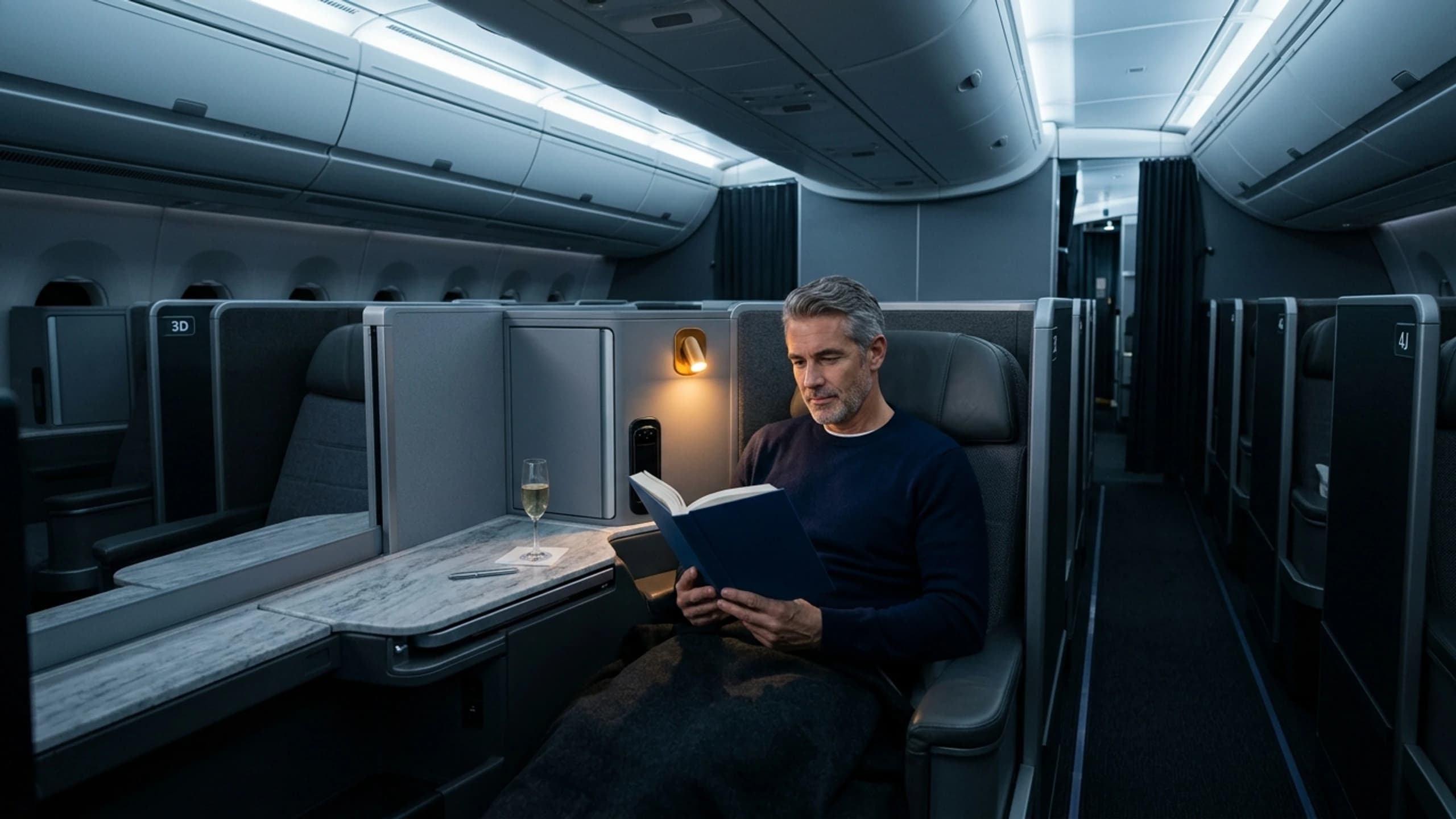
Business class changes the math fundamentally. On Qatar Airways QSuite — widely considered the best business class product in the sky — you're in a private suite with doors, a fully flat 79-inch bed, and 21 inches of shoulder width. On Singapore Airlines Business Class (A380 routes), the 1-2-1 direct-aisle-access configuration means you board, set the seat to flat, sleep, and land functional. British Airways Club Suite on the A350 runs a competitive 78-inch flat bed. These aren't luxury indulgences for the purposes of this conversation — they're the difference between arriving ready and arriving depleted.
Through our airline contracts, CEOFLIGHTS regularly brings business class fares on routes like New York–Tokyo or London–Singapore down from $8,000–$12,000 retail to the $3,000–$5,500 range — sometimes lower on consolidator inventory. That's a meaningful number for any frequent flyer doing this route twice a year. Top rated on Trustpilot by travelers who've compared those fares against what they'd find on their own, and ASTA-accredited (member #900292735), we're not a flash-sale site — we maintain ongoing airline contracts that produce consistent pricing on premium cabins.
Airport lounges matter too, particularly on long connections. The Qantas First Lounge in Sydney, the Qatar Airways Al Mourjan Business Lounge in Doha, and the Singapore Airlines SilverKris Lounge at Changi are legitimate places to eat a proper meal, shower, and sleep for a few hours between segments. Business class tickets on the right carriers get you into these facilities automatically. On a 24-hour journey with a layover, this is not a minor convenience.
The jet lag management piece: adjust your sleep schedule two or three nights before departure, moving bedtime 90 minutes in the direction of your destination. Stay hydrated throughout the flight, eat lightly (heavy meals spike cortisol at altitude), and resist the urge to medicate yourself into unconsciousness on overnight flights — strategic naps of 3–4 hours tend to produce better outcomes than a full Ambien knockout.
Putting it together: what a well-designed trip actually looks like
A genuinely balanced trip has bones. It starts with a comfortable arrival, gives itself time to breathe in the first 24 hours, alternates between demanding and unhurried days, chooses accommodations that support recovery rather than just providing a bed, and builds at least a few unscheduled blocks where the best possible outcome is nothing in particular.
It also starts at the booking stage. Getting the flight right — the seat, the carrier, the connection timing — is the first structural decision and one of the most impactful ones. A bad connection through a chaotic hub at 3am undoes a lot of careful itinerary planning.
If you want help structuring that piece specifically, call us at (888) 851-6897. We've routed executives through some genuinely complicated itineraries — three continents in ten days, positioning flights timed to minimize jet lag, cabin upgrades secured on routes where premium inventory is typically sold out months in advance. That's the kind of planning that makes the five principles above actually work.
The trip you come home rested from? That's the one worth taking.