Quick summary
Published business class fares are behavioral anchors designed to exploit last-minute urgency, causing identical seats to swing between $4,200 and $9,800 on the same flight. To avoid overpaying by 20% to 50%, start monitoring fare classes 60 to 120 days out and utilize private consolidator contracts rather than standard search engines. Structural booking strategies and negotiated rates can easily save more than $3,000 per long-haul ticket without sacrificing seat comfort.
Premium airfare is not a retail product. It never was.
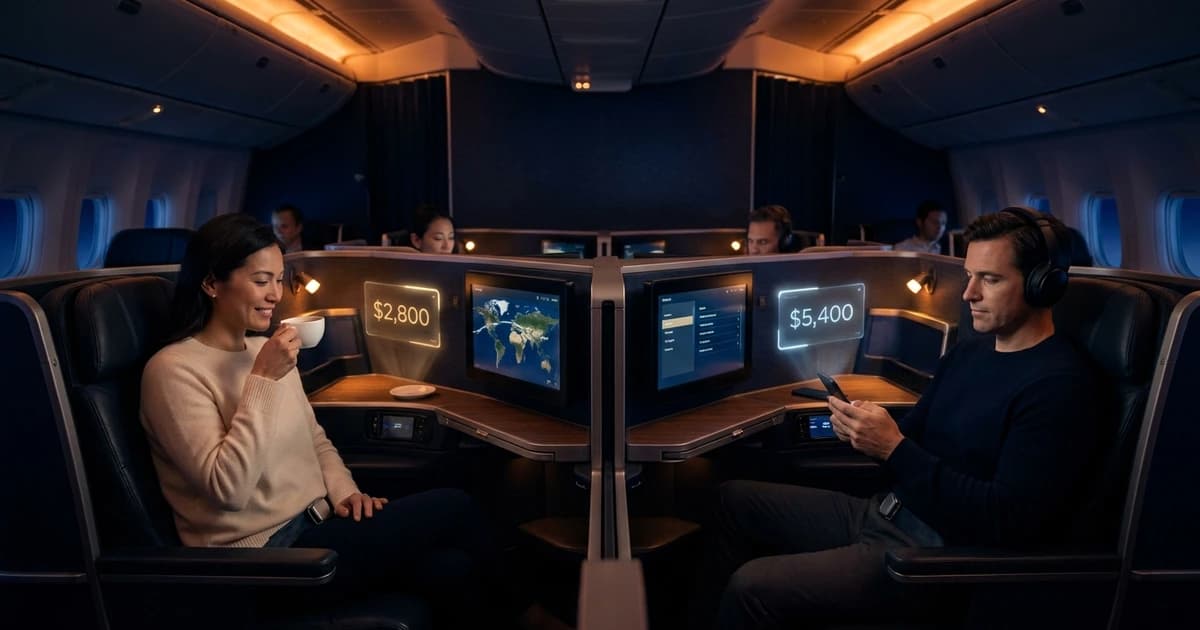
Two executives booking the same Qatar Airways QSuite seat on QR2 from London Heathrow to New York JFK — same departure date, same cabin, same champagne, same 21-inch lie-flat bed — can easily pay $4,200 and $9,800 respectively. Not because one got lucky. Because one understands how the system works, and the other simply opened a browser and clicked the first result.
That gap isn't an anomaly. It's the design.
The premium cabin pricing model is built on behavioral prediction, not distance or comfort. Airlines have spent decades and hundreds of millions of dollars building yield management systems that estimate what you specifically will pay, based on when you search, where you search from, how you've traveled before, and how constrained your options appear to be. The seat stays the same. The price reflects the system's read on your urgency.
Once you understand that, business class stops feeling expensive and starts feeling negotiable.
How airlines actually price premium cabins
Start with what airlines are not doing: they are not pricing seats based on the cost of providing them.
The cost basis of a business class seat — fuel allocation, cabin crew ratio, catering, amortized seat hardware — is relatively fixed on any given aircraft. A Boeing 777-300ER flying Singapore Airlines Suites from Singapore to New York doesn't cost materially more to operate on a Tuesday than on a Thursday. But the fare might be $3,000 higher on Thursday, because Thursday departures on that route historically attract more last-minute corporate travelers who book on company cards without checking alternatives.
Pricing is shaped by advance purchase behavior, route density, historical load factors, and competitive positioning. Critically, it's also shaped by perceived traveler flexibility. The algorithm isn't asking "what does this seat cost?" It's asking "what will this particular traveler accept?"
On New York to London — one of the most heavily monitored routes in the world — business class fares on carriers like British Airways, Virgin Atlantic, and American routinely swing between $3,000 and $7,500 within the same booking quarter on the same aircraft type. No meaningful product change. No upgrade to Club Suite or Airspace cabin. Just demand segmentation doing its work.
On routes like Los Angeles to Tokyo or Sydney to Dubai, the spreads are even wider. It's not uncommon to see a $5,000 variance on the same Qantas or Emirates flight within a six-week window.
The urgency tax — and why it's the most expensive mistake in premium travel
Urgency is the single biggest price driver in business class. More than route. More than airline. More than season.
When you search for a flight ten days before departure on a popular Monday morning route — say, Chicago O'Hare to London Heathrow on AA50 — you are sending a very clear signal to the pricing system: I need this, I have limited options, and I will likely book. The system responds accordingly. Remaining inventory shifts toward higher yield fare buckets. Published prices firm up. What looked like a $4,500 fare three months ago is now $7,200, and availability in lower booking classes has evaporated.
Corporate booking environments make this worse. Internal approval cycles force last-minute purchases. Preferred carrier agreements restrict routing alternatives. Policy rules eliminate the flexibility that would otherwise unlock better pricing. Airlines don't punish corporate travel programs for this. They quietly profit from it.
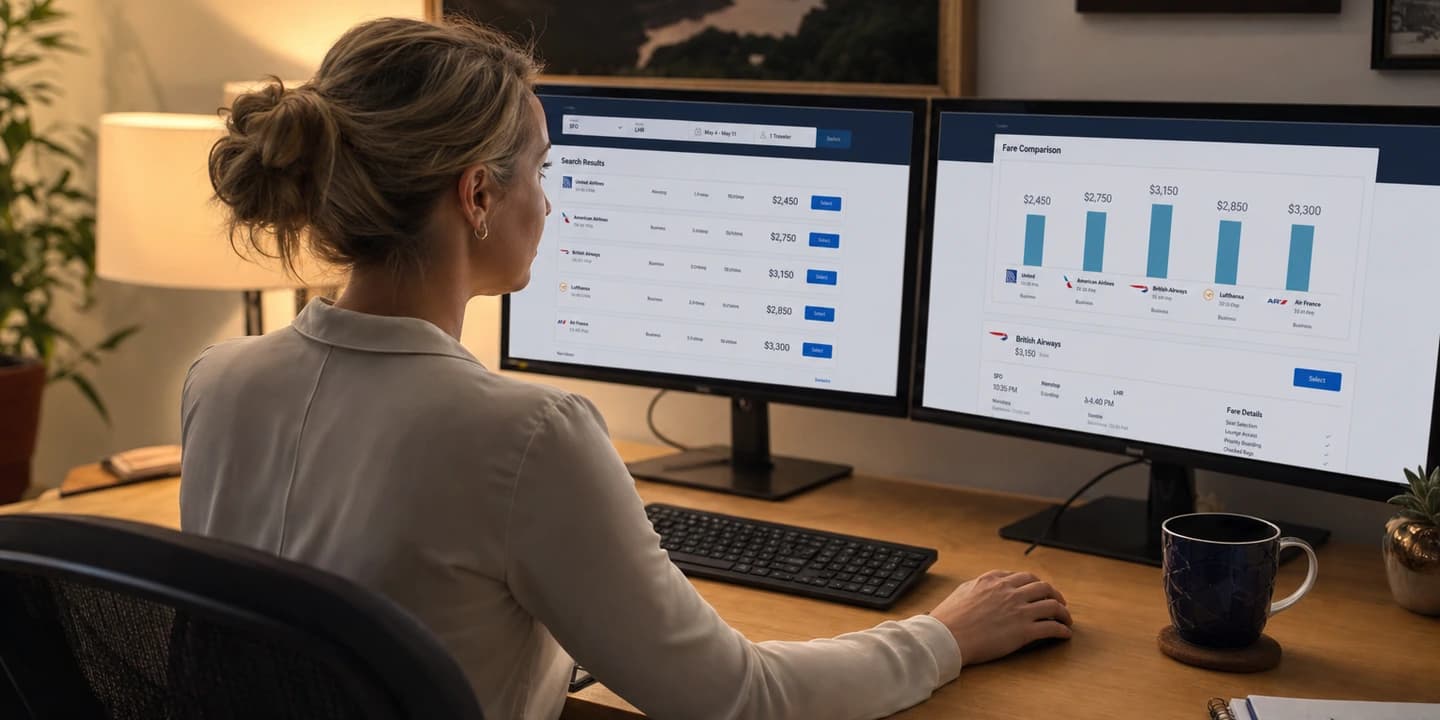
The solution isn't to book impulsively early. It's to begin structured fare monitoring — not price alerts on Google Flights, but proper analysis of booking class availability and release patterns — roughly 60 to 120 days out for transatlantic and transpacific routes. Business class inventory is released in waves tied to load factor projections. Those who watch release patterns rather than react to headline prices consistently find better positioning.
Urgency is sometimes unavoidable. When it is, you pay for it. But treating urgency as the default is simply leaving money on the table.
Published fares are anchors, not offers
The first price you see is not the market price. It's the anchor.
Published business class fares serve a precise strategic function: establish perceived value, capture necessity-driven demand, and create contrast for selectively released inventory below the visible surface. Most travelers never see past the anchor. They evaluate it, decide it feels "reasonable" relative to economy, and book.
Beneath that visible layer is a parallel pricing architecture built around fare construction logic, alternative departure markets, combinable segments, and distribution channels that standard search engines don't surface. This is where real pricing variance lives.
A few concrete examples of how this works in practice:
- Alternate departure city routing: Flying business class from Boston Logan rather than JFK to the same European destination can unlock meaningfully different fare bases — sometimes $1,500 to $2,500 cheaper — on codeshare itineraries that preserve identical onboard service
- Positioning flights: Adding an inexpensive positioning segment to a different origin airport changes the ticketing structure entirely, sometimes dropping the overall fare below what a direct ticket would cost
- Open-jaw construction: Booking into one city and out of another — say, flying into London Heathrow and returning from Paris CDG — can produce materially different fares while actually improving the trip logistics
- Multi-carrier itineraries: Combining a Star Alliance carrier for one segment with a oneworld carrier for another, when codeshare rules allow, can surface fare classes invisible to single-carrier searches
None of this is obscure. It's just not visible through consumer booking interfaces designed to sell simplicity, not sophistication.

Booking habits that quietly inflate your costs
Most premium travelers overpay not because they're careless, but because they've never examined their defaults.
A fixation on nonstop flights is the most common culprit. Nonstop convenience is real — nobody wants a connection in Frankfurt when they're tired — but the pricing premium attached to it is frequently disproportionate. A one-stop routing through a major hub on the same airline, same equipment, often in the identical business class cabin, can be $1,800 to $3,000 cheaper on transatlantic routes. Whether that time premium is worth $3,000 is a legitimate question. Most travelers never ask it.
Rigid date selection is the next issue. Business class pricing tiers are sensitive to day-of-week demand patterns in ways that economy isn't. Shifting a departure by 48 hours — particularly avoiding Monday mornings and Friday afternoons on corporate-heavy routes — can move a fare into an entirely different pricing tier. On a route like New York to Singapore, that shift can be worth $2,000 or more.
Exclusive carrier loyalty compounds everything. Flying Singapore Airlines exclusively, or Emirates exclusively, because of elite status is understandable. But it narrows exposure to joint venture partners, codeshare agreements, and alternate fare bases that frequently offer comparable — sometimes superior — hard product at meaningfully different price points.
And then there's the condition of the fare itself. Refundability, change flexibility, combinability, and fare basis code matter enormously for frequent travelers. A non-refundable I-class fare that saves $800 upfront can cost $2,500 in change fees across a year of schedule adjustments. The headline price is not the total cost.
What sophisticated travelers actually do differently
Experienced premium travelers don't chase deals. They manage structure.
They start with exploratory searches designed to map the pricing contours of a route rather than lock in a purchase. This preserves optionality and reveals where volatility exists in the fare buckets. They treat routing as a strategic variable, not a constraint. They evaluate ticket construction rather than accepting surface pricing.
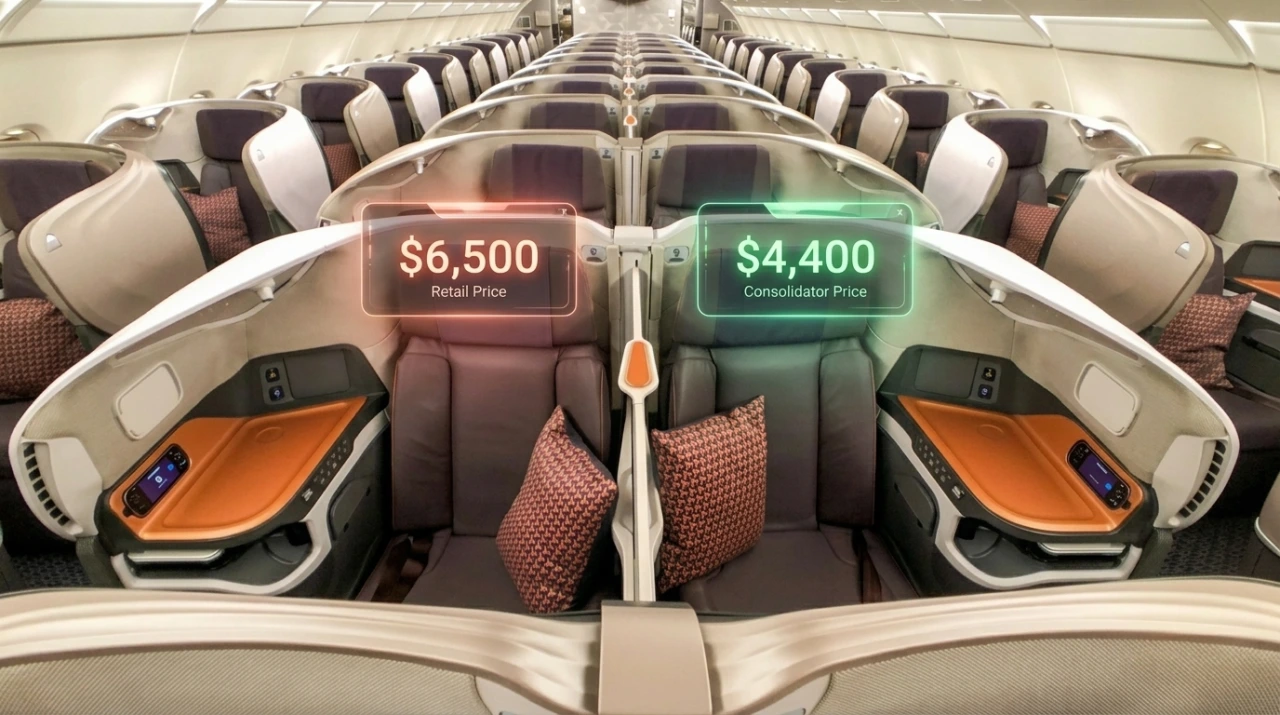
They also work with specialists who operate inside the same distribution infrastructure as airlines themselves. CEOFLIGHTS holds negotiated contracts directly with carriers across the transatlantic, transpacific, and Middle East corridor routes. Through those contracts, fares that retail at $6,500 on Singapore Airlines from New York to Singapore frequently come down to $3,800 to $4,400 — for the exact same Suites or Business Class seat, the same flight number, the same booking. The difference is distribution channel and contracted rate access, not product compromise.
That's not a sale. That's how professional fare consolidation works. We're ASTA-accredited (member #900292735) and top rated on Trustpilot, and every one of those savings is verifiable against the published retail fare.
For travelers spending $30,000 to $80,000 annually on business class, even modest systematic improvement in pricing — 20 to 30 percent — is a material outcome. Not because the travel changes. Because the approach does.
The fare basis conversation most travelers never have
Here's something the airline booking UI will never volunteer: fare class matters more than cabin class.
Business class inventory is divided into multiple booking classes — J, C, D, I, Z are common across most carriers — each representing different pricing tiers, different change and refund rules, and different upgrade eligibility. Two travelers sitting in the same Lufthansa Business Class cabin between Frankfurt and Chicago on LH430 might be in J-class and I-class respectively, paying radically different fares and holding very different fare conditions.
Airlines release lower booking classes (D, I, Z) strategically — typically in advance windows and on routes where they're competing for market share. These fares are not advertised. They surface through GDS systems accessed by travel agents and consolidators, or occasionally in obscure corners of airline booking engines that most travelers never find.
Understanding which fare class you're in before you book — and what that means for changes, cancellations, and upgrade eligibility — is the kind of analysis that separates informed premium travel from expensive guesswork.
Rethinking what "paying full price" actually means
Paying the highest published fare gets framed as efficiency. It's usually disengagement.
When urgency is genuine and time is the scarce resource, paying a premium fare is a rational trade. No argument there. But when flexibility exists — when the trip is planned weeks or months in advance, when dates have some give, when routing isn't fixed — ignoring structural alternatives is a choice, not a necessity. And it's an expensive one.
The premium travel market rewards those who treat it as a system to understand rather than a menu to order from. Fare monitoring, routing flexibility, ticket construction awareness, and access to contracted consolidator pricing are not niche advantages available only to industry insiders. They're accessible to any traveler willing to approach the booking process with the same rigor they'd apply to any other significant financial decision.
For routes like New York to London, Los Angeles to Dubai, or Sydney to Tokyo, the difference between retail pricing and what's actually achievable through proper channel access and construction strategy can easily exceed $3,000 per ticket. Across four or six trips a year, that's a meaningful number.
Call our team at (888) 851-6897 to find out what current contracted pricing looks like on your next route. There's no obligation, and the conversation takes ten minutes. If the retail fare is already the best available, we'll tell you. But in most cases, it isn't.
The seat doesn't change. The approach does.
Some images in this article may be AI-generated and are used for illustrative purposes only.