The complete guide to business class seat types: what you're actually buying
Not all business class seats are equal. Here's exactly what separates a throne seat from a herringbone — and why it matters before you book.
CEOFLIGHTS Editorial11 min read
Quick summary
Business class products range drastically from outdated herringbone layouts to cutting-edge closing-door suites like Qatar's QSuite, despite similar $4,000 to $12,000 price tags. Always verify the specific aircraft architecture and seat configuration—prioritizing 1-2-1 reverse herringbone or enclosed suites—before booking long-haul flights over 7 hours. Matching your specific travel needs (solo work vs. couples double beds) ensures you receive true lie-flat comfort rather than an obsolete compromise.
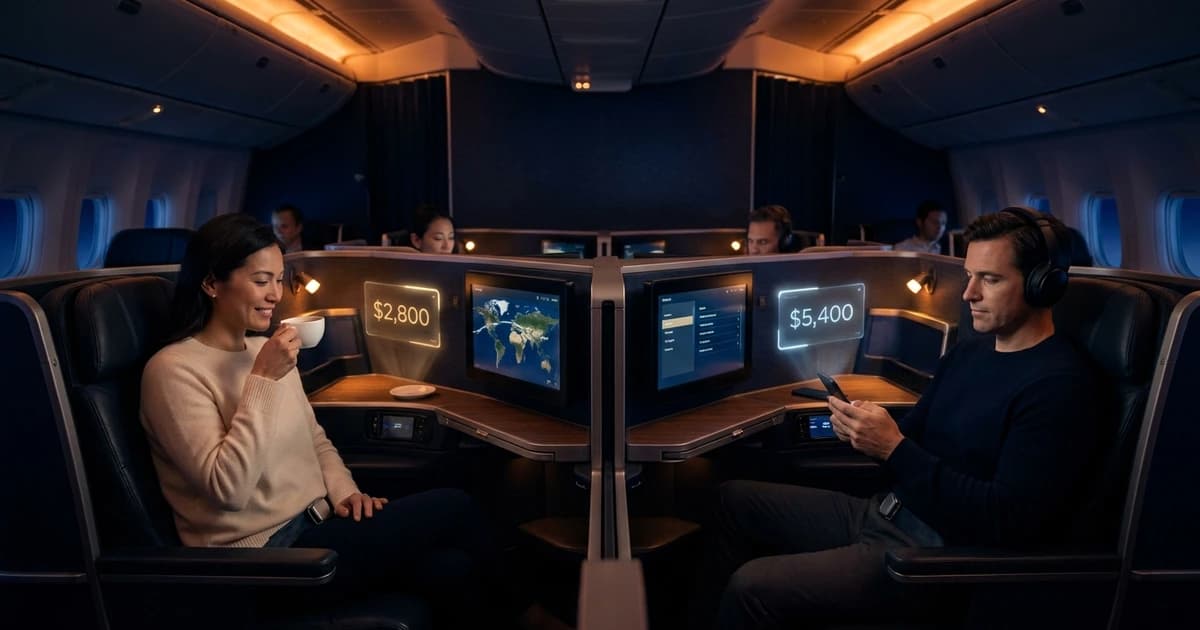
Business class is not a single product. It's a spectrum — and at one end you have a glorified recliner with a curtain, and at the other, a closing-door suite with a door lock and a Do Not Disturb button. The fare difference between the two can be a few hundred dollars. The experience difference is enormous.
Most airlines don't build their own seats from scratch. They work with a handful of specialist manufacturers — Collins Aerospace, Safran, Stelia — and customize what comes off the production line. That's why you'll find broadly similar seat architectures across carriers that have nothing else in common. Understanding those archetypes is the fastest way to know exactly what you're getting before you hand over $4,000 to $12,000 on a transatlantic or transpacific fare.
Here's the breakdown.
Thompson Vantage XL seats
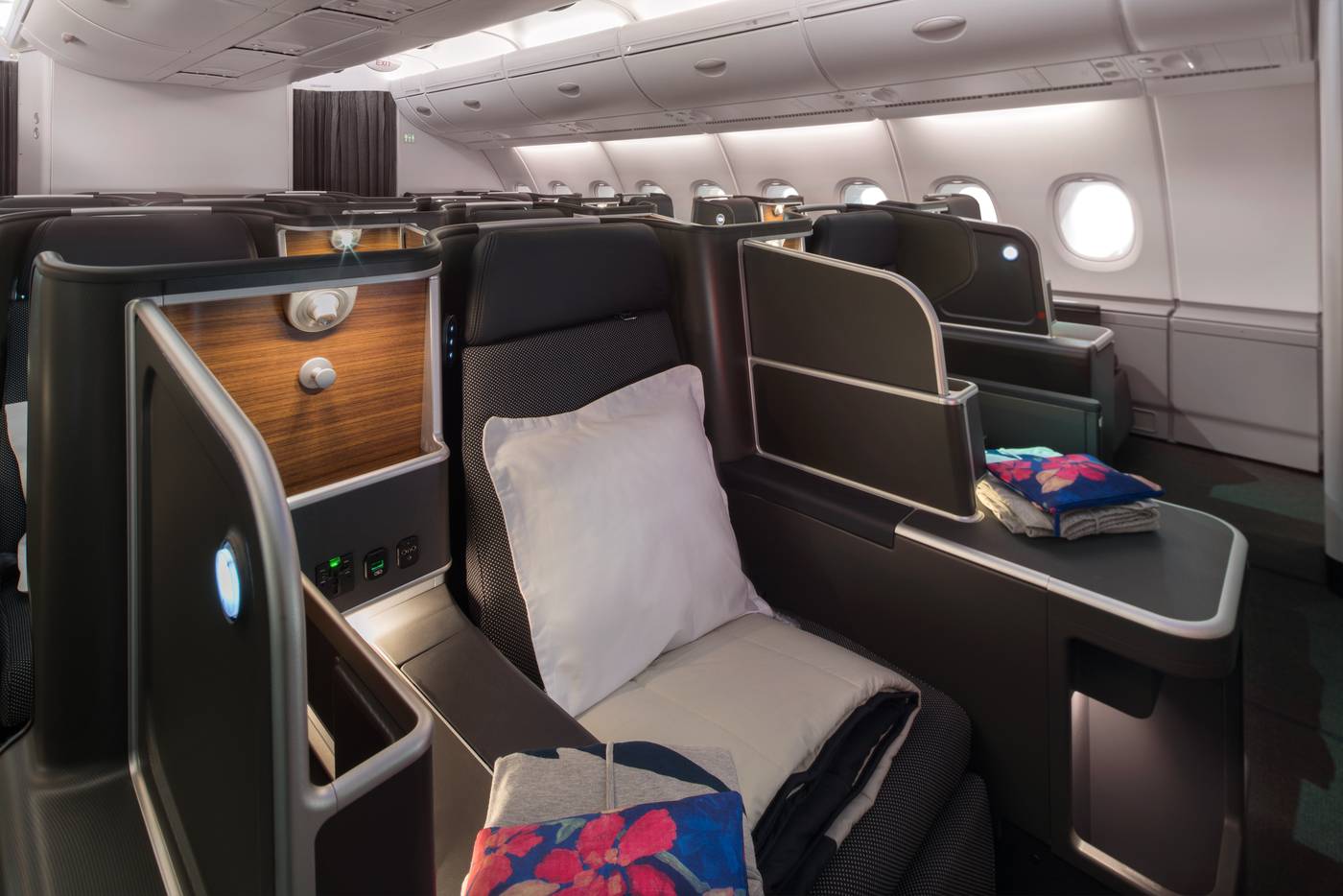
The Vantage XL is the workhorse of premium long-haul seating, and that's not a criticism. In a 1-2-1 configuration, every passenger gets direct aisle access, the seat converts to a fully flat bed, and the newer generations — Vantage XL, Vantage Solo, Vantage Duo — have pushed privacy significantly further than the original design managed.
The Vantage XL platform provides a noticeably broader shoulder area than competitors — a critical advantage when trying to sleep comfortably on a 14-hour long-haul
Width is the Vantage XL's headline number. These seats are genuinely broader than most of their competitors, which matters enormously on a 14-hour flight when you're trying to sleep on your side. The shoulder area doesn't feel like a coffin.
Delta runs Vantage XL seats on their Airbus A350s and select A330s. Qantas fits them on their A330 fleet. Air Canada, SAS, and Virgin Australia all use variants — though each airline tailors finish, IFE, and storage differently, so the seat shell being the same doesn't mean the experience is identical.
The opinion worth stating clearly: if you're booking a longhaul flight and the aircraft has Vantage XL in a true 1-2-1 layout, you're in solid hands. This seat type has earned its reputation.
Apex Suites
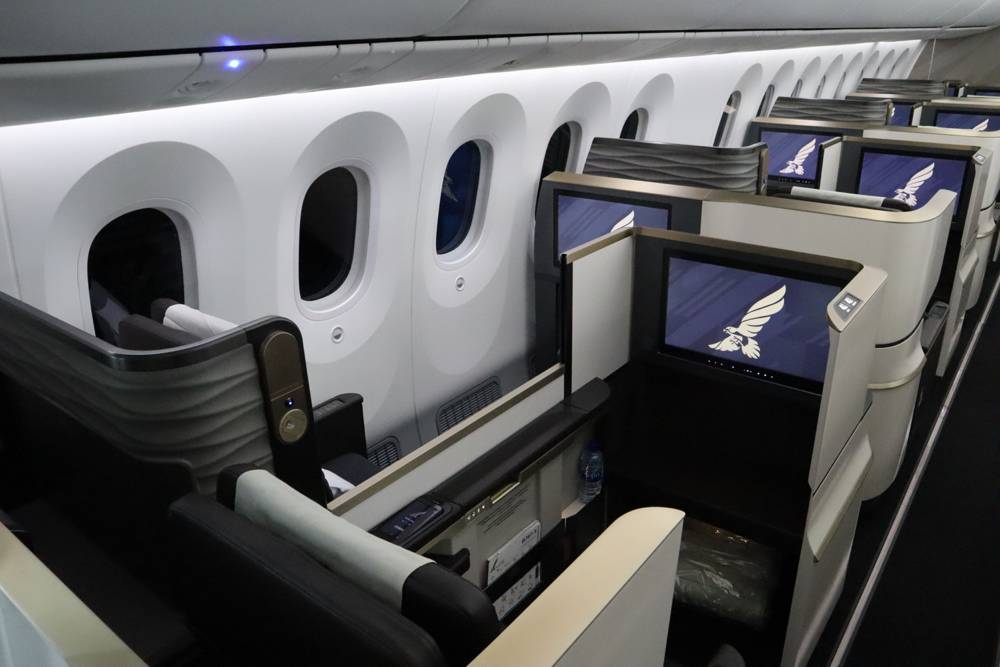
The Apex Suite solves a problem that most business class seats don't bother addressing: what happens to the people in the middle seats of a 2-2-2 configuration? The answer, on most aircraft, is that they get a compromise product. On an Apex-equipped cabin, they get something that actually functions.
The staggered geometry of the Apex Suite successfully salvages the 2-2-2 configuration, giving window passengers a secluded enclosure without forcing middle seats to compromise
Window seats in an Apex arrangement feel genuinely suite-like — shielded from the aisle, angled inward, with a sense of enclosure that most non-closing-door seats can't match. Middle seats are less private, but the staggered geometry means you're not sitting shoulder-to-shoulder with a stranger.
Japan Airlines runs Apex Suites on their Boeing 777s and 787s, and their execution is exceptional — particularly the Sky Suite on the 777-300ER, one of the quieter, more refined business cabins in the sky. Korean Air uses them on 747-8 and 787 routes. Gulf Air and Oman Air both have them installed on their 787 fleets.
If you're flying Japan Airlines business class between Tokyo Haneda (HND) and Los Angeles (LAX) — typically operated by a 777 — you're looking at one of the better Apex Suite implementations available.
Herringbone configuration
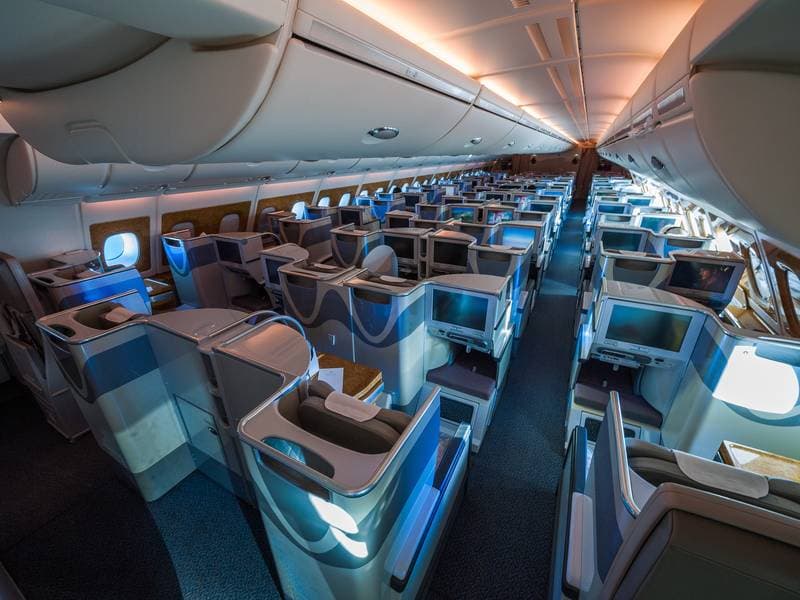
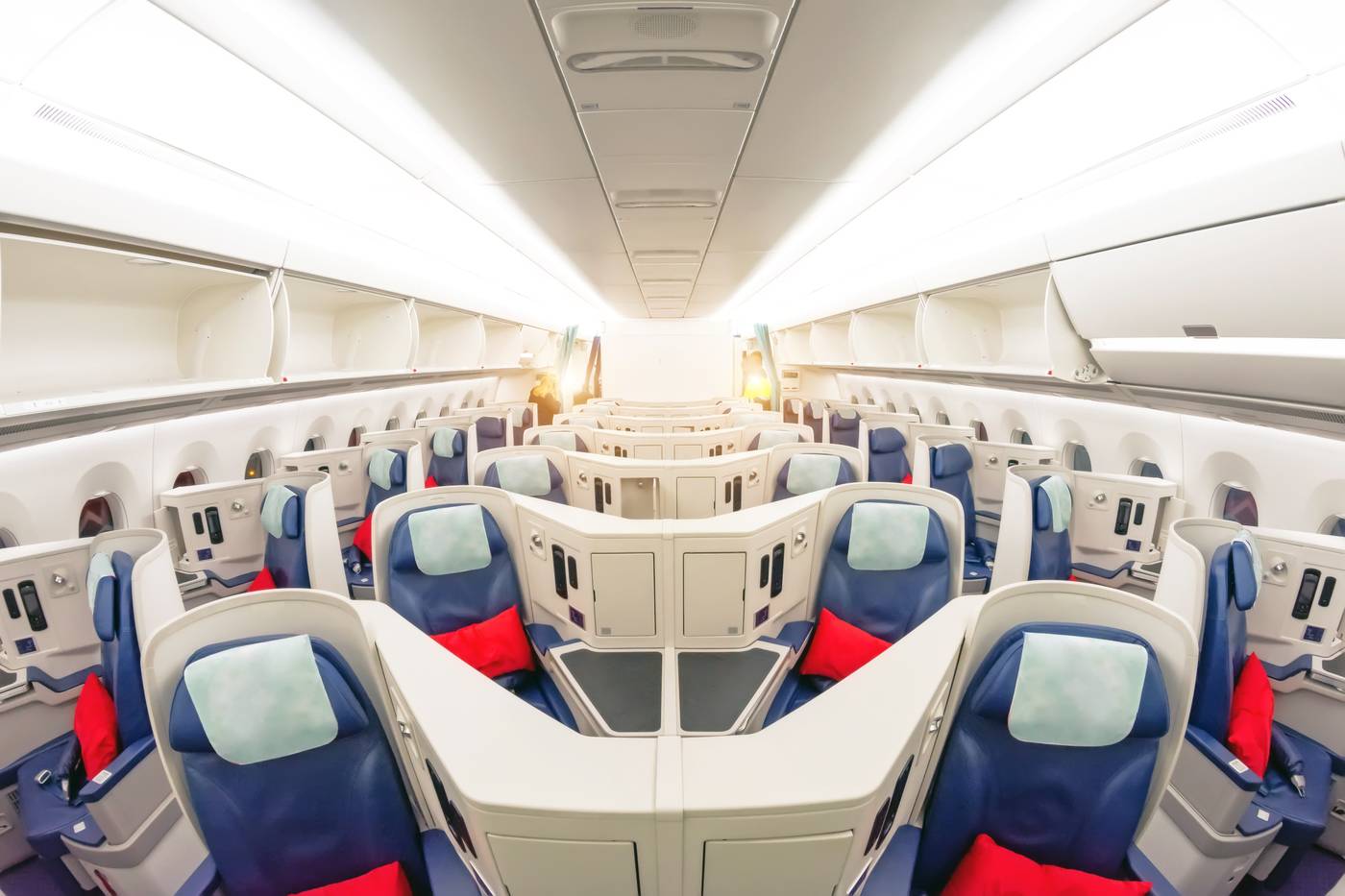
Herringbone seating is the oldest modern business class layout still in wide circulation, and it shows. Seats angle diagonally toward the aisle, which gives every passenger direct aisle access but sacrifices privacy almost entirely. You're essentially sitting in a row of forward-facing lounge chairs that have been tilted sideways.
While standard herringbone layouts guarantee direct aisle access for everyone, angling the seats directly into the main walkway sacrifices nearly all personal privacy
Virgin Atlantic pioneered the herringbone layout and still runs it on A330 and 787 routes. Delta has it on older A330s. Air Canada uses it on 777s and 787s. The beds are fully flat, which is non-negotiable at this price point, and the direct aisle access is genuinely convenient — you're not climbing over anyone at 2am.
The honest assessment: herringbone works fine for sleeping, works fine for short business conversations, and feels dated compared to everything built in the last six years. If you're on a route where this is the only option, book it without anxiety. If you have an alternative with better privacy at a comparable price, take it.
Cirrus seats (reverse herringbone)
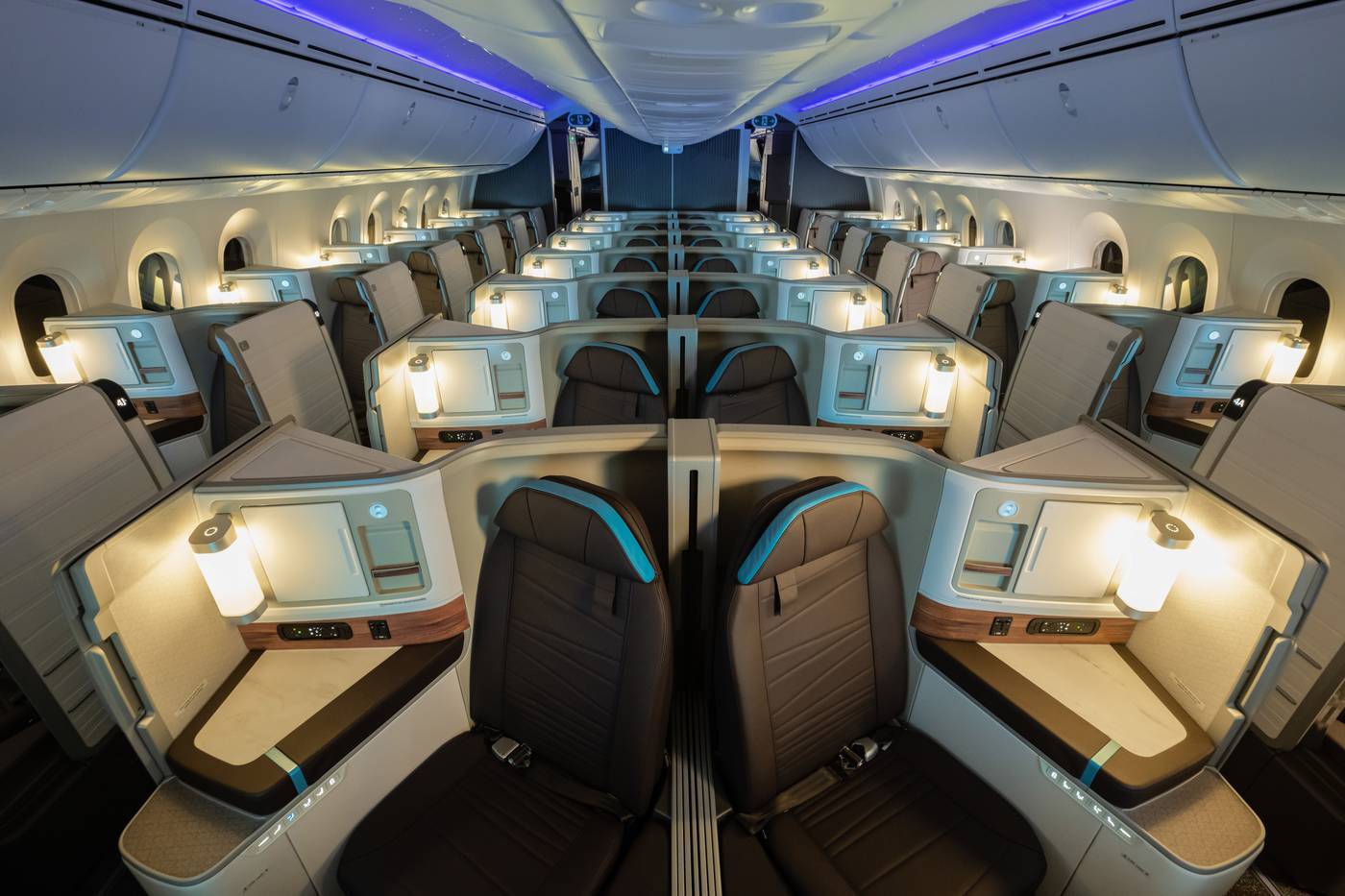
The Cirrus is the evolution the herringbone always needed. Instead of angling seats toward the aisle, reverse herringbone points them away from it — toward the window wall. The result is a dramatically more private experience while keeping the 1-2-1 geometry that everyone wants.
By rotating the orientation toward the windows, reverse herringbone designs like the Cirrus dramatically improve privacy while shielding passengers from disruptive aisle traffic
Cathay Pacific runs Cirrus seats extensively on their 777s and A350s, and their implementation is one of the more polished in the category. American Airlines features them on select 777 and 787 routes. Finnair fits them on their A350s and A330s.
The seat bed on a Cirrus configuration is fully flat, and because you're facing slightly away from the cabin, the ambient light and aisle traffic that disrupts sleep on a standard herringbone layout is substantially reduced. It's a meaningful improvement, not just a marketing repositioning.
At CEOFLIGHTS — top rated on Trustpilot and ASTA-accredited (member #900292735) — we regularly book clients into Cathay Pacific's Cirrus-equipped A350 flights between Hong Kong and North America. Through our airline contracts, fares on these routes drop from retail prices often exceeding $8,000 to significantly more competitive consolidator rates. Call us at (888) 851-6897 to check current availability.
Stelia Solstys seats
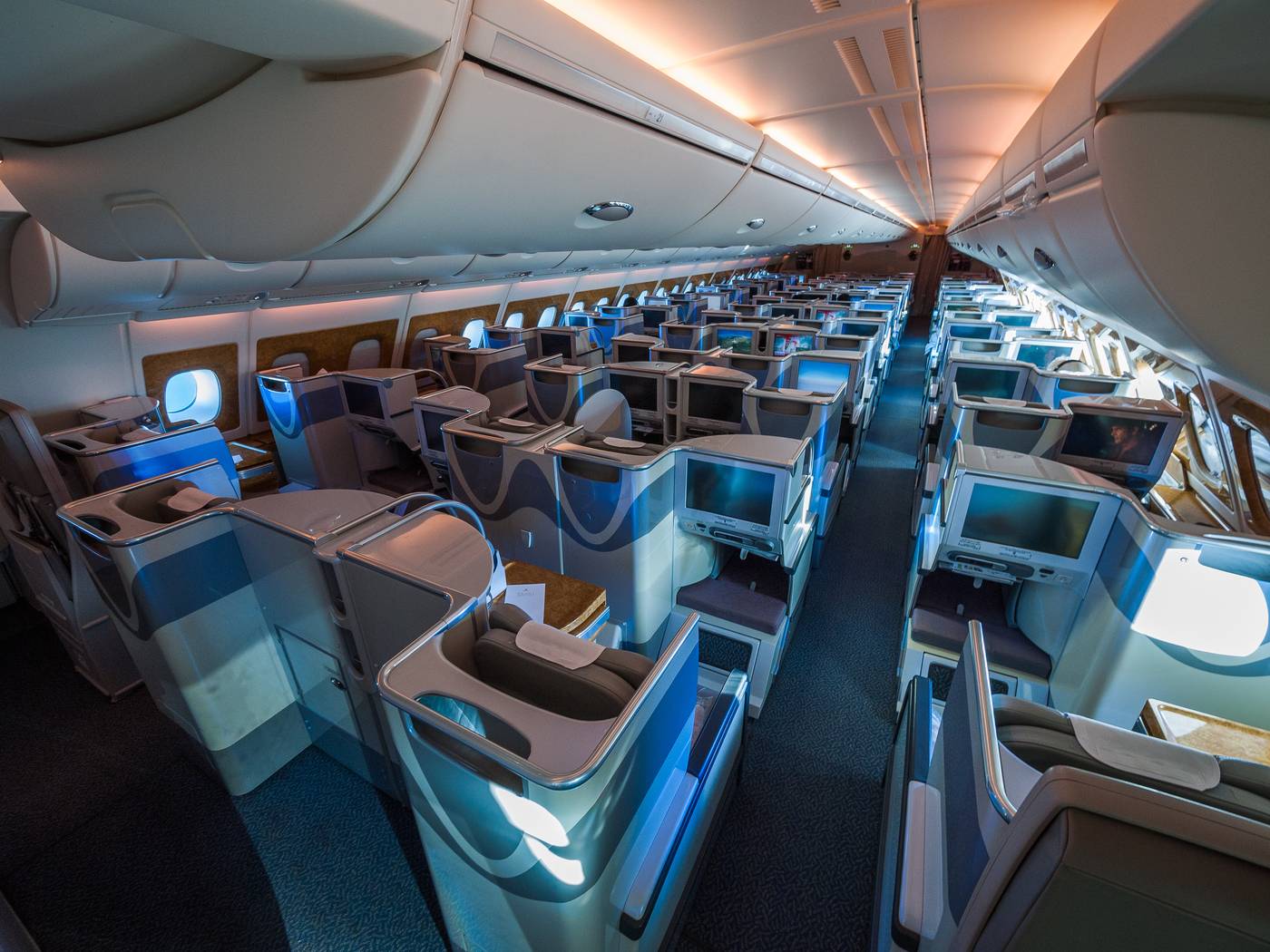
Solstys seats — manufactured by Stelia Aerospace, now part of Airbus — use a staggered layout that lands somewhere between a classic herringbone and a full enclosed suite. Some seat positions get direct aisle access, others don't. Privacy levels depend heavily on where you're sitting within the cabin.
The Stelia Solstys leverages space so efficiently that airlines can maintain competitive seat pitch without compressing the cabin — though aisle access varies sharply by your specific seat assignment
The key advantage of the Solstys design is how efficiently it uses cabin space, which matters more than passengers realize. A more space-efficient seat means the airline can fit more rows in the same fuselage length without shrinking the individual footprint. For passengers, this usually translates to competitive seat pitch without the cabin feeling compressed.
Etihad Airways uses Solstys seats on their A330s, 777s, and certain A380 configurations. Iberia has them on A330s and A350s. ITA Airways (which absorbed Alitalia's routes) featured earlier versions on A330s and 777s. Each carrier's customization affects the finish and storage more than the fundamental geometry.
Worth knowing: if you're in a center-pair Solstys seat, you'll want to check the seatmap before booking. The aisle-access situation varies by position.
Throne seats
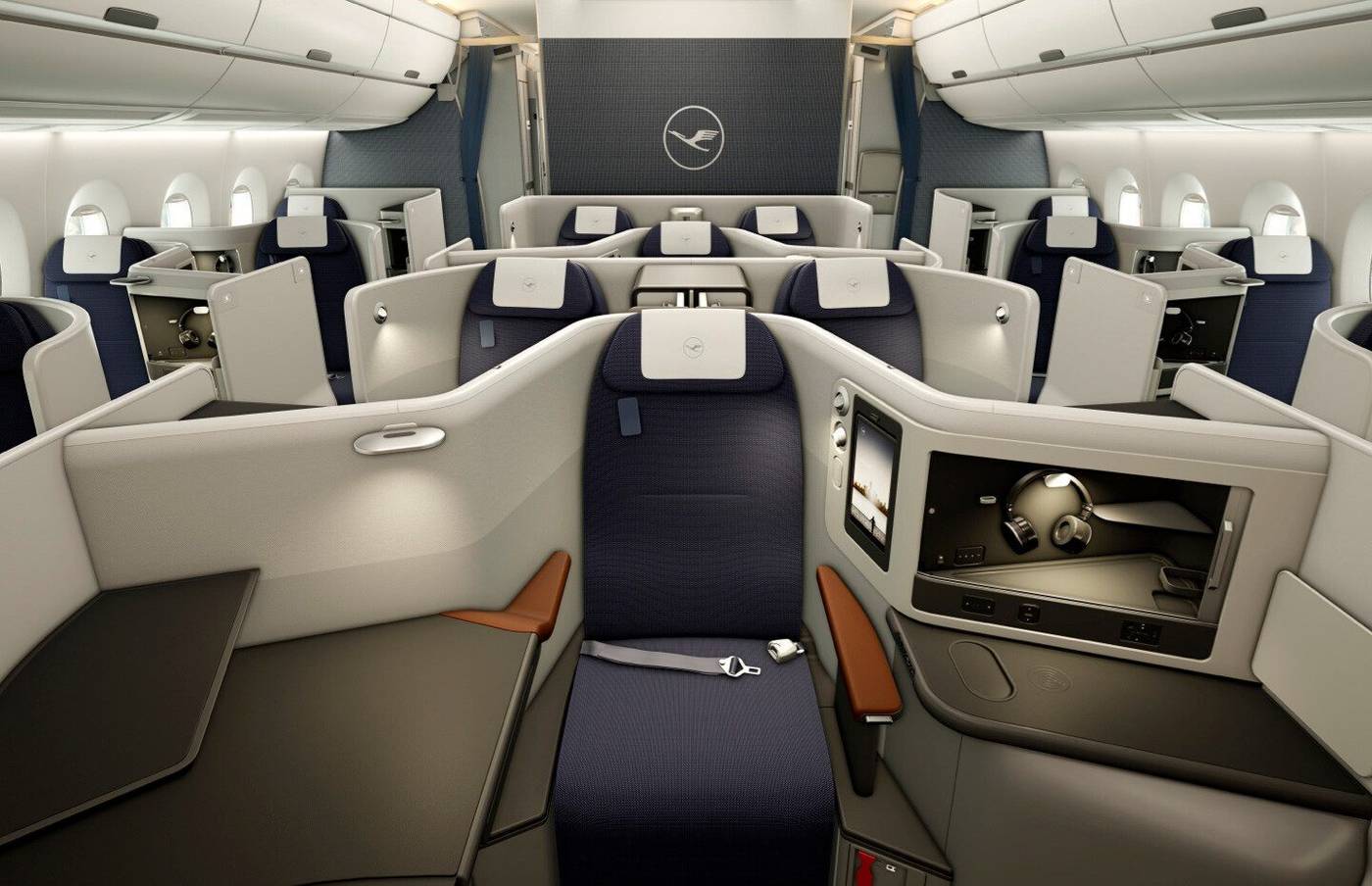
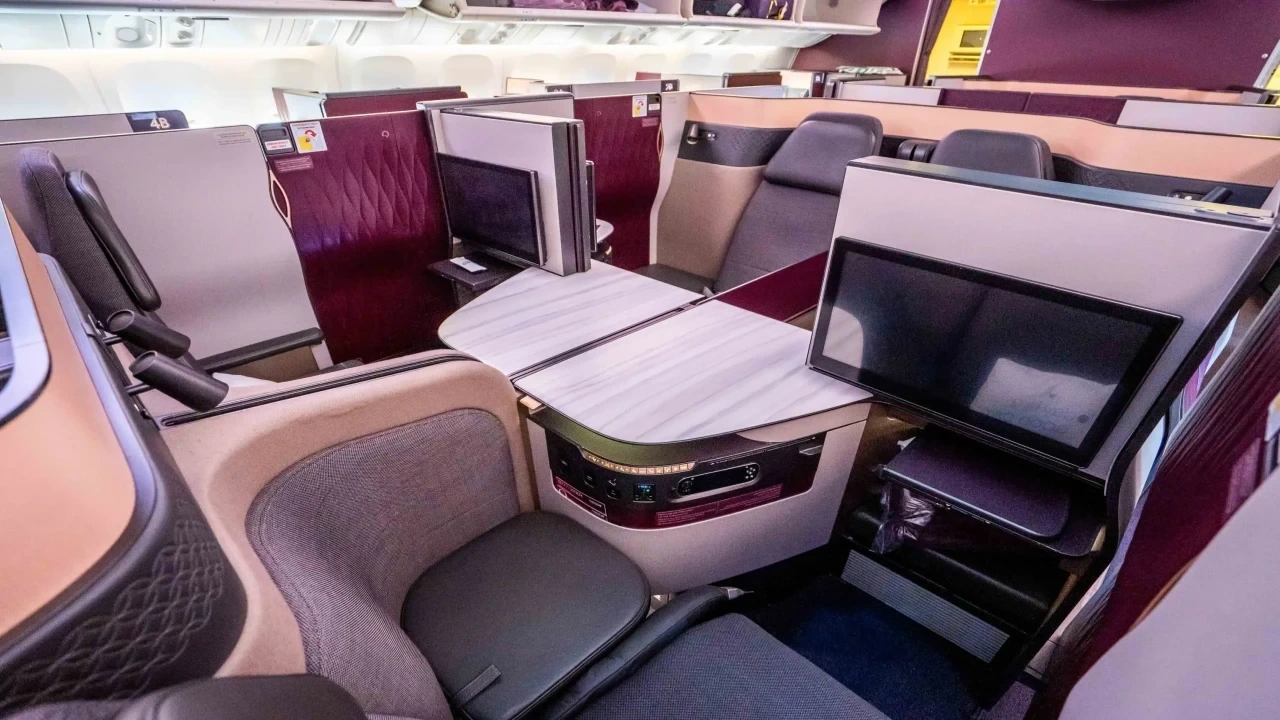
The throne seat is exactly what it sounds like. A standalone business class seat — no neighbor at any angle, extra surface area on both sides for storage and working, a genuinely suite-like sense of personal territory. These are built specifically for solo travelers who don't want to share their spatial footprint with anyone.
For solo executives who need expansive surface area to work and review documents, the isolated geometry of a throne seat is the most functional product in commercial aviation
Swiss International Air Lines offers throne-style seats on select A330 and A340 routes. Lufthansa's new Allegris cabin — visible in the image above — has taken the concept further with its Business Class Suite with Door, the best closing-door product Lufthansa has ever put on a plane. Qatar Airways has implemented comparable single-seat arrangements on certain aircraft outside their QSuite-configured fleet.
These seats recline to fully flat beds, but the real value isn't the bed — it's the working environment. For executives who need to review documents, take calls through noise-canceling headsets, or simply spread out during a daytime flight, throne seats are the most functional business class product available. They're not always easy to find or book at a reasonable price, which is where a consolidator relationship becomes genuinely useful.
Zodiac Optima
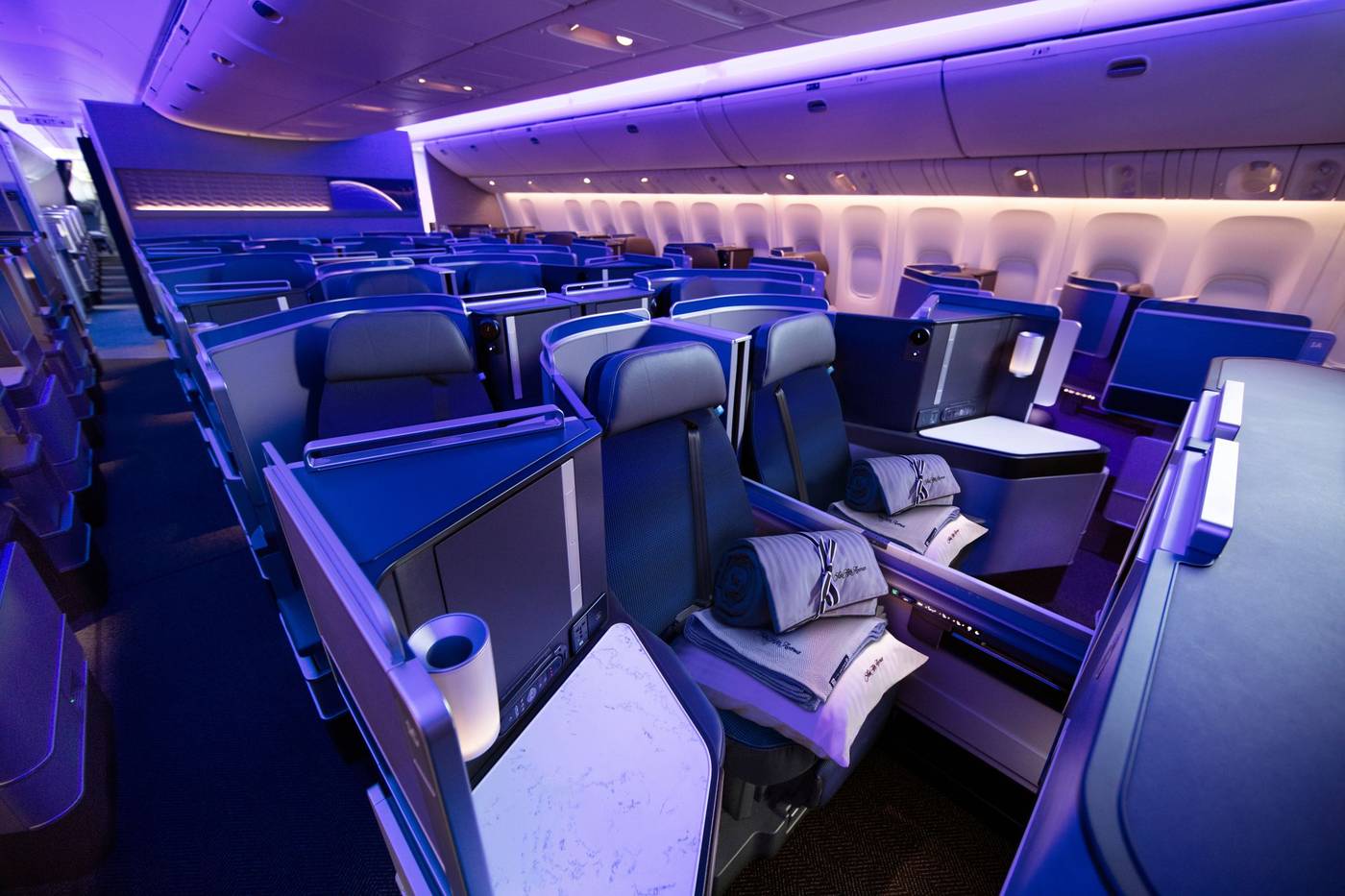
The Zodiac Optima is a staggered layout developed by Zodiac Aerospace (now part of Safran), using alternating seat positions to give each passenger direct aisle access while maintaining a degree of side privacy. The geometry is more complex than it looks from the aisle.
United's Polaris utilizes Zodiac Optima architecture to deliver clean aisle access and surprisingly effective side screening, making it a highly capable product for transatlantic crossings
United Airlines' Polaris business class runs on Zodiac Optima-derived seats across much of their long-haul fleet — you'll find them on 777 and 787 routes including United's Newark (EWR) to London Heathrow (LHR) service. Air France's long-haul 777 business class uses a similar design.
United's Polaris implementation has improved substantially since launch. The bedding is genuinely good, the aisle access is clean, and the seat shell provides enough side screening to make you feel less exposed than the base geometry suggests. It's not QSuite. Nothing at this price point is. But Polaris on a 777-200 transatlantic crossing is a solidly comfortable product.
Couples configuration
Most business class seats implicitly assume you're traveling alone. Couples configurations exist specifically to challenge that assumption. The seats are arranged so two passengers traveling together can face each other, share a surface, or — in the best implementations — convert the space between them into a shared flat bed.
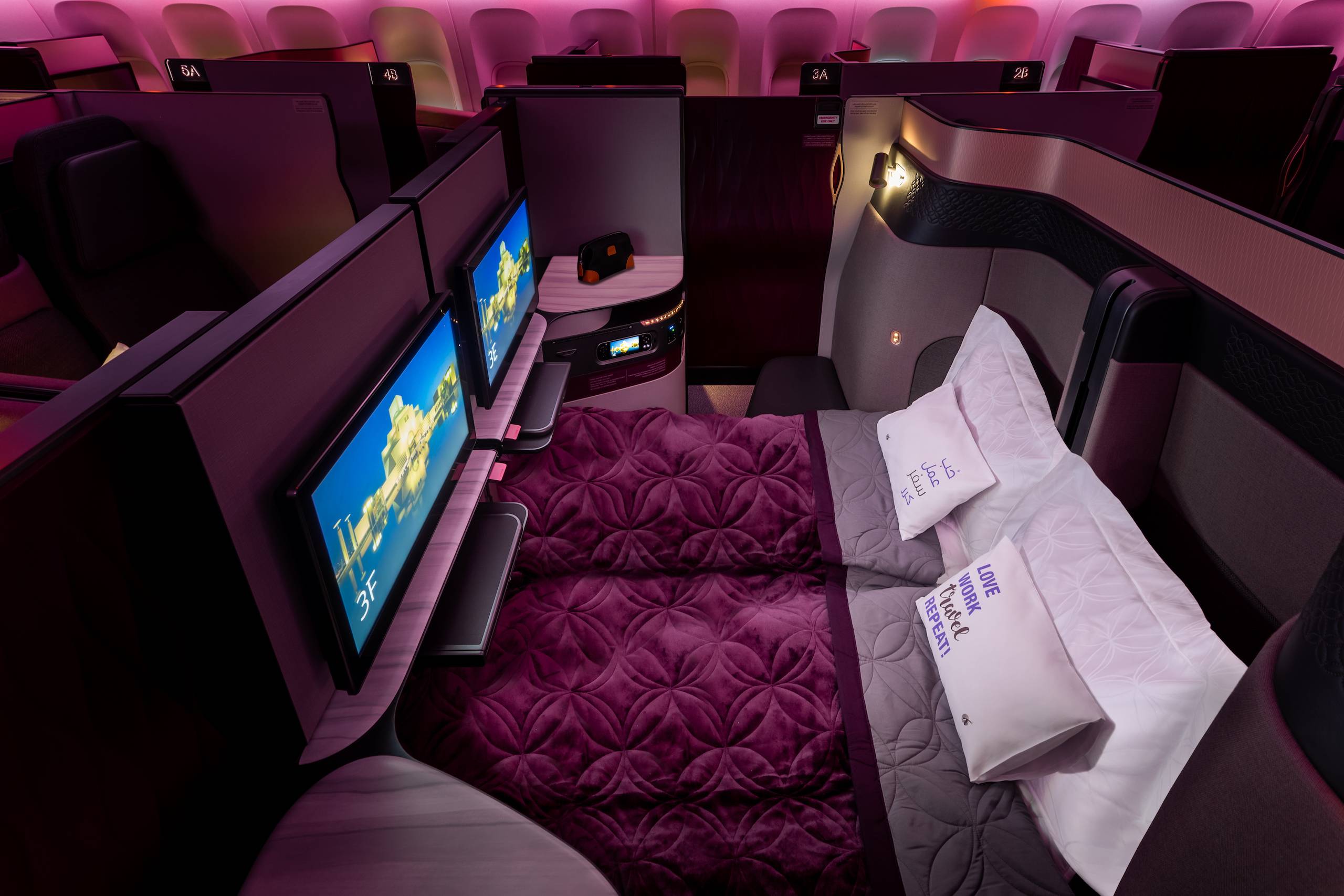
Qatar Airways' QSuite represents the apex of couples travel — center dividers drop completely to form a true double bed, offering intimacy that no other carrier currently matches
Singapore Airlines' new A380 business class features this arrangement, and it's executed with the restraint and precision you'd expect. British Airways' Club Suite on the A350 allows center pairs to open the divider between them, creating an approximating version of the same concept. Qatar Airways' QSuite goes furthest: the panels between adjacent suites drop completely, and the seats convert into a true double bed. On the Doha (DOH) to New York (JFK) route — typically operated by a 777-300ER in QSuite configuration — this is genuinely the most intimate couples product in commercial aviation.
If you're booking as a pair and privacy matters, QSuite center seats are the product to target. Call (888) 851-6897 and we'll tell you which specific flight numbers have the configuration you want.
Quad configuration
The quad configuration takes the couples setup and scales it up to four seats. Typically arranged around a shared central zone, this layout was originally a first-class concept — Etihad's The Residence on their A380 is the most extreme version in commercial aviation. But it has migrated into premium business class on select products.
Qatar Airways QSuite is the most accessible example. Four center suites can be configured into a shared space, with panels lowered and seats adjusted to create something closer to a group living area than a row of airplane chairs. It's the right choice for families, small executive teams, or anyone who wants to hold a meeting at 38,000 feet and arrive with actual decisions made.
The QSuite quad layout transforms four center suites into a private group living area — ideal for families or executive teams who need to collaborate at 38,000 feet.
The product exists. Getting the configuration you want, on the right flight, with the right seats confirmed — that's where it gets complicated. Through our airline contracts at CEOFLIGHTS, we regularly put groups into QSuite quad configurations on high-demand routes at prices well below what Qatar's own website shows for comparable dates. Our team is ASTA-accredited (member #900292735) and top rated on Trustpilot for a reason: we do the hard work before you board.
Which seat type is right for your route?
The seat you want depends on three things: flight duration, whether you're traveling alone or with someone, and how much of the flight you'll spend working versus sleeping.
For a 7-hour transatlantic overnight — something like New York to London — a reverse herringbone like the Cirrus is entirely adequate. For 14 hours from Los Angeles to Sydney, you want the highest privacy product on that aircraft, full stop. For couples on any route over 8 hours, QSuite center seats or Singapore's A380 configuration are the only products worth the premium.
What you should never do is assume that "business class" is a consistent product across all airlines and all aircraft types. A Delta Comfort+ ticket will disappoint someone expecting Polaris. An Air France business class seat on a 777 is a fundamentally different experience from Air France business class on an A380 in their new La Première-adjacent cabins.
Get specific before you book. Know the aircraft, know the seat type, and know which seat number you're targeting. If that sounds like more research than you want to do, that's exactly what we're here for. Call CEOFLIGHTS at (888) 851-6897 — we'll match you to the right product at the right price on the right aircraft.
Content creator and business travel specialist at CEOFLIGHTS, bringing you the latest insights, tips, and trends in premium business and first-class travel.
Become the CEO of Your Journey
You take the lead. Your dedicated Personal Travel Manager handles every detail.