Consolidator fares explained: how agencies sell business class for 15%–60% less
How airline consolidator net fares actually work in 2026: ATPCO Category 35 contracts, GDS fare buckets, married segment logic, and what changes versus a retail ticket.
Austin Rivers12 min read
Quick summary
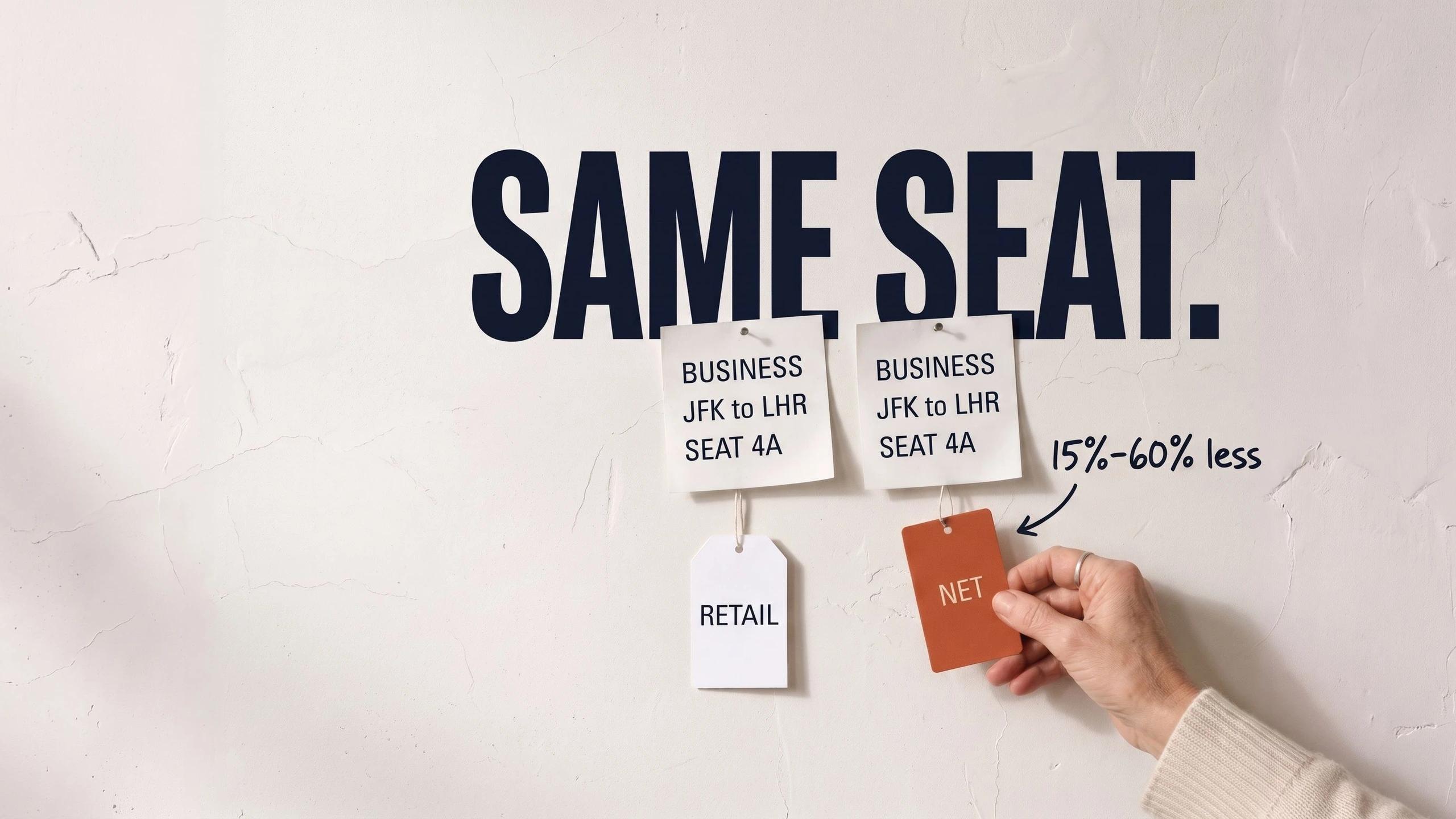
Wholesale Pricing Model: Airline consolidators negotiate private bulk contracts (ATPCO Category 35 net fares) with international carriers, securing business class seats at 15% to 60% below public retail prices.
Why Google Flights Misses Them: Public search engines and online travel agencies (OTAs) are restricted by airline display rules and Airline Tariff Publishing Company (ATPCO) distribution policies from showing unpublished net rates.
Full Premium Perks: Consolidator business class tickets retain every hard and soft product benefit — lie-flat suites, priority check-in, fast-track security, flagship lounge access, and two-to-three-bag checked allowances.
Direct Verification: Legitimate consolidator tickets issue a standard 6-character airline PNR and 13-digit e-ticket number that you can verify immediately on the operating carrier's website.
If you price a nonstop New York to London round-trip on Google Flights ten days before departure, the screen will usually quote somewhere between $5,800 and $7,200. Call a specialist consolidator desk for that same flight, same cabin, and same departure bank, and the ticket frequently comes back between $2,450 and $3,200.
That gap does not come from buying grey-market frequent flyer miles, playing hidden-city roulette, or gambling on standby upgrades. It comes from the oldest B2B distribution channel in commercial aviation: airline consolidator net fares.
Airlines run aggressive yield-management models designed to extract top dollar from last-minute corporate accounts without flying half-empty premium cabins across the Atlantic. To fill the seats that Fortune 500 travel budgets leave behind, long-haul carriers release dedicated blocks of inventory to licensed consolidators at contractually protected net rates. Once you understand how those contracts are filed and why public search engines are barred from showing them, the pricing stops looking mysterious and starts looking like basic supply-chain economics.
What is an airline consolidator?
An airline consolidator is a wholesale airfare distributor that holds direct, volume-based net-rate contracts with international carriers. Instead of selling one seat at a time at whatever retail tariff happens to be live on an airline's consumer site, consolidators commit to moving tens of millions of dollars in premium cabin volume across specific route networks each year. In return, airlines grant private net pricing that sits 15% to 60% below published retail tariffs.
15%–60%Typical savings below published airline retail on long-haul business class
Sourced via unpublished ATPCO Category 35 wholesale contracts
For decades, consolidators operated strictly as a back-office wholesaler: they fed net inventory to brick-and-mortar travel agencies, tour operators, and cruise lines, who then marked the tickets up before selling them on to passengers. Today, specialist desks like CEOFLIGHTS give individual travelers and company flight departments direct access to those same Global Distribution System (GDS) wholesale feeds without middleman layering.
How wholesale net rates are constructed
When British Airways or Lufthansa publishes a retail business class fare to the open market, it files the tariff through the Airline Tariff Publishing Company (ATPCO) as a public fare. Every public search engine — Google Flights, Kayak, Skyscanner, Expedia — reads that same public feed and displays the exact same price within a few dollars.
A consolidator net rate takes a different path through ATPCO:
Base net cost: The airline establishes a raw wholesale price (the "net fare") for a discounted business class inventory bucket — most commonly I, Z, or D class.
Private distribution coding: The carrier files the tariff under ATPCO Category 35 (Negotiated Fares) or Category 25 (Fare By Rule), restricting visibility to specific Pseudo City Codes (PCCs) in Sabre, Amadeus, or Travelport.
Transparent agency margin: The ticketing desk adds a negotiated service margin on top of the net base.
Delivered fare: The total all-in ticket price lands 15% to 60% below the public retail fare — typically saving $1,200 to $3,500 per round-trip ticket on transatlantic and transpacific routes.
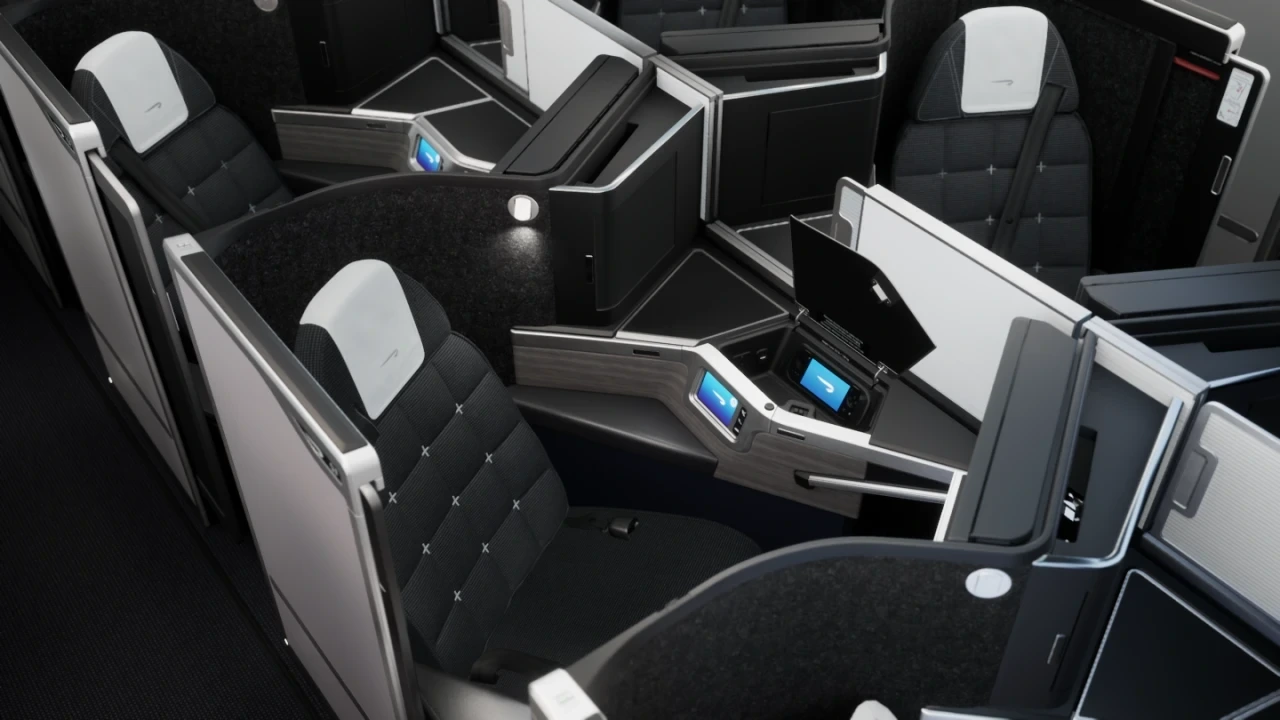
British Airways files its public business fares through ATPCO like everyone else. A net fare in I or Z class still seats you in this same Club Suite; only the price path differs.
Why airlines sell seats below their own website price
The obvious question any skeptical traveler asks is: Why would a multi-billion-dollar airline let a third party sell its best cabin for less than the airline charges on its own website?
The answer comes down to a fundamental tension in airline revenue management: spoilage versus dilution.
An airline seat is the ultimate perishable asset. The moment the boarding door closes, an empty business class suite generates zero revenue forever. At the same time, the carrier cannot simply slash prices on its website four weeks before departure without cannibalizing its highest-margin customers.
Once the door closes, any unsold business class seat earns nothing. Wholesale contracts are how airlines fill those seats without cutting the public fare.
+----------------------------------------------------------+
|                 PUBLISHED RETAIL TARIFFS                 |
|  Displayed on Google Flights, OTAs & airline websites    |
|  - Built for price-inelastic corporate accounts          |
|  - Typical transatlantic round-trip: $5,200 - $8,500+    |
+----------------------------------------------------------+
                             |
                             v
+----------------------------------------------------------+
|             UNPUBLISHED CONSOLIDATOR NET RATES           |
|  Filed under ATPCO Cat 35; accessed via GDS terminals    |
|  - Fills remaining lie-flat capacity quietly             |
|  - Protects public pricing from fare wars                |
|  - Typical transatlantic round-trip: $2,250 - $3,400     |
+----------------------------------------------------------+
Spoilage risk vs. dilution risk
Every long-haul revenue manager is paid to balance two competing hazards:
Spoilage: Pushing back from the gate with 14 empty business class seats on a 60-seat widebody because the public fare was held too high.
Dilution: Dropping the public website fare from $6,400 to $2,600 to fill those 14 seats — and watching law firms, investment banks, and corporate travelers who would have gladly paid $6,400 buy the $2,600 fare instead.
If an airline discounts publicly, it triggers two immediate problems: its own corporate buyers trade down, and competing airlines match the cut within hours through automated ATPCO fare-filing bots. By routing excess capacity through private Category 35 consolidator contracts, the airline fills those 14 seats with leisure couples, retirees, and independent business owners while keeping its public $6,400 tariff intact.
Fare buckets and married segment logic
While passengers see a single cabin behind the curtain, the airline's inventory control system slices business class into five or six single-letter booking codes:
J class: Full-fare, unrestricted, last-seat-availability business class.
C / D class: Standard corporate business class with moderate flexibility.
Z class: Advance-purchase discounted business class.
I / P class: Deep-discount promotional and wholesale consolidator buckets.
Insider Strategy
When a public search engine shows only $6,800 'C' or 'D' class seats left on a flight, that does not always mean lower buckets are sold out. Airlines frequently hold separate allocation pools for private Category 35 contracts, or open 'I' and 'Z' inventory when a specialist agent prices the itinerary with a specific GDS corporate tour code.
Modern carriers also govern inventory using Married Segment Logic (MSL) — pricing availability by the origin-and-destination pair rather than leg by leg. A carrier might block all discounted I class space on its nonstop hub-to-hub flagship flight for local passengers, yet leave I class wide open on that exact same aircraft for travelers connecting from a secondary U.S. departure city or continuing onward to Milan, Zurich, or Athens. A human fare desk working inside Sabre or Amadeus can test these routing combinations in minutes.
Married segment logic prices space by origin and destination. The same flight can be closed to local passengers in I class and open to someone connecting from a smaller city, so agents test routings.
Published fares vs. corporate rates vs. consolidator net rates
Not all "discounted" business class tickets work the same way. If you manage travel for a small company or book your own long-haul trips three or four times a year, it helps to see how the three main pricing tiers stack up.
1. Published retail fares
Open-market public tariffs filed with ATPCO and pushed to every consumer website simultaneously.
Where you see them: Airline websites, Google Flights, Kayak, Skyscanner, Amex Travel retail portal.
Best for: Last-minute walk-up bookings requiring instant, penalty-free full cash refunds (J class) or travelers burning airline-specific credit card companion certificates.
2. Corporate enterprise negotiated rates
Direct alliance contracts negotiated by Fortune 500 procurement teams committing $5 million+ in annual air spend.
Where you see them: Internal corporate portals (Concur, Navan, Amex GBT, BCD Travel).
Typical pricing: 10% to 22% off published flexible (J/C/D) tariffs.
The catch: Because a 15% corporate discount is often calculated off an inflated $7,500 flexible fare, corporate travelers routinely end up paying $6,300 for a seat that a consolidator desk can issue for $2,800.
3. Consolidator net rates (the CEOFLIGHTS model)
Private wholesale contracts built for volume distribution through accredited specialist desks.
Where you see them: Quoted directly by phone or email after a live GDS search.
Typical pricing: 15% to 60% below published airline retail ($2,150–$3,400 transatlantic; $3,100–$4,600 transpacific).
Best for: Affluent leisure travelers, couples, retirees, founders, and small-to-midsize companies paying out of pocket rather than billing a client.
Corporate rates are often 10% to 22% off an inflated flexible fare. For a small company paying its own way, a net rate quoted on the same flight can cost thousands less.
Why Google Flights and Skyscanner never show these fares
It is easy to assume that Google Flights scrapes every fare in existence. In reality, metasearch engines are bound by strict contractual display rules enforced by the airlines themselves.
Metasearch sites can only show the public fares airlines let them display. Private Category 35 fares never reach that grid, however long you scroll.
ATPCO Category 35 distribution controls
When an airline files a private wholesale tariff under ATPCO Category 35, the fare rule includes security settings that limit who can view, sell, and ticket the fare, so the net price cannot be exposed on a public, unauthenticated web page or metasearch comparison grid. If an agency redistributes raw Category 35 net fares outside its authorization, the airline can withdraw its access to the fare and issue debit memos (ADMs).
Automated APIs vs. manual GDS construction
Public search tools rely on cached API snapshots designed to return results in 800 milliseconds. That architecture has three blind spots:
It reads only public fare inventory.
It cannot test private corporate tour codes, Point-of-Sale (POS) currency advantages, or complex interline combinability across alliance partners.
It cannot access offline allotment blocks held by specialist desks.
Consumer search tools read cached public fares in under a second. A human agent working in Sabre or Amadeus can test tour codes, point-of-sale options and partner combinations those tools never try.
+----------------------------------------------------------+
|              PUBLIC CONSUMER METASEARCH FLOW             |
|                                                          |
|  Traveler -> Google Flights -> Public Tariff             |
|                                        |                 |
|                                        v                 |
|                           Public Retail: $5,800+         |
+----------------------------------------------------------+

+----------------------------------------------------------+
|            CEOFLIGHTS CONSOLIDATOR DESK FLOW             |
|                                                          |
|  Traveler -> Specialist Agent -> Sabre / Amadeus GDS     |
|                                        |                 |
|                                        v                 |
|                         Cat 35 Wholesale Net Contract    |
|                                        |                 |
|                                        v                 |
|                           Delivered Net: $2,450          |
+----------------------------------------------------------+
Published retail vs. consolidator net fare examples
Savings vary by season, advance-purchase window, and route competition. On heavily monopolized nonstop hubs, a consolidator contract might save 18% to 30%; on competitive one-stop European, Middle Eastern, and Asian corridors, savings regularly reach 45% to 58%.
Route
Primary Carriers
Published Retail Fare
CEOFLIGHTS Net Rate
Total Savings
New York (JFK) to London (LHR)
British Airways / Virgin / AA
$5,800
$2,450
58% ($3,350)
Los Angeles (LAX) to Tokyo (HND)
ANA / Japan Airlines / United
$6,900
$3,150
54% ($3,750)
San Francisco (SFO) to Singapore (SIN)
Singapore Airlines / United
$7,400
$3,450
53% ($3,950)
New York (JFK) to Dubai (DXB)
Emirates / Qatar Airways
$6,800
$3,190
53% ($3,610)
Chicago (ORD) to Frankfurt (FRA)
Lufthansa / United Airlines
$5,400
$2,380
56% ($3,020)
Miami (MIA) to Buenos Aires (EZE)
American Airlines / LATAM
$4,600
$2,150
53% ($2,450)
Unlock unlisted business class fares saving 15%–60% on your upcoming long-haul routes. Request a custom net-rate quote from a dedicated travel manager.
What stays identical — and what changes — on a consolidator ticket
First-time consolidator buyers often worry that paying 45% less means boarding last, losing lounge access, or getting stuck in a middle seat. In practice, the physical travel experience is indistinguishable from a retail ticket because the airline's airport systems only read your cabin class (J, C, D, Z, I), not the agency contract code used to price it.
Airport systems read the cabin and booking class on your pass, not the contract used to price it. Priority check-in, fast-track and lounge entry follow the cabin.
What stays 100% identical
The seat and cabin: Full lie-flat suite and immediate advance seat selection using your 6-character airline PNR directly on the carrier's app.
Flagship lounge access: Full entry to departure and transit lounges (such as Qatar Airways' Al Mourjan Lounge, United Polaris Lounges on long-haul itineraries, or British Airways Galleries Club).
Baggage and priority handling: Two or three checked bags at 32 kg (70 lbs) each, priority check-in counters, fast-track security, and Group 1/2 boarding.
Frequent flyer mileage accrual: True revenue consolidator tickets (issued in Z, D, or I class) generally earn redeemable miles and elite status qualifying credits according to the operating carrier's published chart for that booking letter.
What actually differs (and how to verify your ticket)
There are two real trade-offs you should understand before ticketing:
Change and cancellation rules: While a $7,500 retail J fare lets you cancel for a full cash refund ten minutes before pushback, a $2,600 consolidator net fare typically carries a $250 to $500 change or cancellation penalty (or converts into future travel credit) under the underlying Category 35 contract. Always ask your agent for the exact penalty rules before paying.
Agency servicing prior to departure: Because the fare is privately contracted, voluntary date or routing changes before travel begins are handled by your consolidator travel manager rather than the airline's general reservations line. Once you check in at the airport (within 24 hours of departure), airport gate agents and lounge staff have full control of your ticket during delays or irregular operations.
How to spot mile-broker scams posing as consolidators
A legitimate airline consolidator issues a revenue cash ticket in a standard business class bucket (I, Z, D) backed by ARC/IATA accreditation and ASTA membership. Beware of unaccredited websites that secretly book your seat using bought-and-sold frequent flyer miles (which show up on your receipt in award buckets like U, X, or O with zero fare basis). Airlines actively audit and cancel brokered award tickets at the gate. Always verify that your confirmation includes both a 6-character airline PNR and a 13-digit e-ticket number (starting with the airline's 3-digit prefix, such as 125- for British Airways or 176- for Emirates).
How to book a consolidator fare step by step
Because Category 35 net rates cannot be placed in a public shopping cart, booking takes a quick four-step exchange with a human specialist:
Share your route and date window: Submit your departure city, destination, approximate travel dates, and preferred airlines through the quote form or by calling (888) 851-6897. If you have a one- or two-day flex window, mention it — shifting a transatlantic departure from Thursday evening to Wednesday or Saturday often opens a lower I or Z bucket.
Live GDS contract search: Your travel manager queries Sabre and Amadeus across nonstop and one-stop partner tariffs, checking married-segment availability and cabin hardware (so you don't accidentally book an unretrofitted 2-2-2 aircraft).
Compare written options: Within 15 to 30 minutes, you receive side-by-side flight options showing exact flight numbers, layover times, aircraft types, total all-in fares, and written change/cancellation terms.
Verify your PNR and select seats: Once you approve an option, the desk issues your e-ticket and sends your 6-character airline confirmation code so you can log straight into the airline's website, verify the booking, and pick your window suite.
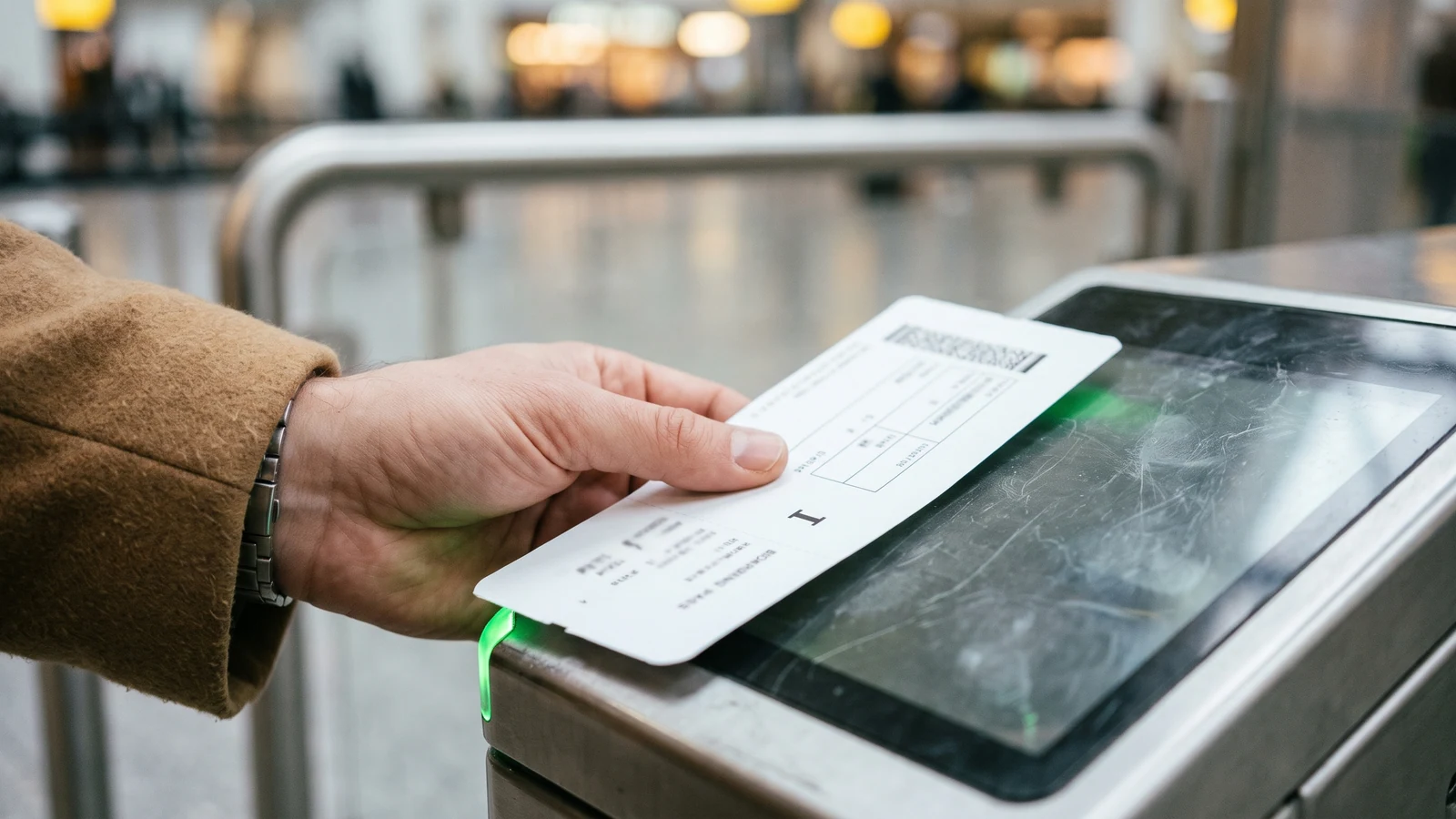
A legitimate consolidator booking comes with a 6-character airline PNR and a 13-digit e-ticket number. Enter the PNR on the airline's own site to check the booking and choose seats.
Frequently asked questions
What is the difference between a published fare and a consolidator net fare?
A published fare is a public tariff filed with ATPCO and displayed identically across airline websites and metasearch tools like Google Flights. A consolidator net fare is a private wholesale contract rate (ATPCO Category 35) distributed through accredited travel desks, saving travelers 15% to 60% below airline retail on international business class flights.
Are consolidator business class tickets legitimate?
Yes, when issued by an accredited agency. Legitimate consolidator tickets are standard revenue tickets issued directly through Sabre, Amadeus, or Travelport under contractual agreements with the airline. You receive a live 6-character airline PNR and a 13-digit e-ticket number that you can verify immediately on the airline's own website or mobile app.
Do I still earn frequent flyer miles on consolidator business class flights?
In most cases, yes. Because true consolidator tickets book into revenue business class fare buckets (I, Z, or D), they earn redeemable miles and elite status credits according to the airline's published chart for discounted business class. Some carriers reduce or exclude mileage accrual on certain unpublished or deep-discount fares, so ask your agent to confirm earning for your specific fare before ticketing.
Why can't I find these rates on Google Flights or Kayak?
Airlines file wholesale contract rates under ATPCO Category 35 security rules, which restrict who can view and sell them so the carrier does not undercut its own full-fare corporate sales. Accessing those tariffs requires a human agent working inside an authorized GDS terminal.
What happens if I need to change or cancel my flight?
Consolidator tickets carry specific change and cancellation rules defined by the airline's wholesale contract — typically a $250 to $500 fee for voluntary date changes or a credit toward future travel. Your CEOFLIGHTS travel manager provides the exact fare rules in writing before you ticket and handles any rebooking directly if your plans shift. Need a quote for an upcoming trip? Talk to a CEOFLIGHTS travel manager to compare unpublished net rates on your route.
Share
A
Austin Rivers
Content creator and business travel specialist at CEOFLIGHTS, bringing you the latest insights, tips, and trends in premium business and first-class travel.
Become the CEO of Your Journey
You take the lead. Your dedicated Personal Travel Manager handles every detail.