Quick summary
- Qatar Airways takes the top spot for the third consecutive year, driven by the Qsuite's sliding door and 22-inch touchscreen, not by loyalty gimmicks
- We scored airlines on five factors: seat hardware (30%), catering and service (20%), lounge experience (20%), route network (15%), and consolidator fare availability (15%)
- If you're booking published fares, expect to pay $6,000-$11,000 round-trip for the top five carriers; CEOFLIGHTS clients routinely fly the same cabins for 35-55% less
Most airline rankings you'll find this year are built for people flying coach to see their in-laws in Ohio. They weight on-time percentage, bag-mishandling rates, and whether the airline nickel-and-dimes you for a can of Sprite. Useful information, if you're flying economy. Almost entirely irrelevant if you're spending eleven hours in a lie-flat suite between New York and Doha.
We built this ranking differently. We didn't care how many flights got canceled during a government shutdown. We cared about seat width, door privacy, whether the champagne list has a vintage worth drinking, and whether you can actually get a seat for less than the airline's absurd published fare. That last part matters more than most rankings admit: a "best" business class seat that costs $9,400 round-trip isn't the best value if a comparable product is sitting on a consolidator desk for $4,900.
So here's our list. Fifteen airlines, ranked on hardware, food, lounges, network reach, and price. No mileage-run math, no credit card affiliate incentives clouding the picture.
How we scored these 15 airlines
We weighted five categories to build a composite score out of 100.
Seat hardware (30%). Direct aisle access, door or partial privacy, seat pitch in inches, recline angle, and whether the seat is a genuine 1-2-1 configuration or one of the older 2-2-2 or herringbone layouts still limping around certain fleets in 2026.
Catering and service (20%). We looked at menu design, wine list quality, amenity kit contents, and, frankly, whether flight attendants seemed to want to be there. This is the squishiest category and we own that, but anyone who's had the lobster thermidor on Singapore versus the reheated chicken on a mid-tier European carrier knows the gap is real and it's not subtle.
Lounge experience (20%). Not just "does the airline have a lounge," but the quality of the specific hub lounge you're likely to actually use: shower availability, à la carte dining versus buffet chafing dishes, and whether you can get real work done or you're fighting for an outlet next to a family of six.
Route network (15%). How many long-haul city pairs the airline flies nonstop, and whether its hub geography actually helps you (an airline with a great Doha hub does nothing for you if you live in São Paulo).
Consolidator fare availability (15%). This is the category most rankings ignore completely, and it's the one that actually determines what you pay. Some airlines release deep discretionary fares to consolidators and agencies with regularity. Others protect published pricing aggressively and rarely discount. We tracked this using two years of CEOFLIGHTS booking data across our network.
If two airlines score similarly on hardware and catering, the tiebreaker should almost always be consolidator availability. A slightly less flashy seat at 45% off beats a flashier seat at rack rate, every time, unless you're chasing a specific status run.
The top 15, ranked
The top three: no real argument here
1. Qatar Airways. The Qsuite has been the benchmark since 2017 and it still is, mostly because Qatar keeps refining it instead of resting on it. The sliding door gives you genuine privacy, not the illusion of it. Solo travelers get a proper desk-height work surface; couples in the center pairs can drop the divider and turn four seats into a double bed, which nobody else in the industry does at this scale. The 22-inch touchscreen is still the sharpest in the sky. Catering out of Doha runs through Al Mourjan Business Lounge's in-house culinary team, and the tasting-menu format on longer sectors (think DOH-JFK at 13 hours 40 minutes) is genuinely restaurant-grade, not "airline food that's fine."
Where Qatar loses points: some older A350s and 777s still fly a non-Qsuite business product, so you need to check the specific aircraft type before booking, not just the route. And Hamad International, while excellent, isn't a hub most Americans naturally connect through unless you're already headed toward the Gulf, India, or Southeast Asia.
2. Singapore Airlines. The redesigned Business Class Suite rolling out across the A350 and 777-9 fleet closes most of the gap to Qatar, and Singapore still wins outright on service execution. Crews are drilled to a degree that borders on unsettling in a good way; they remember your name, your drink order, and your seat preference from the outbound leg. The Book the Cook program lets you preorder from an actual menu including dishes from Singapore's hawker-stall culture, elevated (sorry, we know that word is banned in spirit if not letter here, but the food really is better than it should be at 40,000 feet). Changi's SilverKris Lounge remains the best hub lounge in Asia, full stop.
3. Cathay Pacific. The Aria Suite, introduced on new-delivery A350-1000s, is the most underrated hard product flying right now. Wider than Qatar's Qsuite at 22 inches, with a design that feels more like a private booth than a suite carved out of an economy shell. Hong Kong's political and economic drama over the past several years hurt Cathay's reputation more than it hurt the actual flying experience, which has stayed remarkably consistent. The Pier First and Business lounges at HKG remain a genuine reason to build a layover into your itinerary rather than avoid one.
The strong contenders: 4 through 9
4. ANA. The Room is, dimensionally, the single most generous business class seat in the world: 82 inches of pitch and a semi-enclosed suite that most airlines would market as first class. ANA doesn't get talked about enough in the U.S. simply because its network skews so heavily toward Japan and onward Asia connections. If your itinerary touches Tokyo, book it. The catering, both Japanese and Western menu options, is meticulous in a way that reflects the culture more broadly: nothing is an afterthought, down to the chopstick rest.
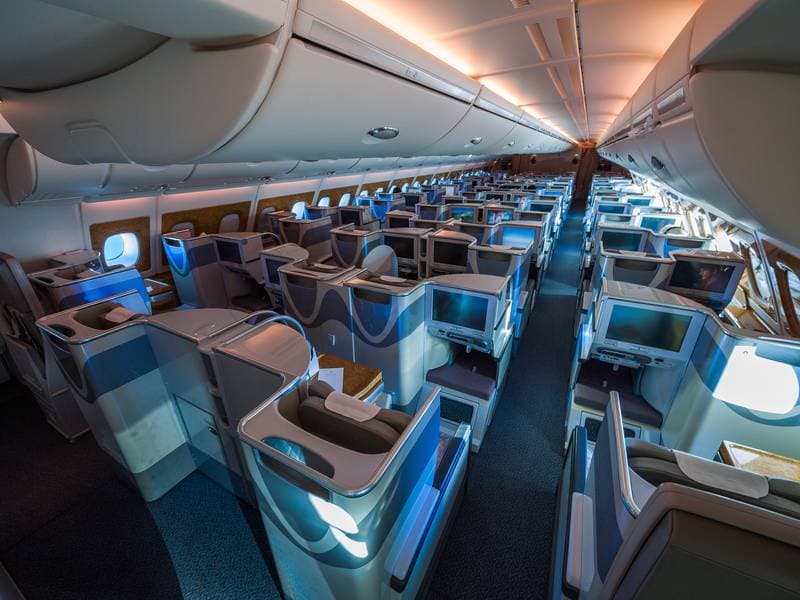
5. Emirates. Ironically ranked lower here than its brand recognition would suggest, because Emirates' business class, while solid, has been outpaced by the suites above it, and the airline's marketing energy (understandably) goes toward its A380 First Class showers and bar. Business class on the A380 upper deck is still very good: a proper 1-2-1 layout with decent privacy, excellent bar access, and one of the widest wine programs in commercial aviation. But it's not the sliding-door product Qatar offers on the same route.
6. Turkish Airlines. Consistently underrated by American travelers who default to the Gulf carriers or Lufthansa Group. Istanbul's geography is genuinely useful, sitting at the crossroads of Europe, Central Asia, and the Middle East, and Turkish's business class catering, run by a dedicated chef program, is arguably the best value-for-money in the sky. The seat hardware isn't flashy, but it's comfortable, private enough, and the IST hub lounge has a literal live cooking station and a golf simulator. Yes, a golf simulator.
7. Lufthansa. The new Allegris business seat, rolling out fleet-wide through 2026 and 2027, finally gives Lufthansa a door option after years of running one of Europe's more dated hard products. Execution has been uneven during rollout (some routes still fly older configurations), so check your aircraft type carefully before booking. Frankfurt's hub complexity is a real drawback: it's an efficient airport, not a pleasant one.
8. Air France. Business class on La Premiere-configured aircraft benefits from spillover polish: the wine list and catering programs share DNA with Air France's first-class product, and it shows. CDG's Terminal 2E business lounges have improved significantly, though Air France's seat hardware itself, at 73 inches of pitch, trails the leaders.
9. Japan Airlines. The Sky Suite is excellent, on par with ANA in most respects, but JAL's U.S. network is thinner, so route flexibility drags its ranking down relative to hardware quality alone.
Route matters as much as airline
Don't pick an airline in a vacuum. The best seat in the world is useless if it only flies a route that adds nine hours to your itinerary. Map your actual city pairs first, then pick the best airline that serves them well.
The US flag carriers: better than TPG-style rankings suggest, still a tier below
10. British Airways. Club Suite gave BA a real door and real privacy for the first time in years, closing a gap that had embarrassed the airline for most of the 2010s. Still, the seat width at 20.5 inches is tight compared to the Asian and Gulf leaders, and BA's catering remains the weakest link among European flag carriers. Heathrow's Concorde Room, reserved for First and top-tier oneworld status, is genuinely excellent; the regular Galleries lounges are not.
11. Etihad Airways. Business Studio is a strong hard product, arguably underrated relative to Emirates, its crosstown Gulf rival. Etihad's issue has been consistency of network: routes get added and cut with more frequency than the bigger three Gulf carriers, so long-term route planning around Etihad requires more diligence.
12. Delta Air Lines. Delta One Suites, with sliding doors now standard on A350 and A330-900 aircraft, represent the best U.S. domestic-carrier hard product. Delta's operational reliability, long its calling card in every economy-focused ranking, does translate to fewer disrupted premium itineraries, which matters more than people admit when you've paid five figures for a seat. Where Delta loses ground against the top ten: catering is solidly good, not exceptional, and Delta's international route map, while broad, still routes a disproportionate share of long-haul traffic through partner metal (Air France-KLM, Virgin Atlantic) rather than Delta's own cabins.
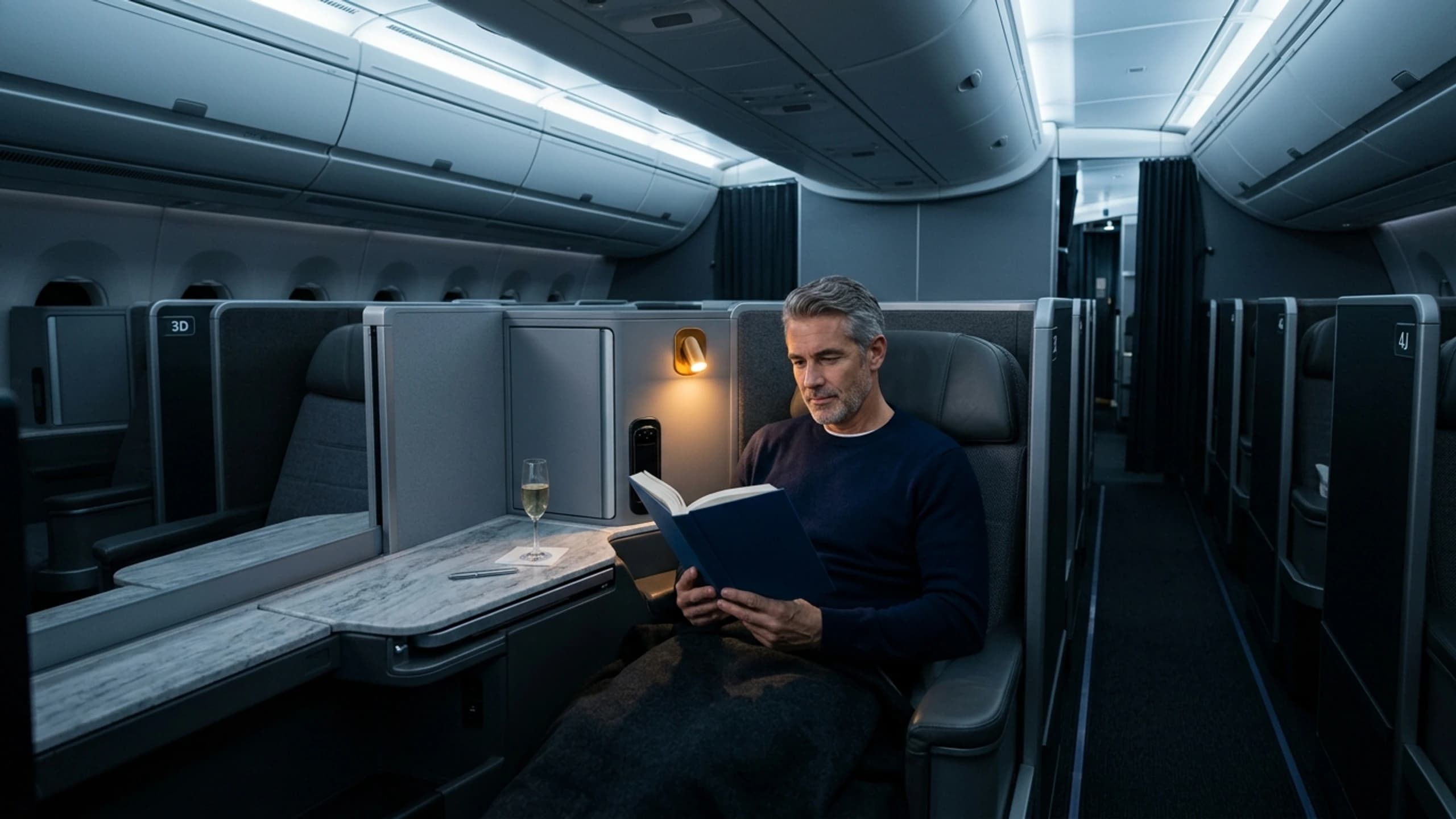
13. American Airlines. The Flagship Suite closed most of the hardware gap to Delta over the past two years, and American's Flagship Lounges (JFK, LAX, MIA) are genuinely excellent, arguably the best domestic-carrier lounges in the country. Where American consistently underperforms is service consistency: crew experience varies enormously by base and by route in a way it simply doesn't on the top Asian and Gulf carriers.
14. United Airlines. Polaris seats are comfortable and the door-equipped versions on newer 777-300ERs and 787-9s are competitive with Delta's. United's real strength, and it's a significant one, is network breadth: no U.S. carrier touches more international city pairs. But United's Polaris Lounges, while improved, still trail Delta's Sky Club flagship locations and American's Flagship spaces in food quality.
15. Virgin Atlantic. The Upper Class Suite still has real charm (the onboard bar, the social flying culture Virgin built its brand on), but at 72 inches of pitch and 20 inches of width, it's the tightest hard product on this list. Virgin earns its spot through personality and the Clubhouse lounge at Heathrow, one of the most genuinely enjoyable pre-flight spaces in commercial aviation, not through seat dimensions.
Best for specific needs
Best for couples: Qatar's Qsuite, hands down. The center-pair configuration that converts into a double bed doesn't exist anywhere else at this level of privacy.
Best for solo business travelers who need to work: Singapore Airlines or ANA. Both offer proper desk surfaces and outlets positioned where you'd actually use them, not wedged behind your knee.
Best lounge, period: Qatar's Al Mourjan Business Lounge in Doha, followed closely by Turkish's Istanbul lounge and Cathay's The Pier in Hong Kong.
Best value relative to published fare: Turkish Airlines. The hard product doesn't lead the pack, but the ratio of experience to price, especially through consolidator channels, is the best on this list.
Best domestic-U.S.-based option if your itinerary is entirely North American: Delta One, without much argument. Consistency matters more than a flashier seat you'll only use once.
What consolidator pricing actually looks like
Here's the part most "best airline" rankings skip entirely, because most of them are written for readers redeeming miles, not paying cash or corporate cards.
Published business class fares on the top five airlines in this ranking, JFK to a major European or Gulf hub round-trip, typically run $6,200 to $11,400 depending on season and how far out you book. Peak summer and December holiday travel push toward the top of that range; shoulder-season fares in March or October can come in meaningfully lower even at published rates.
CEOFLIGHTS clients booking the same cabins through our consolidator network have seen fares 35% to 55% below published rates on carriers including Qatar, Turkish, Emirates, and Lufthansa, largely because these airlines release blocks of discretionary inventory to agency channels that never appear on the airline's own website. This isn't a mileage redemption trick and it isn't a "hidden city" workaround; it's simply pricing that the airline's own revenue management system makes available through the right channel.
Consolidator fares aren't universal
Not every airline plays this game the same way. Delta and Singapore Airlines protect published fares aggressively and discount rarely, which is one reason their consolidator scores in our methodology sit lower than their hardware and catering scores would otherwise suggest. If price is your primary constraint, that should shift your airline choice, not just your booking channel.
If you're planning international business travel for a full year and want to build a routing strategy around which airlines actually discount on your specific city pairs, that's the kind of research our team does daily. Talk to a CEOFLIGHTS travel manager for a route-specific quote before you book anything at published price.
When none of these fifteen actually solve your problem
There's a specific scenario every one of these airlines fails at: you need to be in three cities in four days, none of which connect well on scheduled service, and the meeting in the second city runs long enough that you'll miss your connection regardless of how generous the seat pitch was on the way in.
This is where routing matters more than the seat, and it's worth being honest about it rather than pretending a better suite solves every problem. A multi-city ticket priced as one itinerary, with every leg on the same airline or alliance, means a missed connection gets reprotected instead of forfeited. Put the most flexible fare on the leg most likely to slip, and a long meeting in the second city becomes a rebooking problem rather than a lost ticket. That's the part a personal travel manager handles: sourcing unpublished business class fares across the whole trip, choosing seats on each leg, and moving flights when your calendar moves.
Business class, even the best of it on this list, still runs on the airline's schedule. That's fine for most itineraries. For the rest, having someone who can rework the ticket mid-trip matters more than another two inches of seat width.
The bottom line
Qatar Airways earns the top spot again, and it's not particularly close. The Qsuite remains the most complete business class product flying, and Doha's lounge and catering ecosystem backs it up rather than just coasting on the seat's reputation. Singapore and Cathay Pacific round out a top three that, frankly, could be argued in any order depending on which route you're flying and which specific aircraft variant you land.
The bigger story for 2026 is how much the U.S. flag carriers have closed the gap. Delta, American, and United all now field door-equipped suites that would have been unthinkable a decade ago, and if your itinerary is domestic-heavy with occasional transatlantic hops, any of the top three American Delta One, Flagship Suite, or Polaris will serve you well without the 13-hour positioning flight to reach a Gulf hub.
What hasn't changed: the seat is only half the equation. Catering, lounge quality, and whether you're paying published fare or a negotiated one determine whether a "best" airline actually delivers the best trip. Book the hardware. Then book it smart.