Austrian Airlines business class review: Viennese charm at 38,000 feet
Austrian Airlines business class blends DO & CO dining, flat-bed comfort, and genuine Viennese hospitality — here's what to expect on every aircraft type.
Olivia Brooks8 min read
Quick summary
Austrian Airlines combines exceptional DO & CO catering with genuine Viennese hospitality, providing a premium experience that gets even better on the new 787-9 Dreamliner. With a nearly 78-inch flat bed and consolidator fares frequently dropping to the $3,200-$4,800 range, we highly recommend choosing the Dreamliner for your next transatlantic trip.
Austrian Airlines doesn't get nearly enough credit in the business class conversation. Travelers fixate on Qatar's QSuite or Singapore's Suites and overlook an airline that consistently delivers one of the most genuinely hospitable experiences in the sky — complete with a Flying Chef, Viennese coffee service, and DO & CO catering that puts most transatlantic competitors to shame.
The flag carrier of Austria and a Lufthansa Group member, Austrian operates long-haul routes from Vienna International Airport (VIE) to New York (JFK), Washington Dulles (IAD), Chicago O'Hare (ORD), Montreal (YUL), Bangkok (BKK), Tokyo Narita (NRT), Delhi (DEL), and Shanghai (PVG), with seasonal service to Cape Town. Its long-haul fleet currently runs Boeing 777 and 767 aircraft fitted with Thompson Vantage seats, while the new Boeing 787-9 Dreamliner is gradually replacing both. That transition matters — and we'll tell you exactly why.
Austrian's long-haul fleet is in transition, shifting from older Thompson Vantage seats on the 767 and 777 to a vastly improved 787-9 Dreamliner experience.
Cabin design and seat configuration
The current aesthetic across the 777 and 767 cabins is clean, composed, and unmistakably European: a red-and-gray palette, warm ambient lighting, subtle wood accents, and metallic trim that never tips into ostentation. It feels like a well-appointed business hotel rather than an airline trying too hard.
Boeing 767 and 777
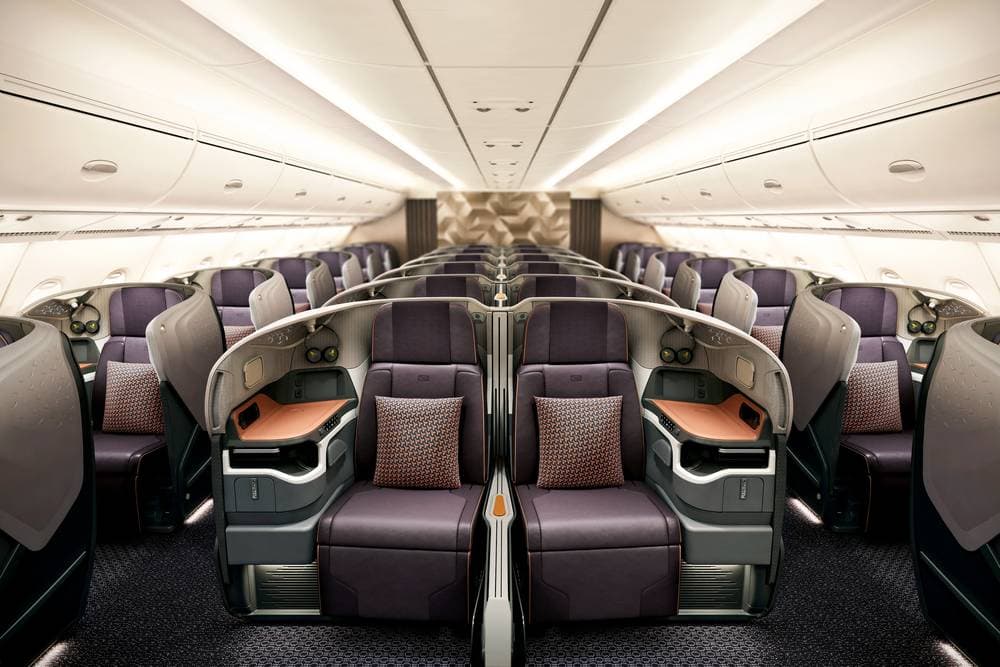
On these aircraft, Austrian fits the Thompson Vantage seat in a staggered 1-2-1 configuration on the 777 and a 2-2-1 layout on the 767. Most seats provide direct aisle access. Solo travelers should specifically request the "throne seats" — single-seat rows with extra side surface area and a genuine sense of isolation from the rest of the cabin. On a red-eye to JFK, that distinction matters.
Boeing 787-9 Dreamliner
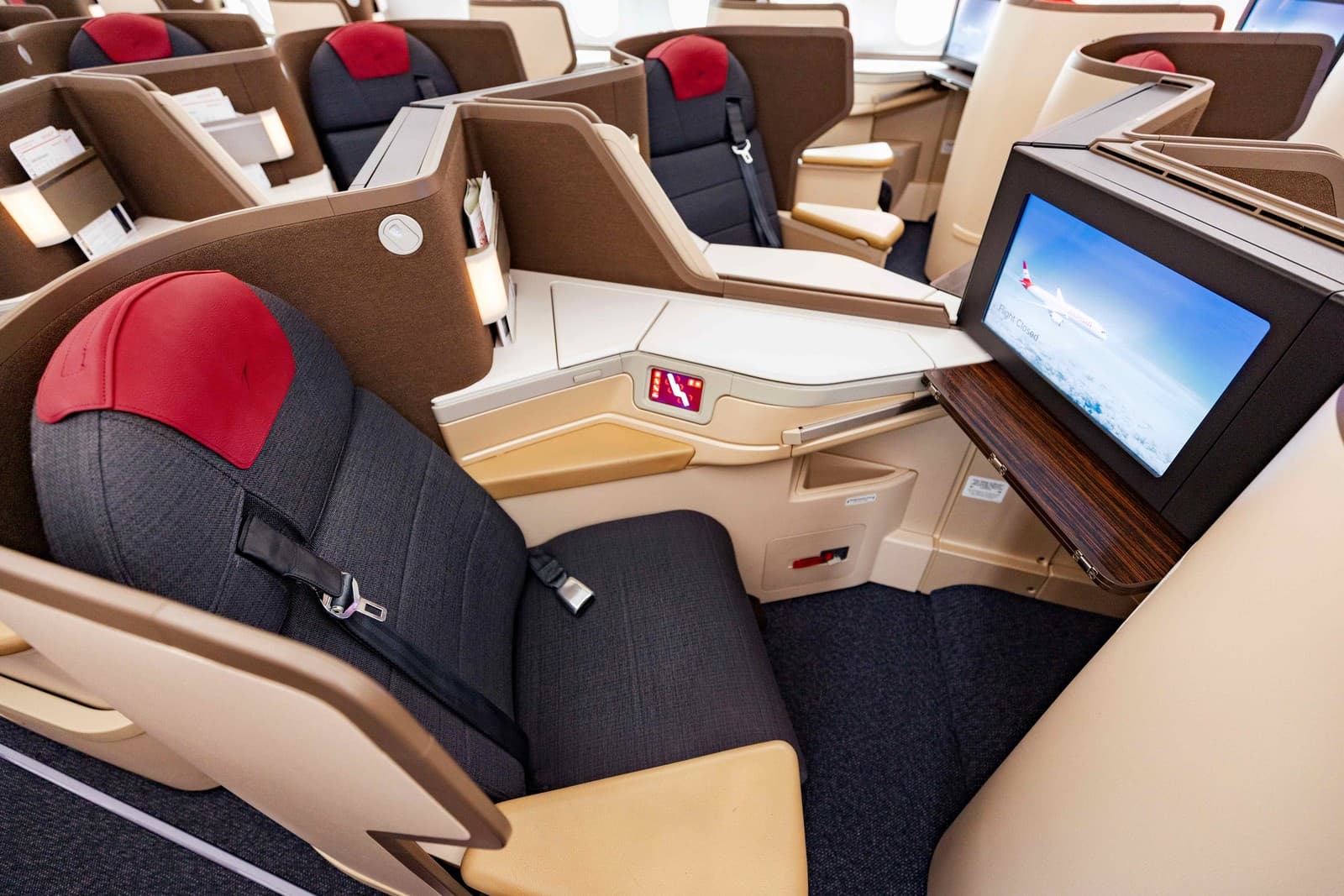
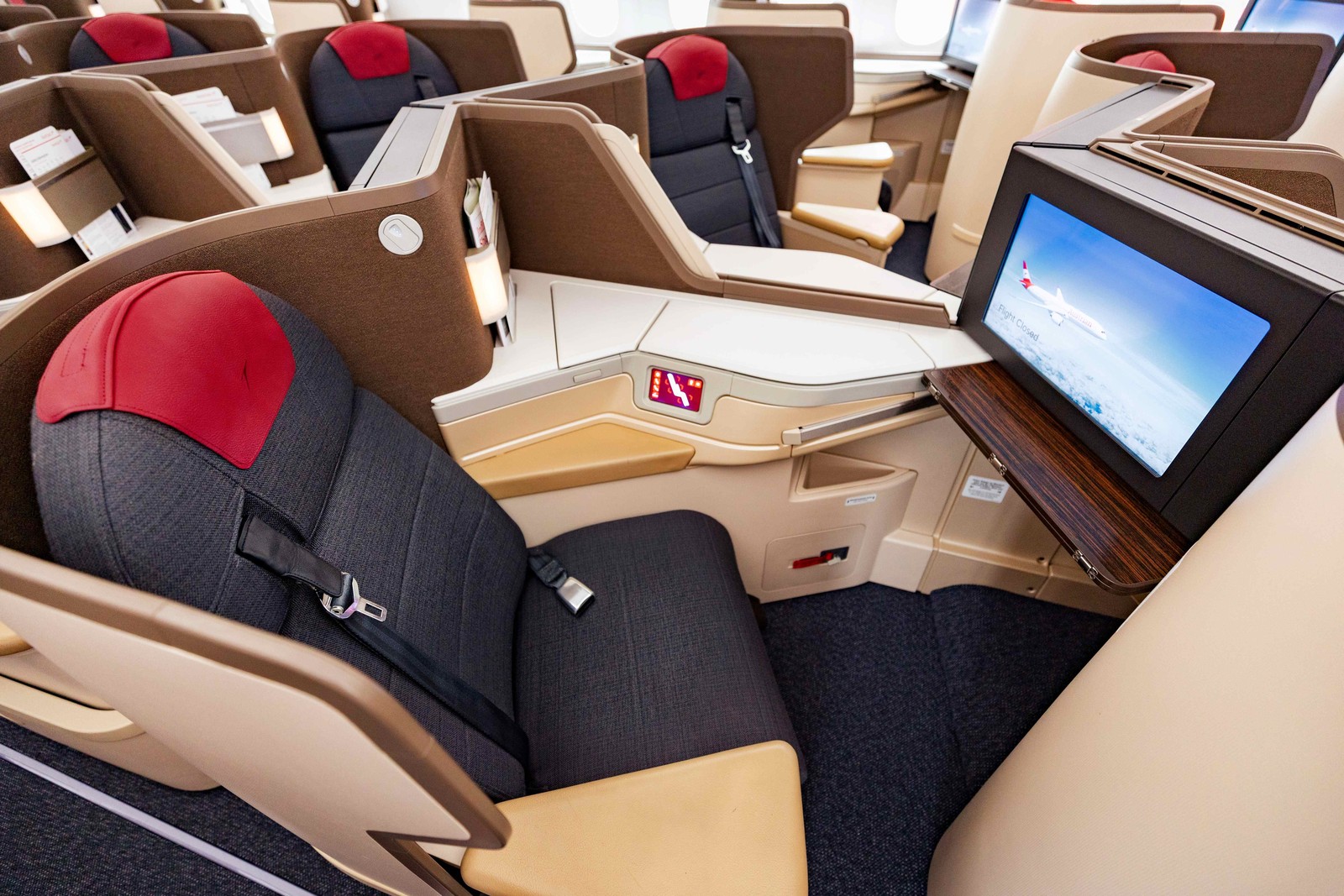
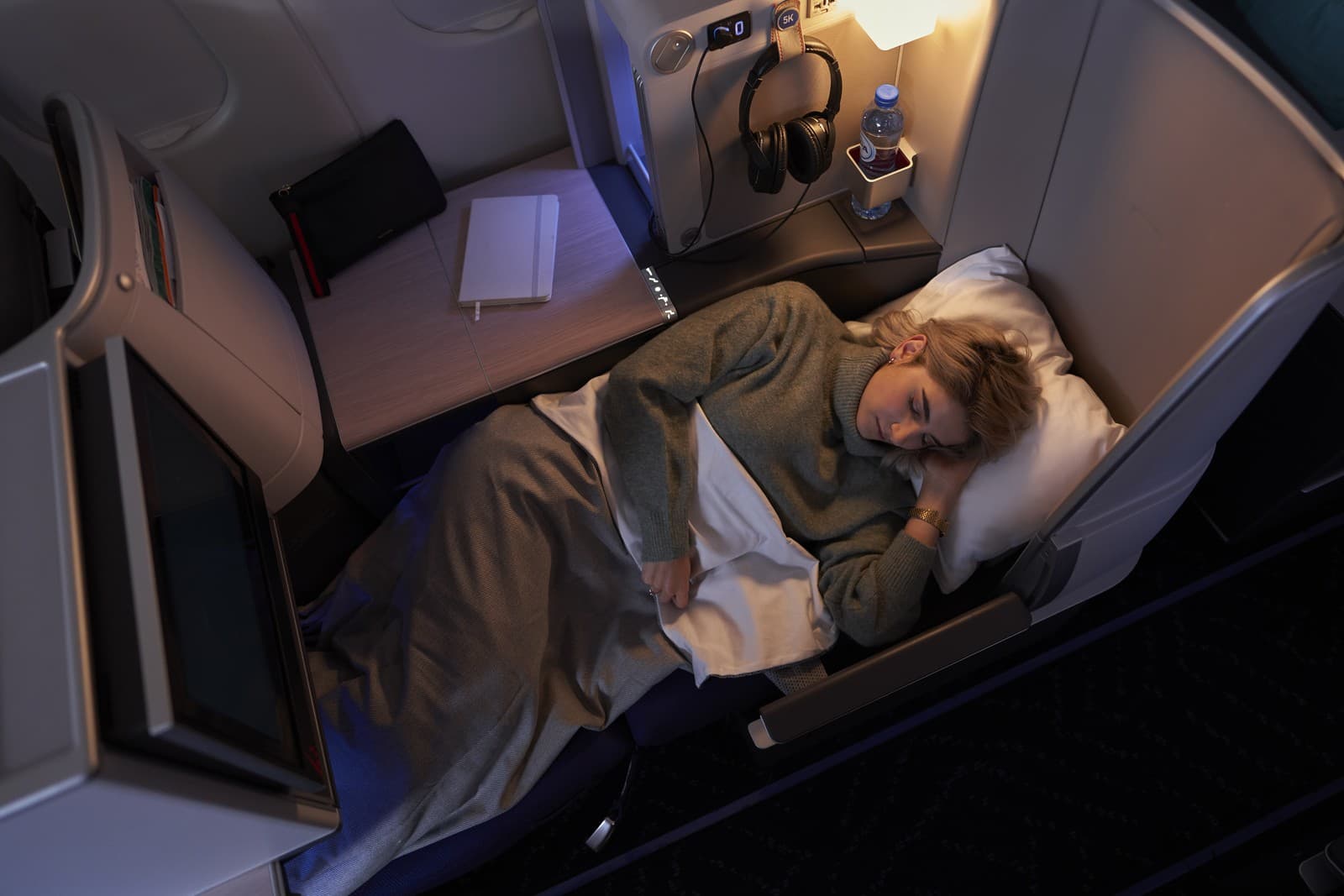
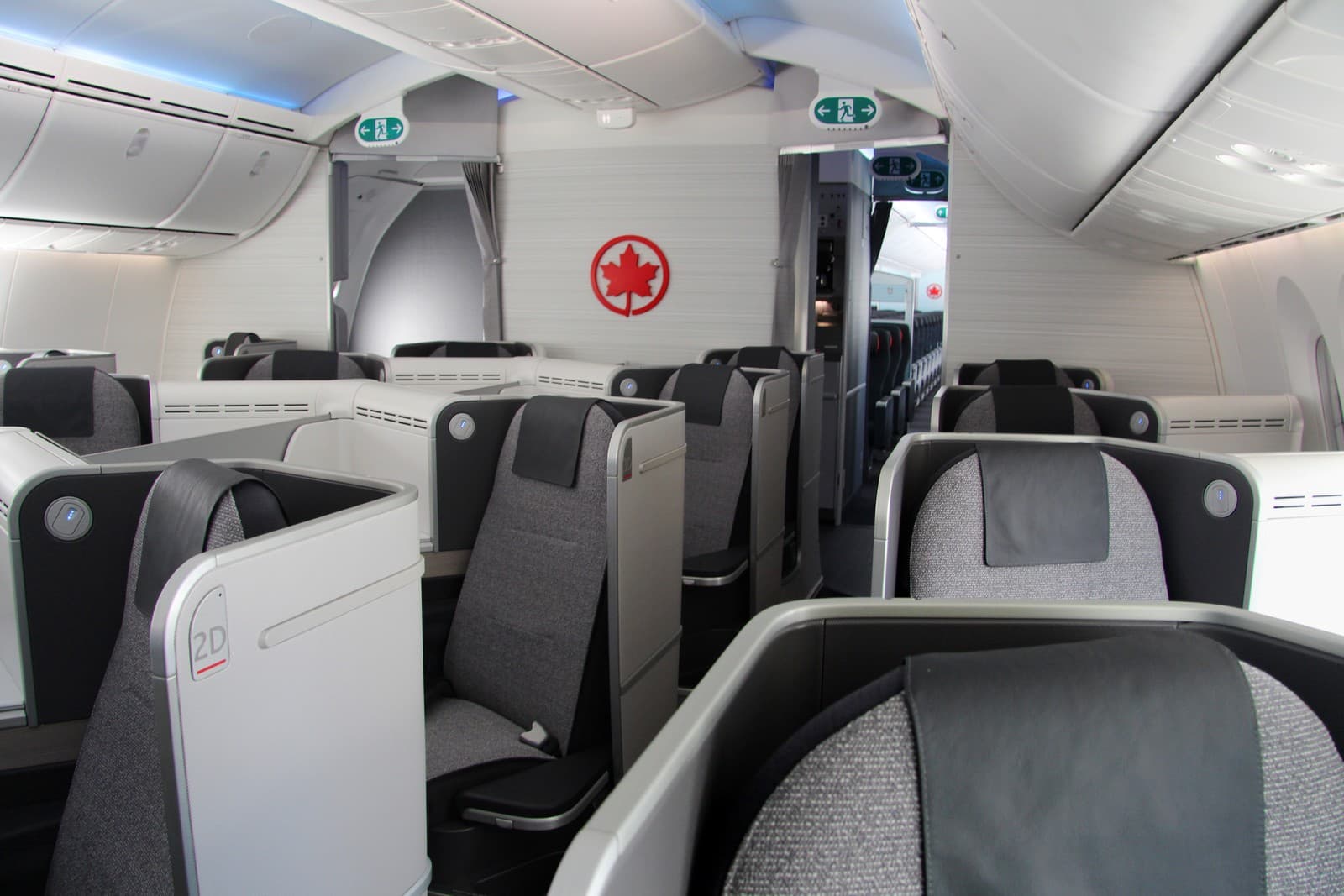
The 787 is a different animal entirely. Austrian's new Dreamliner cabin features a reverse-herringbone 1-2-1 layout, meaning every single passenger gets direct aisle access without exception. The seats sit inside sleek shell-style enclosures with higher walls, more intuitive controls, and storage compartments that actually hold a laptop bag without gymnastics.
Crucially, the 787 cabin is quieter, better pressurized (cabin altitude of roughly 6,000 feet versus 8,000 on older jets), and runs higher humidity levels. You arrive feeling measurably less depleted. If you're booking a flight to Bangkok or Tokyo and have a choice between equipment, take the Dreamliner.
The Dreamliner's 1-2-1 layout guarantees direct aisle access for everyone, while the higher shell walls and better pressurization drastically reduce long-haul fatigue.
Seat comfort and what you actually get
Every seat across the long-haul fleet converts to a fully flat bed measuring approximately 2 meters (78 inches) in length. The Thompson Vantage seats on the 767 and 777 offer decent shoulder width and a solid lie-flat position, though the padding is showing its age on older frames. Multiple recline positions, lumbar adjustment, and a built-in massage function are standard. USB ports, universal power outlets, a reading light, and accessible side storage round out the basics.
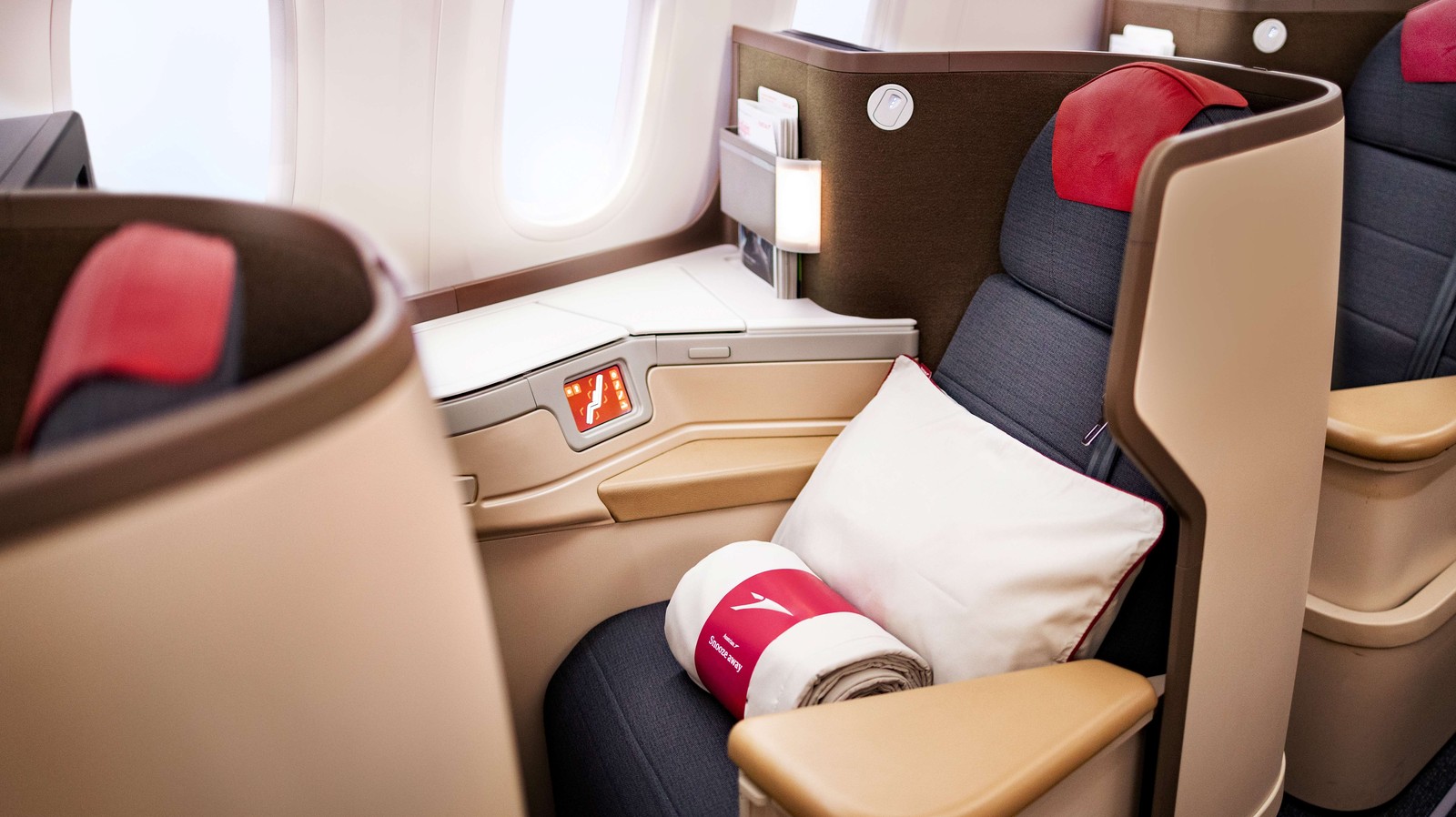
The 787's seats are simply better. Higher side walls give you real privacy, and the expanded personal space means you're not negotiating elbow room with the seat architecture. For overnight routes, mattress toppers are available on request — worth asking for before boarding rather than after.
The 787 sets a new benchmark for Austrian, offering more intuitive controls, meaningful privacy, and larger storage compartments compared to their older jets.
Couples or colleagues traveling together on the 777 should consider the center pairs in the 1-2-1 layout, which allow easy conversation without shouting across an aisle. On the 787, those center pairs feel more cocoon-like, with a shared console between seats that can be raised for privacy or lowered when you want to talk.
The 787 sets a genuinely new benchmark for Austrian — not just an incremental upgrade, but a meaningful step closer to the best in class on these routes.
In-flight entertainment and connectivity
Austrian's IFE screens are large, HD, and responsive. The content library covers the usual spread of Hollywood releases, international cinema, documentaries, and music, but what makes it distinctly Austrian is the curation: a dedicated section of Austrian and European films, classical programming, and content tied to Viennese cultural institutions. It's a small touch that lands well on a 9-hour flight to New York.
Noise-canceling headphones are provided. They're adequate — bring your own Bose or Sony if audio quality matters to you.
Here's the meaningful divide: the 777 and 767 have no Wi-Fi. Full disconnection, whether you see that as a feature or a problem. The 787-9 Dreamliner brings high-speed Wi-Fi throughout the cabin, plus Bluetooth audio pairing so you can connect your own wireless headphones to the entertainment system — a detail that's overdue across the industry.
Dining experience
This is where Austrian Airlines earns its most passionate defenders, and rightly so.
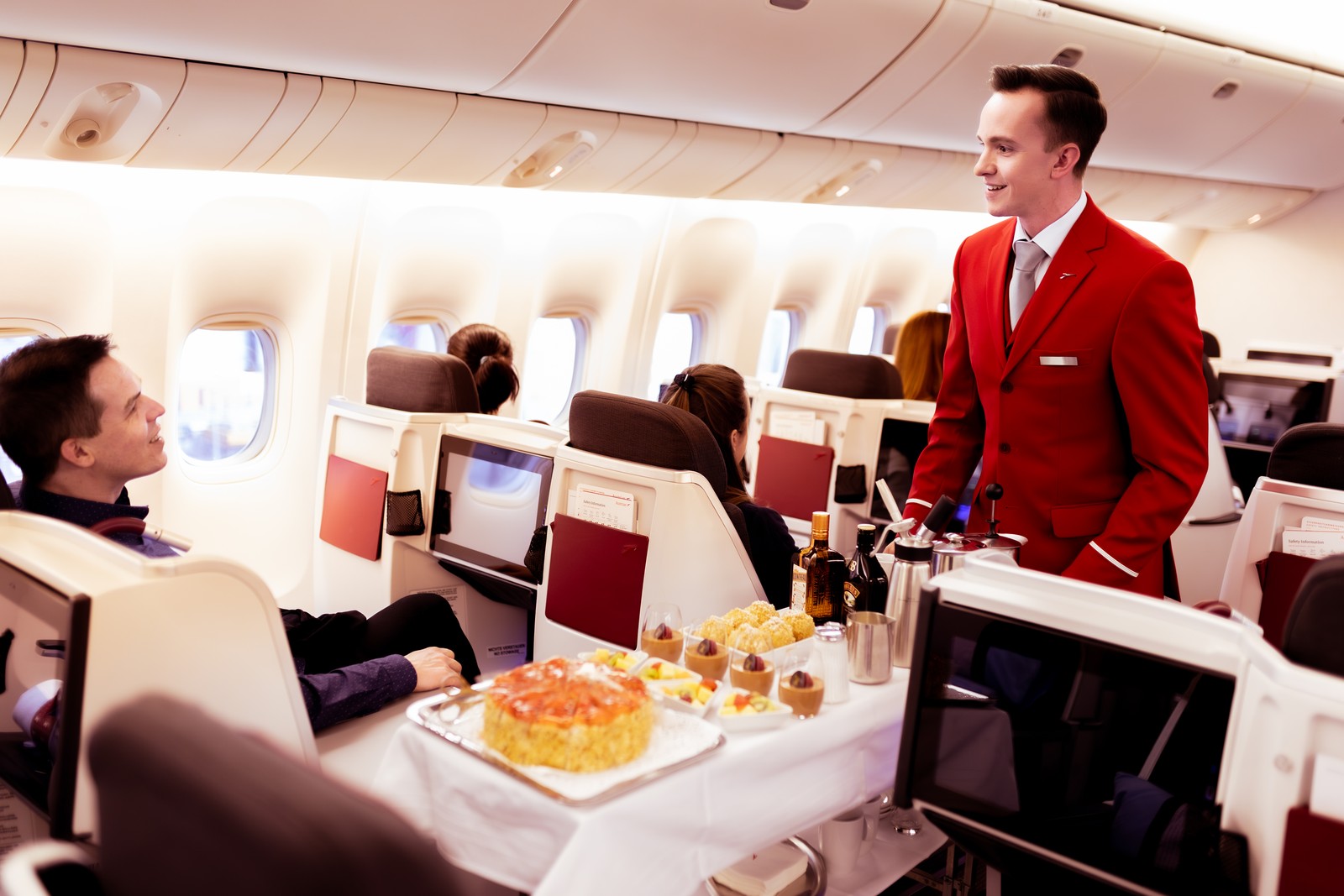
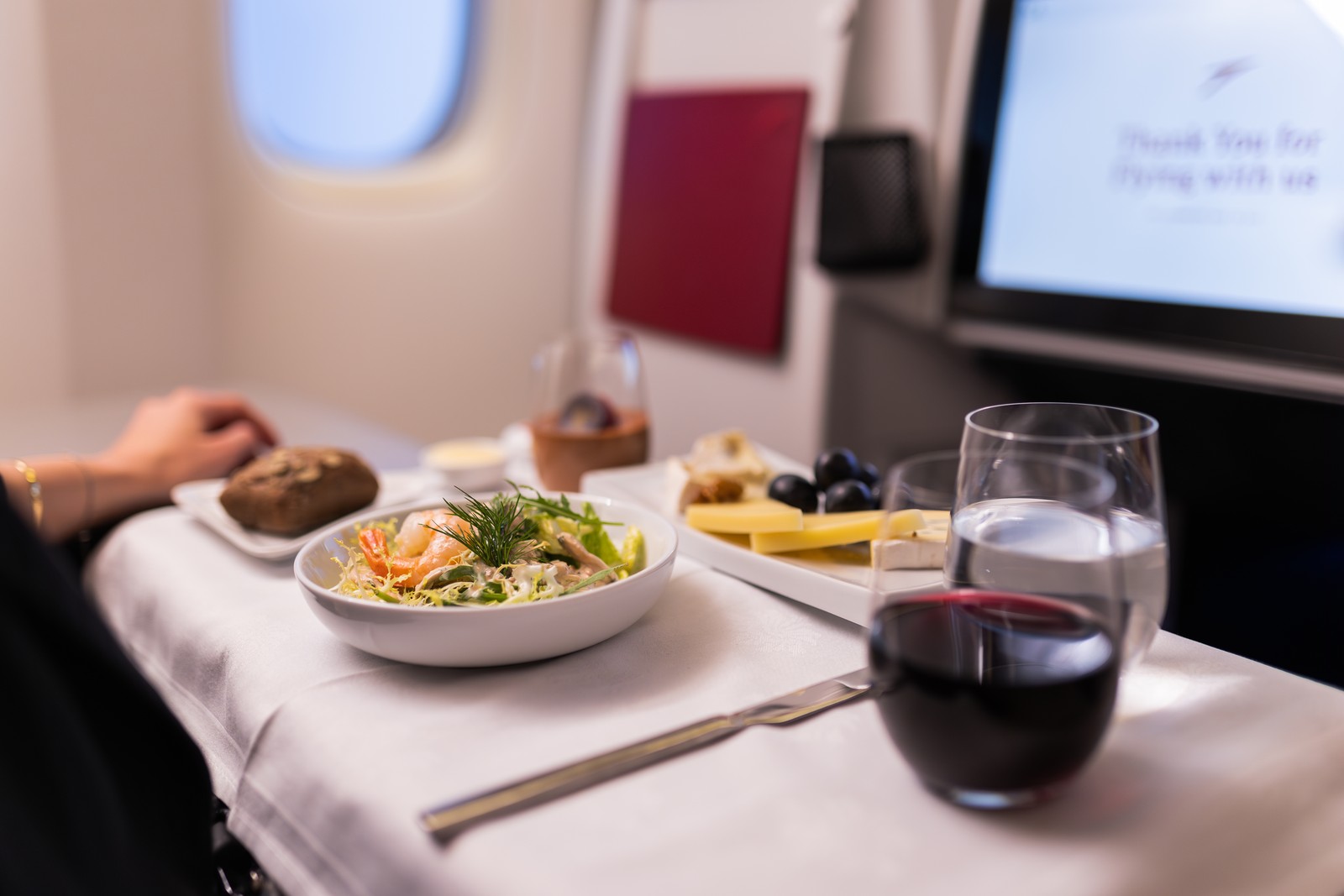
DO & CO catering ensures meals are freshly prepared and plated on board, offering Austrian specialties like Wiener Schnitzel with genuine confidence.
The airline partners with DO & CO — the Viennese catering group that also handles Formula 1 hospitality and Wimbledon dining — and the results are evident from the first course. Meals are freshly prepared and plated on board, not reheated in a foil tray. The multi-course service runs through appetizers, a choice of mains, a cheese course, and dessert, with Austrian specialties anchoring the menu: Wiener Schnitzel, Tafelspitz slow-boiled beef, and Apfelstrudel served with genuine confidence rather than as novelty items.
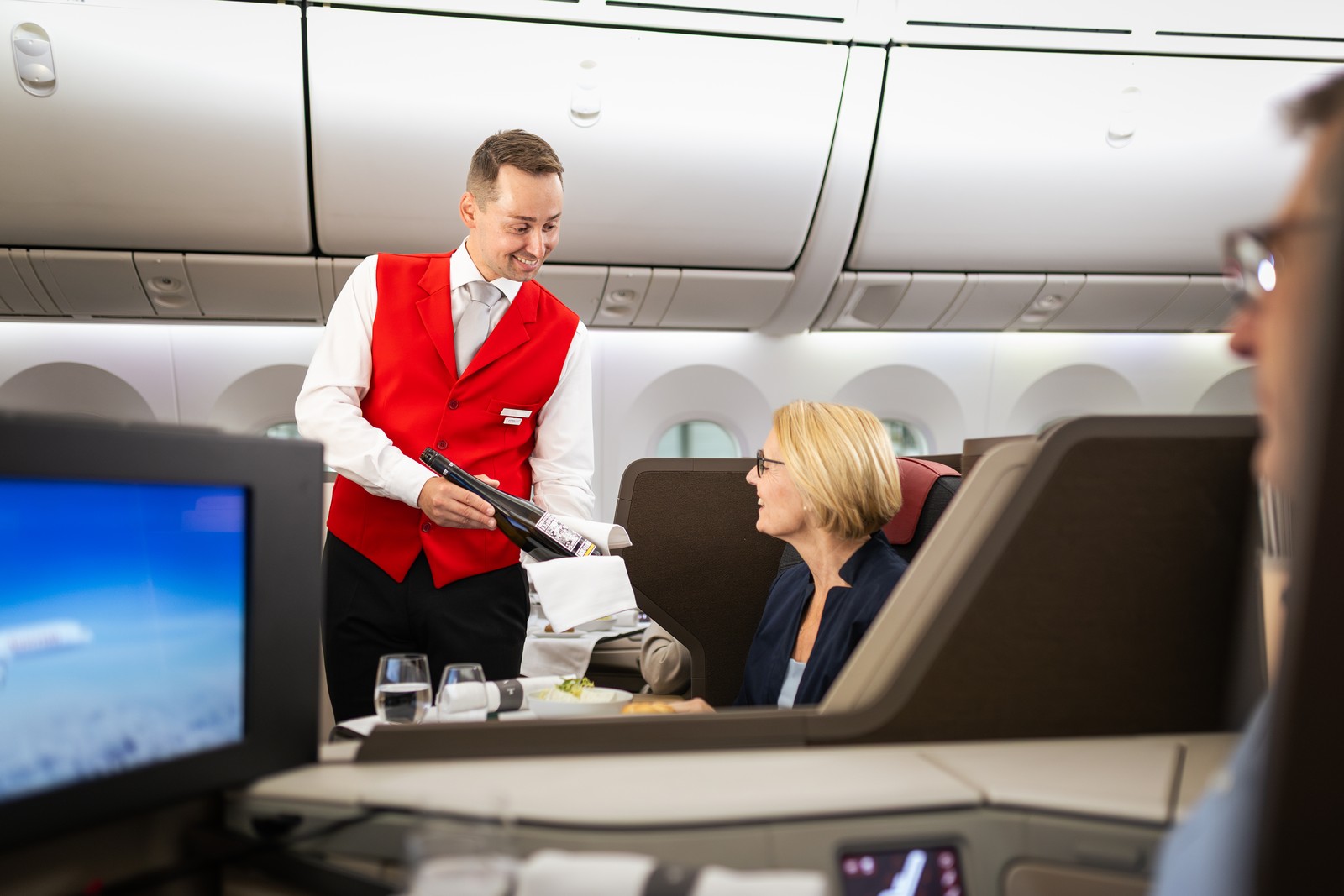
The thoughtfully curated wine list features Austrian standouts like Grüner Veltliner, which pair exceptionally well with the robust main courses.
The wine list draws from Austrian and broader European producers — look for Grüner Veltliner and Blaufränkisch among the Austrian selections, which pair exceptionally well with the heavier main courses. The sommelier-selected pairings listed in the menu aren't marketing copy; they're actually thought through.
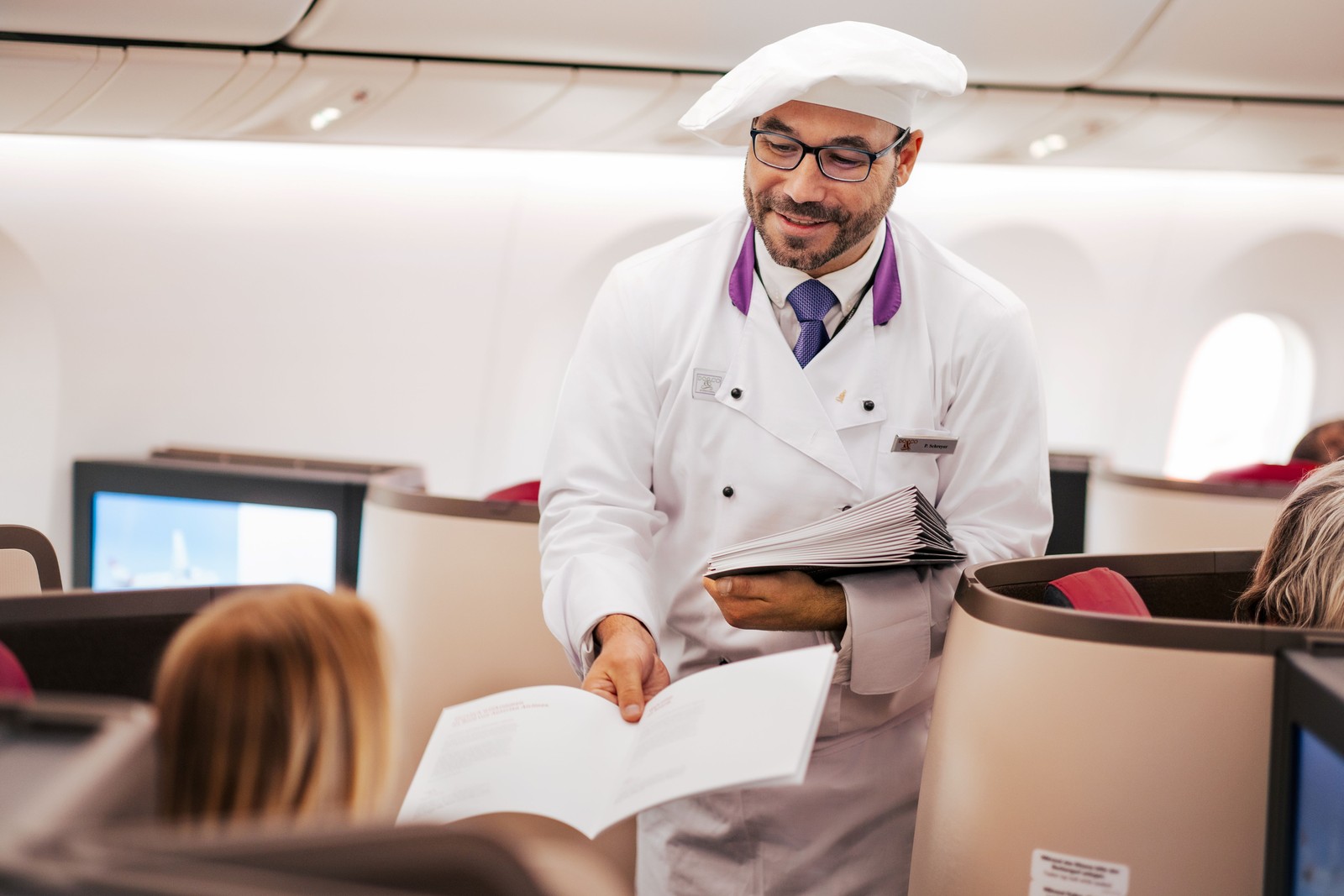
The Flying Chef manages on-board service like a proper restaurant, ensuring dishes are plated perfectly rather than sitting under a heat lamp.
Then there's the Flying Chef — present on most long-haul routes — who manages on-board preparation and service with the attention of someone running a restaurant. Dishes arrive with proper plating. Sauces haven't been sitting under a lamp for 40 minutes. The difference between Austrian's catering and that of most North American carriers is not subtle.
The coffee program deserves its own mention. Vienna's coffeehouse culture is one of the city's defining institutions, and Austrian brings it on board: Melange, Einspänner, and other specialty brews prepared to order. It's the kind of thing you notice on the first flight and specifically look forward to on every subsequent one.
Amenity kits and sleep comfort
The amenity kits are functional and well-assembled — skincare products, socks, eyeshade, earplugs — in a reusable pouch with Austrian's characteristic restrained design. No excessive branding, no products you'll throw away. Standard long-haul bedding includes a soft blanket and full-size pillow; overnight routes add a mattress topper option.
Sleep quality on the 787 is noticeably better than on the older jets, full stop. Lower cabin altitude, higher humidity, and a quieter airframe all contribute. On a VIE–BKK service — roughly 9.5 hours — arriving without that familiar long-haul fog is worth paying attention to when choosing your equipment.
Airport experience and lounges
Austrian Business Class passengers get priority check-in, dedicated security lanes at VIE, and early boarding. At Vienna International Airport, the Austrian Business Lounge sits in the Schengen area for European connections and in the non-Schengen zone for long-haul departures.
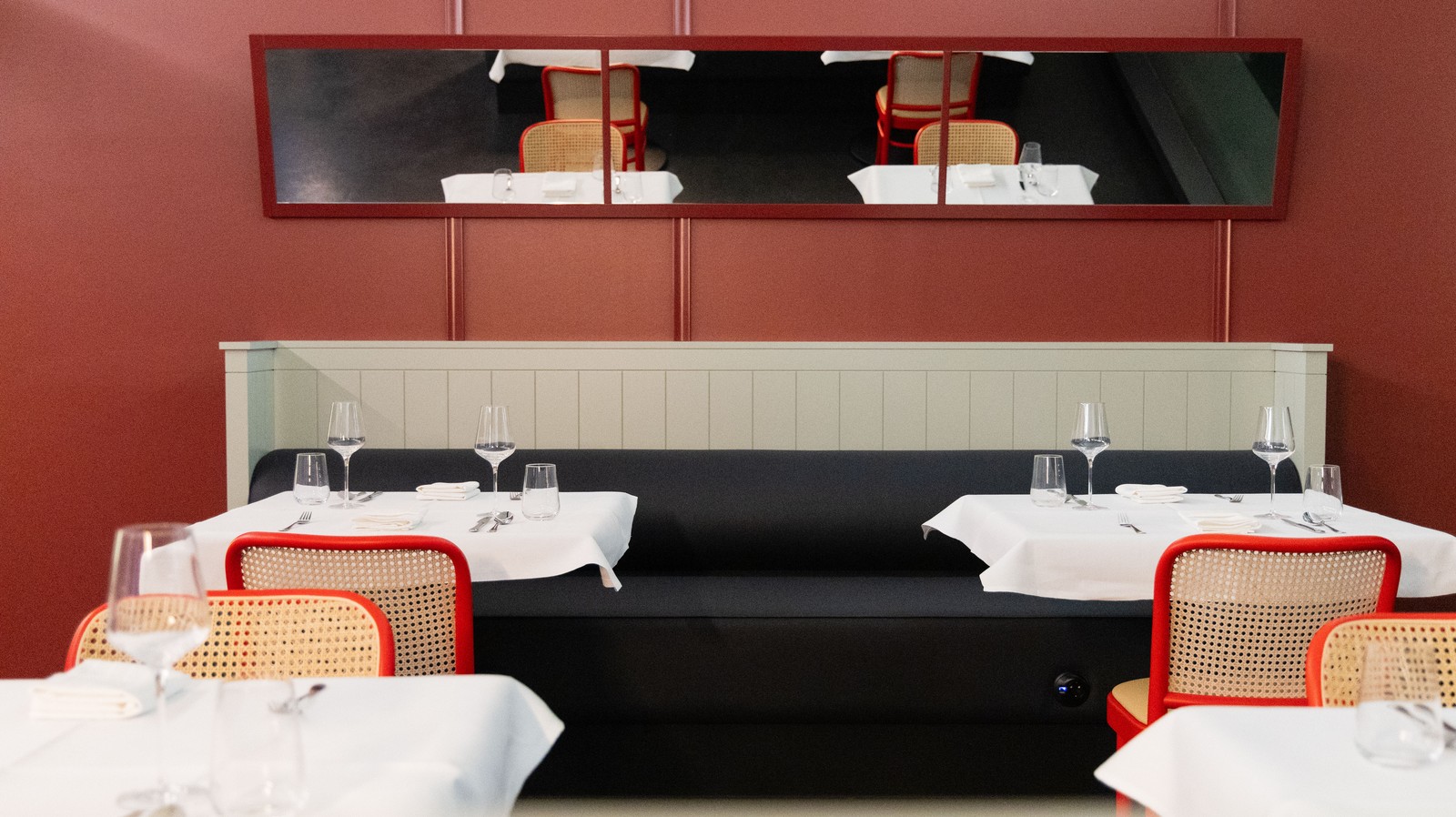
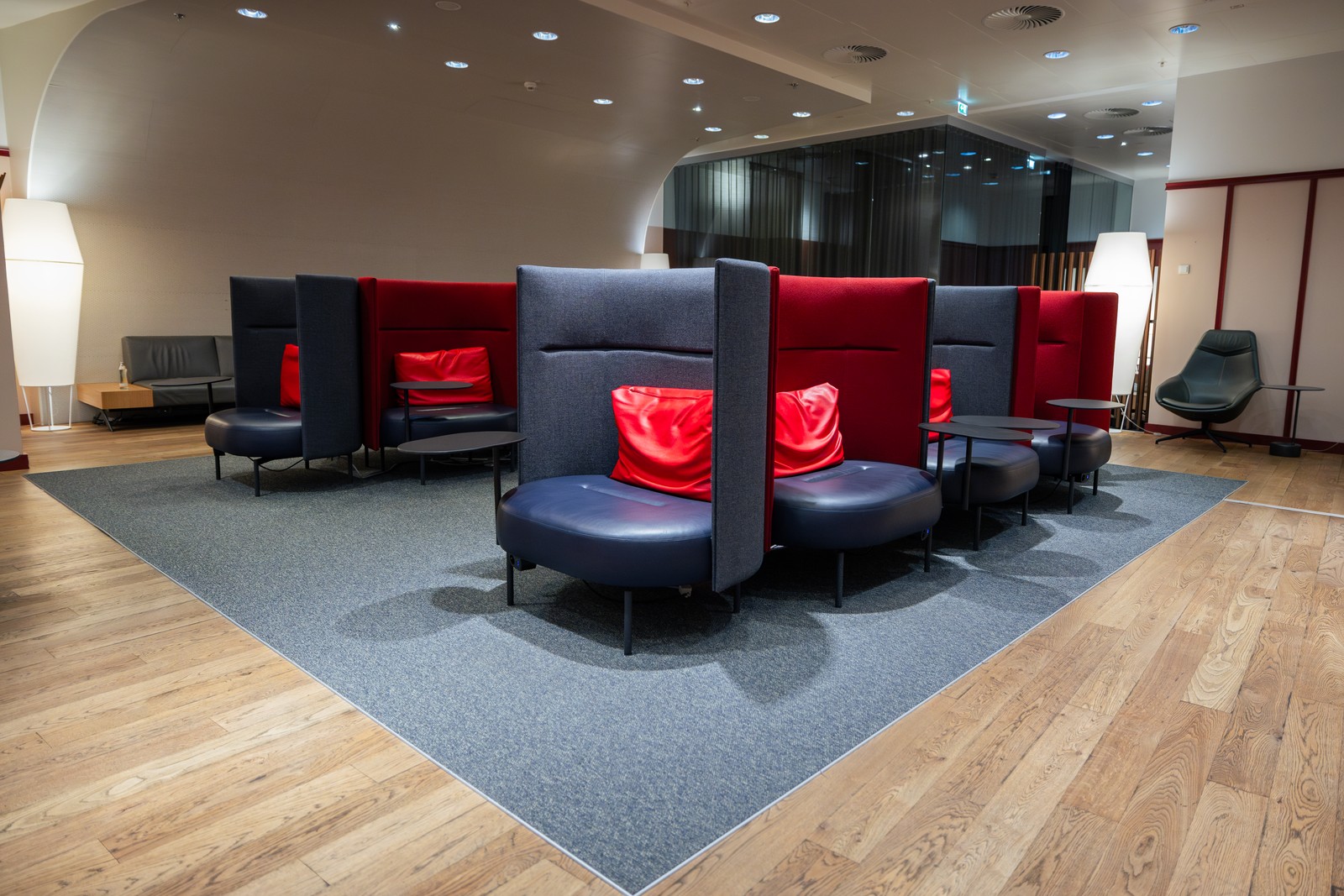
The Austrian Business Lounge in Vienna mirrors the onboard aesthetic with warm lighting, quiet work areas, and freshly prepared dishes.
The lounge offers freshly prepared Austrian dishes — not just a buffet of packaged food — alongside a self-service bar, quiet work areas, and seating that doesn't feel like a waiting room. The design mirrors the onboard aesthetic: warm lighting, clean lines, nothing shouting for attention.
Instead of feeling like a waiting room, the lounge provides comfortable seating zones and a food program that easily surpasses typical packaged buffets.
For connecting flights through Star Alliance partners, Austrian provides access to partner lounges across the network, maintaining consistent pre-flight standards globally.
How to book Austrian Airlines business class without overpaying
Retail fares on Austrian business class from the US East Coast to Vienna or beyond regularly run $7,000–$10,000 round-trip at published rates. Through CEOFLIGHTS' airline contracts, those same itineraries frequently price at $3,200–$4,800 — sometimes lower on routes with competitive inventory, like VIE–JFK or VIE–NRT.
CEOFLIGHTS is ASTA-accredited (member #900292735) and top rated on Trustpilot. We work with consolidator fares and unpublished inventory that don't appear on any OTA or airline website. Our advisors know the Austrian fleet schedule, which routes are getting 787 service first, and how to position connections through VIE for maximum lounge time.
Call (888) 851-6897 to talk through options. Austrian's business class is a genuinely strong product — particularly on the 787 — and at consolidator pricing, it becomes one of the better-value transatlantic and Asian business class buys available right now.
Content creator and business travel specialist at CEOFLIGHTS, bringing you the latest insights, tips, and trends in premium business and first-class travel.
Become the CEO of Your Journey
You take the lead. Your dedicated Personal Travel Manager handles every detail.