Quick summary
Air France's new 777-300ER business class delivers a genuinely private suite with its sliding door and 2-meter flat bed. While retail fares can reach $8,500, consolidator pricing drops this to the $2,800 range, making it a highly recommended upgrade for frequent Paris-New York flyers.
Air France has never lacked ambition when it comes to cabin design. The French national carrier has produced some genuinely beautiful interiors over the years — and some genuinely frustrating ones. The old business class product on the Boeing 777-300ER fell squarely into the second category: angled-flat seats in a 2-2-2 configuration that felt dated the moment Qatar Airways introduced QSuite in 2017. Frequent flyers on the CDG–JFK route knew to book alternatives whenever possible.
That changes with the new cabin.
Air France has committed to retrofitting 12 of its Boeing 777-300ERs with a completely redesigned business class, launching initially on Paris Charles de Gaulle to New York JFK — a route with serious historical weight, given Concorde once flew it in under three and a half hours. The new product won't get you there faster. But it will, finally, get you there in a seat worth the fare.
Here's a detailed look at what Air France is delivering, where it genuinely competes with the best in class, and where it still has ground to close.
The 3F concept: what it actually means on a 777
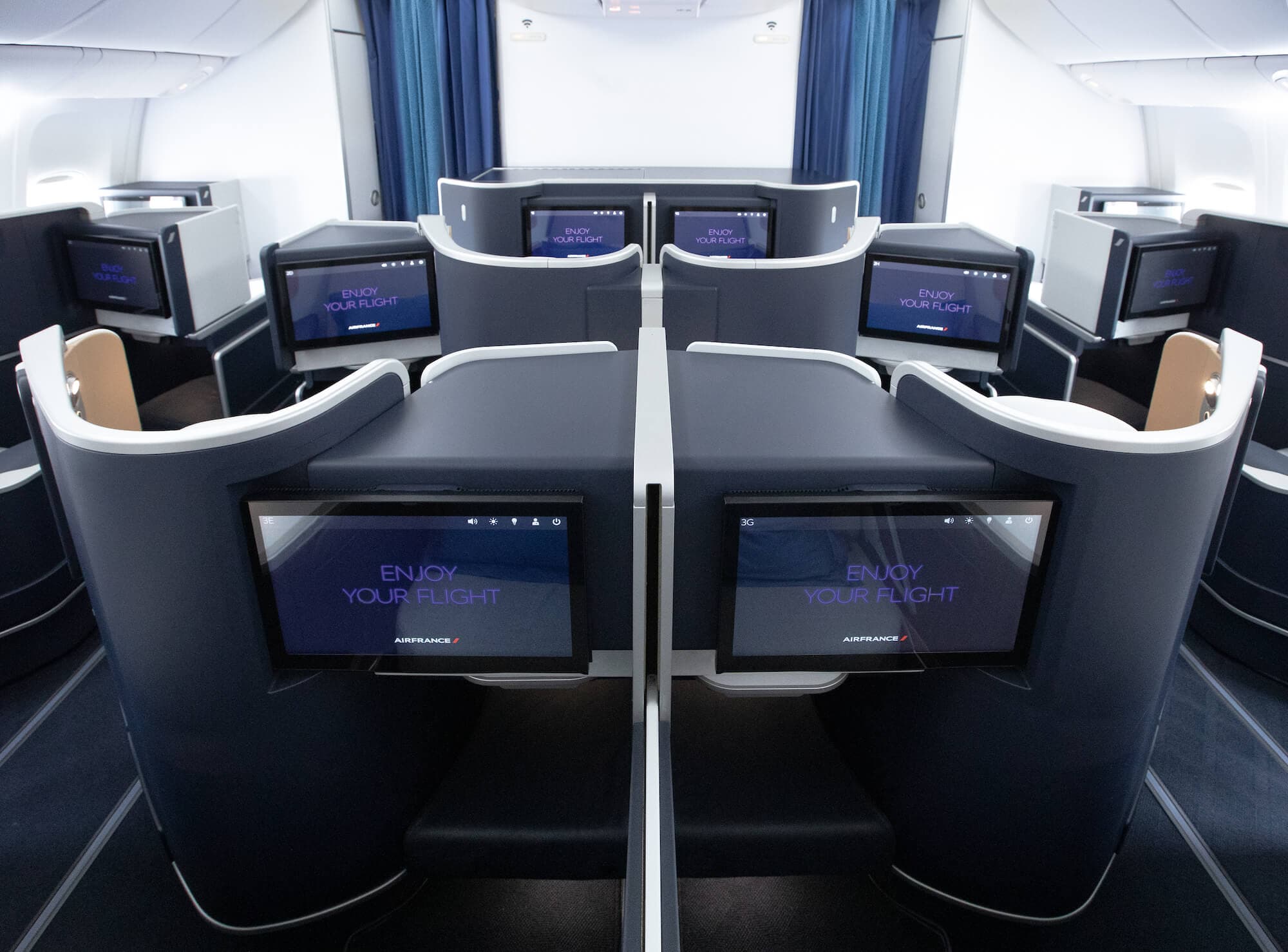
Air France built the new cabin around a framework it calls 3F: Full Flat, Full Access, Full Privacy. Marketing language, yes — but in this case, the hardware backs it up.
Full Flat means what it says. The seat converts to a bed measuring 2 meters (6'5") long and 70 centimeters (2'3") wide in a single motion. That width is meaningful. British Airways' Club Suite bed runs narrower, and on overnight transatlantic flights, the difference between a 70cm and a 58cm sleeping surface is the difference between waking rested and arriving at JFK stiff-necked for a 9am board meeting.
Full Access means every passenger gets direct aisle access. No more middle-seat passengers climbing over their neighbors at 2am. The cabin is configured in a 1-2-1 layout, with the center pairs designed for both solo travelers and companions.
Full Privacy comes from a sliding door — a real door, not a privacy screen — that seals the seat into something genuinely resembling a private suite. It's not Qatar QSuite territory (nothing is, yet), but it's a credible competitor to the Club Suite on British Airways or the Polaris suite on United's retrofitted 777s.
Seat specs that matter
Spec sheets are easy to publish. What separates a good seat from a great one is the engineering behind the numbers.
The ergonomic foam used in the new Air France seat has been developed specifically for this cabin, with lumbar support that adjusts automatically as the seat transitions between upright, recline, and flat positions. That sounds like a minor detail until you've spent eight hours in a seat whose lumbar support becomes a liability the moment you recline past 45 degrees.
A few other details worth noting:
- The 17.3-inch 4K screen is among the largest in any current business class product — Singapore Airlines' new Business Class on the A350 uses a 18-inch screen, but Air France's 4K resolution gives it a genuine edge in image quality
- Noise-reducing headphones are included in the seat, not handed out in a bag
- Bluetooth connectivity is built into the IFE system, meaning you can pair your own AirPods or Sony WH-1000XM5s without an adapter
- Each seat has USB-A, USB-C, a standard AC power outlet, and a Qi wireless charging pad — the full complement, not a partial solution
- Lighting adjusts automatically based on seat position but remains fully manual-overrideable
The entertainment library runs to over 350 movies plus music and podcasts, which is adequate rather than exceptional. Emirates' ICE system on the 777 still sets the benchmark for sheer volume of content. Air France's curation is sharper, though — fewer filler titles.
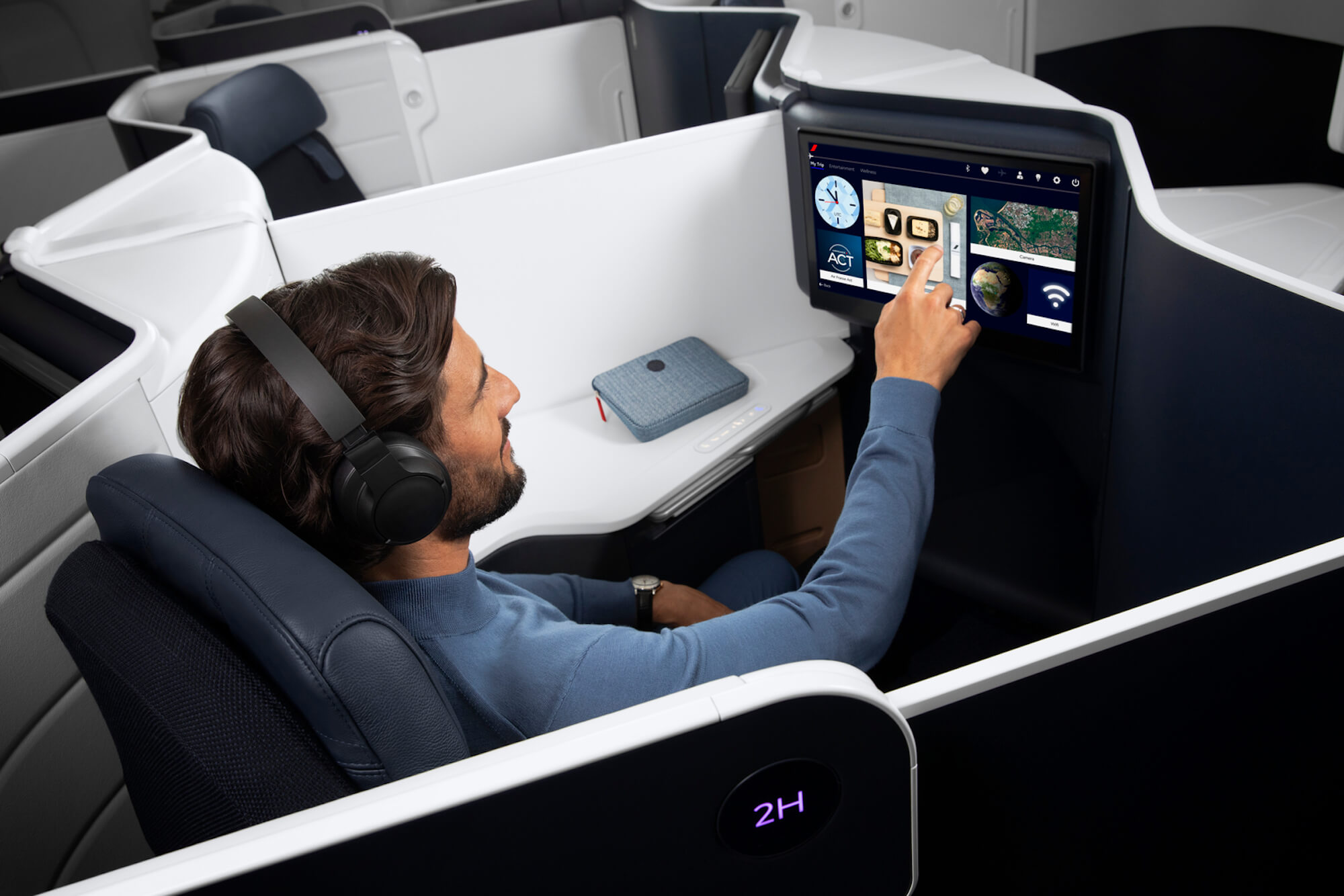
Privacy: genuinely useful, not just a marketing photo
The sliding door on the window seats is the product's standout feature for solo travelers, and it works exactly as advertised. Close it, hit the "Do Not Disturb" button on the seat's control panel, and the crew won't bother you until you're ready. That's a meaningful quality-of-life upgrade on a nine-hour overnight.
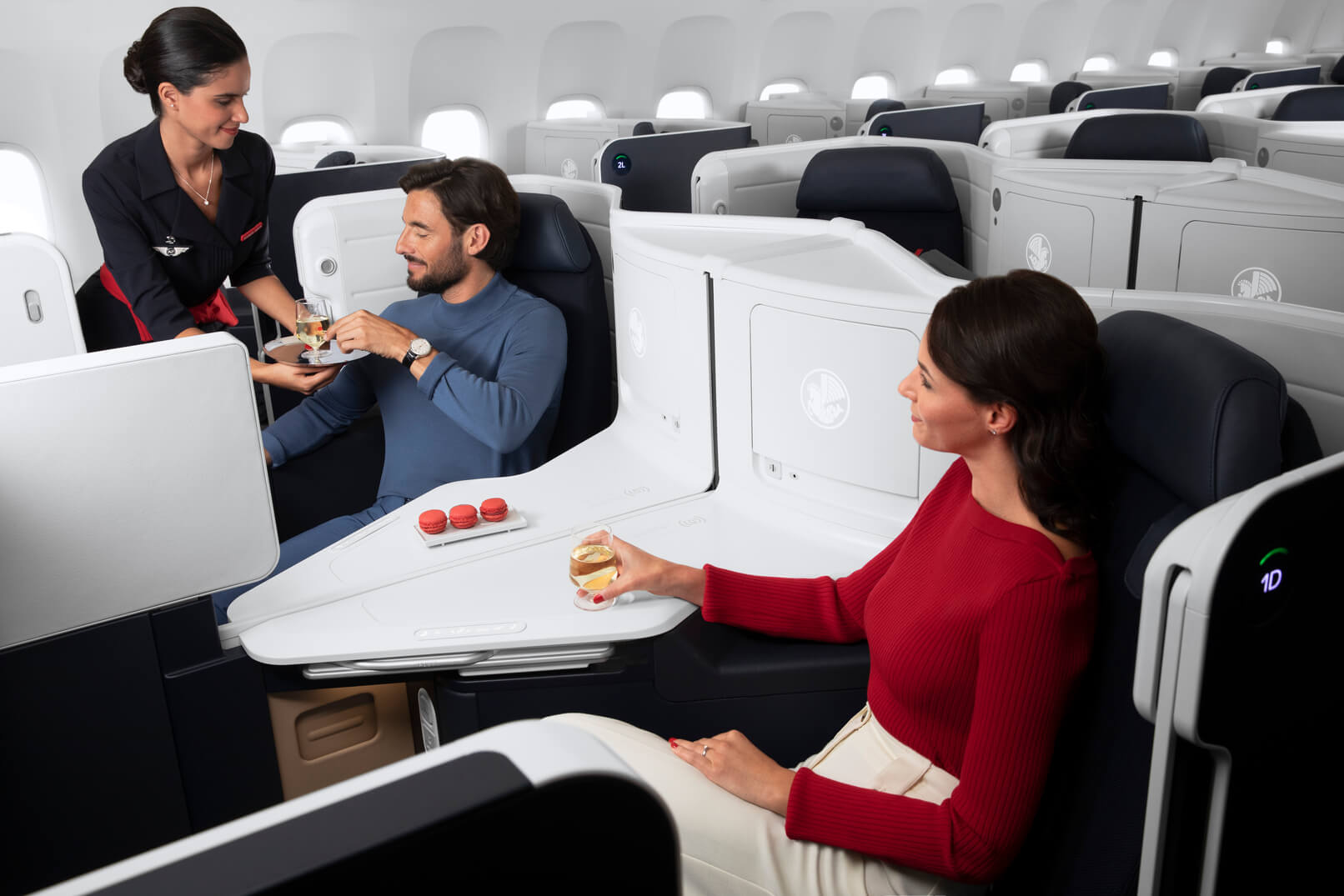
For couples or colleagues traveling together, the center pairs have a collapsible dividing wall between them. Lower it completely and you get a shared cocktail table wide enough to work across together — useful for CFOs who want to review a deck before landing, or anyone who simply wants to share a meal without the awkward seatback-tray choreography that defines most side-by-side business class arrangements.
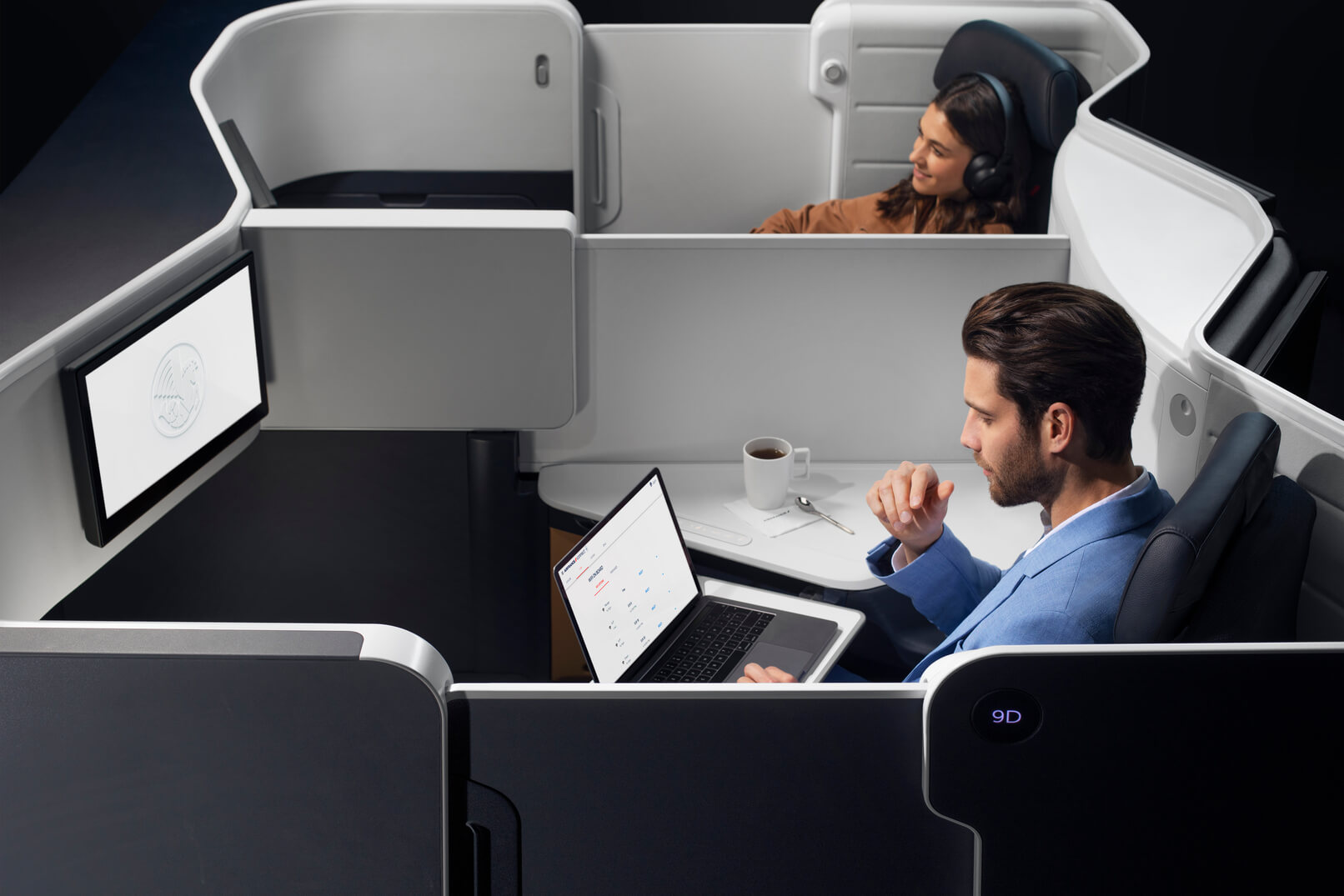
The design philosophy here is worth acknowledging: Air France is one of the few carriers that has genuinely thought about the social dimension of long-haul business travel. Most cabins optimize for privacy at the expense of conviviality, or vice versa. This one gives passengers real control over both, and the execution is more elegant than the spec sheet suggests.
How it compares to the competition on this route
Paris–New York is one of the most competitive business class routes in the world. Air France's direct competition on CDG–JFK includes its own SkyTeam partner Delta (with its well-regarded Delta One Suites on the A350), as well as American Airlines' Flagship Suite product, which launched on select JFK routes in 2022.
The honest comparison:
Against Delta One Suites (A350): Delta's suite is slightly wider at the shoulder but uses a herringbone layout that some passengers find claustrophobic. Air France's new product has a more open feel, and the sliding door is more substantial than Delta's privacy panel. Call it a draw, with Air France winning on aesthetics.
Against American Flagship Suite: American's product on the 777-300ER is a strong competitor with a similar door-equipped layout. The seat dimensions are comparable. Air France edges ahead on in-flight dining — the catering on Air France's transatlantic routes, developed with chefs from the broader culinary world, is still a cut above what American serves in first, let alone business.
Against British Airways Club Suite (747 or A350): The Club Suite and Air France's new cabin are genuinely close. BA's product has been in service longer and the crew familiarity with the seat shows. Air France's 4K screen is better than the Club Suite's 18.5-inch HD display. Seat width is roughly comparable at 70–73cm. This one comes down to personal preference and route scheduling.
Against Qatar QSuite: QSuite remains the category leader. The double-bed configuration, the superior catering, the Doha transit experience — Air France isn't there yet. But CDG–JFK is a direct route, and for travelers who want to skip a Doha layover, Air France's new product is now a reasonable alternative rather than an obvious downgrade.
Connectivity: no excuses at 35,000 feet
Air France CONNECT offers Wi-Fi passes across multiple tiers. For business travelers, the full-flight browsing option is what matters, and it's priced reasonably compared to what Lufthansa or BA charge for equivalent connectivity on transatlantic routes.
The built-in Bluetooth pairing, combined with USB-C fast charging and the Qi wireless pad, means the seat genuinely supports a full working setup without adapter fumbling. If you're the type who travels with a laptop, a phone, AirPods, and a smartwatch — all of which need charging — this seat handles all of it simultaneously.
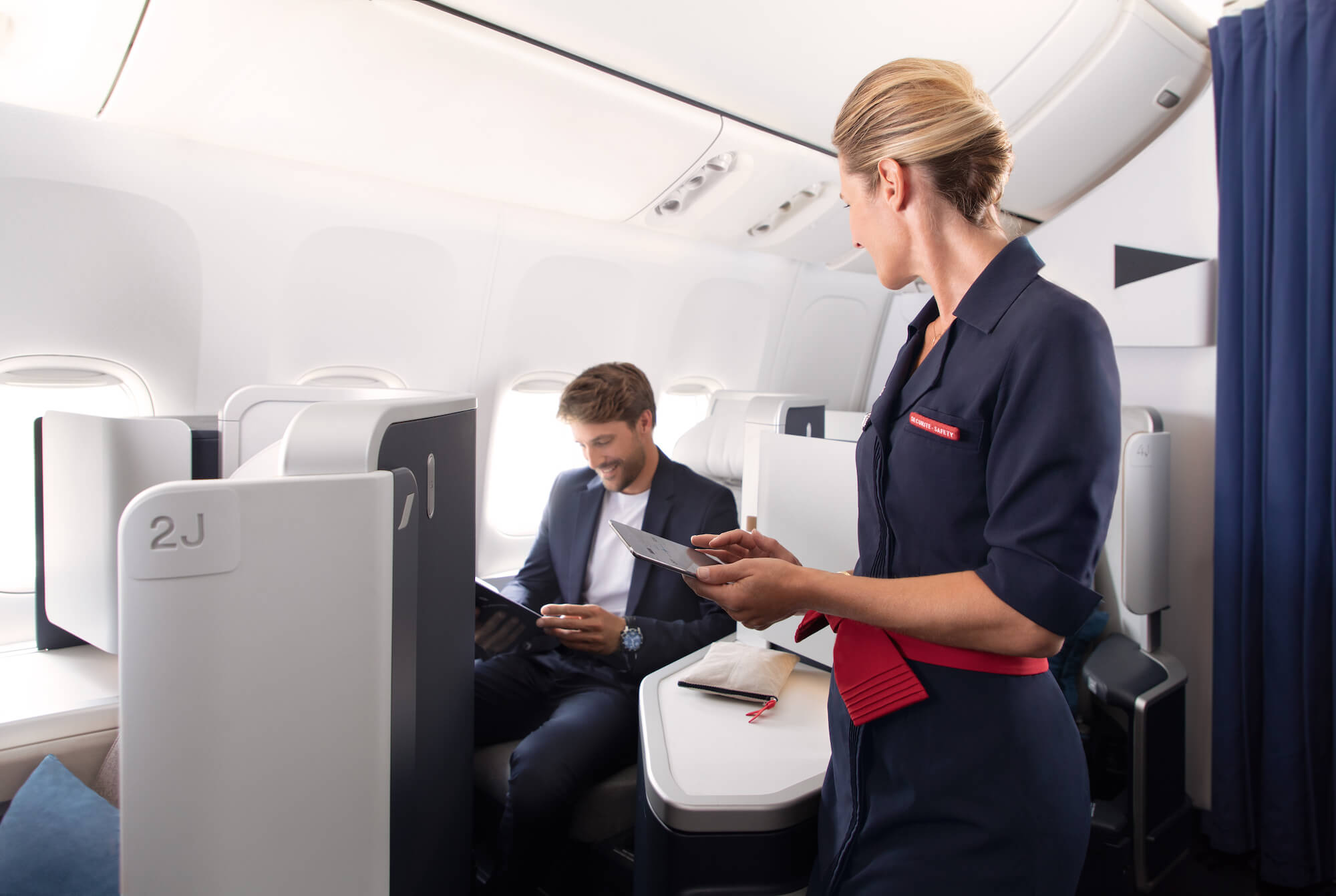
The wider cabin reconfiguration
Beyond business class, the 777-300ER retrofit changes the entire aircraft. Air France is reconfiguring the cabin to include 48 premium economy seats at 96cm (37.8 inches) of pitch — the same specification as the A350's premium economy product. That's a significant upgrade from the current 777's 24 premium economy seats.
Economy class drops from 315 to 273 seats, with pitch increasing to 79cm (31.1 inches). Fewer seats, more space — a trade that makes the overall aircraft experience better for every cabin. The math works because premium economy revenue per seat justifies the configuration change.
The 12 aircraft receiving this retrofit represent the bulk of Air France's 777-300ER long-haul capacity. Expect the new product to roll out progressively through 2023 and into 2024 on routes beyond Paris–New York, including CDG–LAX, CDG–MIA, and CDG–IAD.
What you'll pay — and what you should pay
Retail fares on CDG–JFK in Air France business class typically run between $4,800 and $8,500 round-trip depending on season and booking window. January is cheapest. June and September command a premium. Holiday windows — Thanksgiving, Christmas, February school break — are routinely above $7,000.
Through our airline contracts at CEOFLIGHTS, fares on this route regularly drop into the $2,800–$4,200 range round-trip, depending on dates and availability. That's not a stripped-down fare with no changes — it's the same fully refundable or changeable ticket at a fraction of the published price. On a $6,000 retail fare, the savings alone cover your hotel for two nights in Paris.
We're ASTA-accredited (member #900292735) and top rated on Trustpilot, which matters when you're putting a four-figure fare on a card and trusting someone to get the booking right.
Who this cabin is actually for
Executives who fly Paris–New York three or four times a year will find this product genuinely changes the trip. The bed is long enough for anyone under 6'5". The door eliminates the ambient anxiety of being observed sleeping. The charging setup supports a full working session before landing.
Solo travelers get a clean, private cocoon. Traveling pairs get a genuinely usable shared space. The seat does both well, which is rarer than it should be.
The IFE and entertainment are solid without being exceptional. The catering, if Air France maintains its historical standard on this route, will be the product's other strong suit — and that's something no spec sheet covers.
Book with someone who flies this route
The new product starts boarding in fall 2023, with Paris–New York as the launch route. If you're targeting the first few months of operation, availability in the new cabin will be tight — airlines historically protect those seats for high-status members and premium fares.
That's exactly when it helps to have a consolidator with airline relationships rather than a search engine. Call (888) 851-6897 and ask about availability on the new 777-300ER product specifically. We can confirm which aircraft is operating your date — because Air France will be running a mixed fleet during the retrofit period, and booking the wrong flight means ending up in the old seat.
The gap between Air France's old business class and the new one is substantial. This is a product worth seeking out.