Your Rights When Business Class Flights Are Canceled or Delayed
A $9,400 Emirates First Class ticket and a $220 economy fare get exactly the same DOT refund protection, but wildly different treatment everywhere else. Here's what you're actually owed.
CEOFLIGHTS Team15 min read
Quick summary
U.S. DOT rules require an automatic full cash refund—within 7 business days for credit card purchases—if your flight is canceled or delayed 3+ hours domestic (6+ hours international) and you decline the rebooking.
EU261/UK261 compensation for a canceled or heavily delayed long-haul flight tops out at €600 (£520) per passenger, paid in cash on top of your duty-of-care or ticket refund regardless of fare paid.
If an airline involuntarily downgrades you from Business Class to Economy, EU261 Article 10 entitles you to a 75% fare reimbursement on long-haul flights over 3,500 km (50% on 1,500–3,500 km routes, and 30% under 1,500 km).
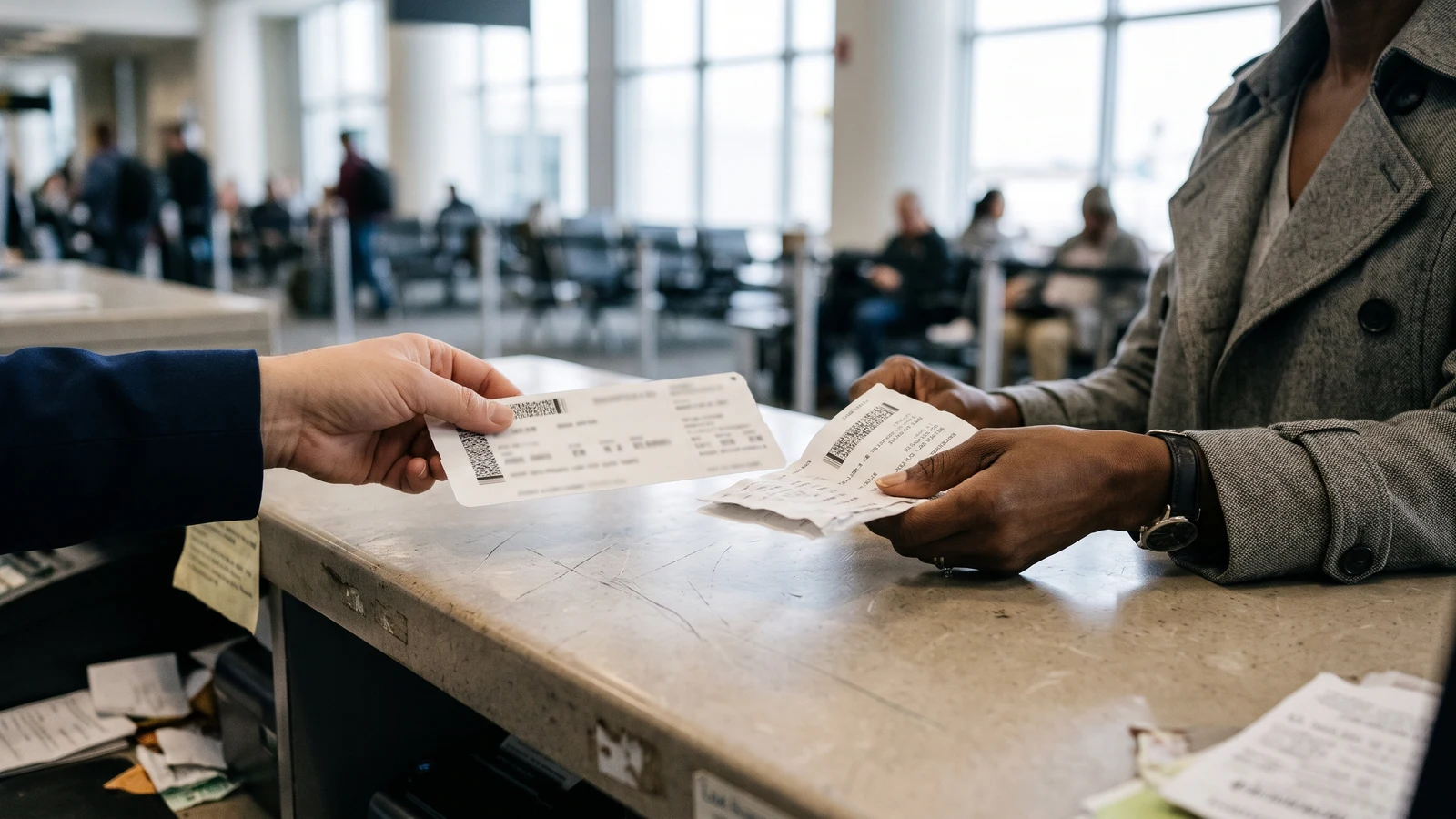
A $14,000 Etihad Residence ticket and a $340 basic economy fare are entitled to precisely the same refund under U.S. federal law. That's not a typo. It's also not something most business class flyers realize until they're standing at a rebooking counter in Frankfurt, watching a gate agent offer them a food voucher for a canceled flight that just cost them a board meeting in New York.
The airline industry spends a fortune making premium cabins feel exclusive. Lounge access, priority boarding, the works. But when things go wrong, the rulebook doesn't care what cabin you were sitting in. It cares about three things: where you were flying, what caused the disruption, and whether you accepted a replacement flight. Get those three variables right and you can walk away with real money. Get them wrong and you'll spend months arguing with a chatbot.
This is the guide we wish someone had handed us before our first six-figure annual travel budget got tangled up in a canceled Lufthansa First flight out of Munich. Let's get into it.
The DOT Rules Every Business Class Flyer Should Memorize
Under U.S. Department of Transportation policy, you're owed a full cash refund for the unflown portion of your ticket if your flight is canceled or "significantly" delayed and you choose not to travel. This applies to domestic flights and any international flight departing from or arriving in the United States. It doesn't matter whether the airline caused the disruption or a blizzard in Denver did. Weather, mechanical failure, crew scheduling, a government shutdown grounding air traffic controllers: none of it matters. If you don't fly, you get your money back.
There's a catch, and it's the one that trips up almost everyone. The refund only kicks in if you decline the rebooking. If your 7:45 a.m. flight out of JFK gets canceled and the airline slots you onto a 6:30 p.m. flight the same day, and you take it, you are not owed a refund. You flew. The ticket did what it was supposed to do, just twelve hours later than promised. Annoying, yes. Refundable, no.
Take the rebooked flight and you have flown. Decline it after a cancellation or significant delay and the DOT says your refund is automatic: 7 business days on a credit card.
7Business days for automatic credit card refunds under U.S. DOT rules
Under the U.S. DOT automatic refund rule and the 2024 FAA Reauthorization Act, airlines cannot drag their feet anymore. Refunds must be automatic when you reject a rebooked itinerary after a cancellation or significant change, and prompt: seven business days if you paid by credit card, twenty calendar days for any other payment method. If you're still chasing an airline for a refund forty-five days after a canceled flight, that's a federal violation you can report directly to the DOT's Aviation Consumer Protection portal, not a negotiation.
What Actually Counts as "Significant"
The word "significant" used to be doing a lot of vague, unhelpful work in airline policy. Federal rules now set bright-line thresholds: a domestic flight departing three hours or more early or arriving three hours or more behind schedule counts as significantly delayed or changed. For international flights, the threshold is six hours. Cross that line, decline to travel on the altered flight, and you are legally entitled to a full cash refund to your original form of payment.
Schedule changes count too, as does an involuntary downgrade to a lower cabin class or a routing change that adds a connection or swaps your arrival airport (say, EWR instead of JFK).
The Voucher Trap: When "Compensation" Isn't Compensation
Here's where airlines make their money back. You're owed a refund, and instead of processing it, the gate agent or the app offers you a travel voucher, or a pile of miles, framed as if it's the only option on the table. It isn't. Under DOT rules, if an airline offers a voucher or miles as an alternative to a cash refund, it must clearly disclose your right to a full cash refund first. (The rule's five-year minimum validity for travel credits applies only to passengers who can't fly because of a serious communicable disease or a government travel restriction, not to ordinary cancellations.)
A meal voucher is not a refund. If an airline offers vouchers or miles in place of cash, DOT rules say it must first tell you that you have the right to a full cash refund.
Should you ever take the miles anyway? Sometimes, but do the math first. If you're staring down a $6,200 business class refund and the airline offers 60,000 miles, don't just nod along. Depending on the program, that batch of miles might be worth $700 to $1,000 in realistic redemption value, a fraction of the cash you're giving up.
Insider Strategy
Airlines devalue miles on their own schedule, not yours. If you do accept miles as a customer-service gesture after a delay you still flew, burn them within 90 days. Waiting a year to "find the right trip" is how a 110,000-mile business class award quietly becomes a 210,000-mile dynamic award.
And don't expect hotel or meal vouchers as a statutory right in the U.S. Those are voluntary commitments airlines publish on the DOT's Customer Service Dashboard, and U.S. carriers only honor them when the disruption is "controllable" (mechanical issue, crew scheduling, baggage loading). A thunderstorm or an FAA ground stop leaves you on your own for the airport hotel. Don't count on that changing: in November 2025 the DOT formally withdrew the proposed rule that would have required cash compensation for long controllable delays (as of November 2026, only the refund rule is in force). That's why paying with a travel card that carries Trip Delay Reimbursement (up to $500 per covered traveler after a 6-hour or overnight delay on cards such as the Chase Sapphire Reserve) is essential on U.S. itineraries.
EU261 (and UK261): The Regime That Actually Pays Cash
If DOT rules are a floor, EU Regulation 261/2004 (and its post-Brexit British twin, UK261) is a genuinely useful ceiling, and it's the reason we tell clients flying business class through European hubs to keep their boarding passes and delay confirmations.
EU261 applies to any flight departing an EU/EEA/Swiss airport (regardless of whether the airline is European, American, or Middle Eastern) and any flight landing in the EU on an EU-based carrier (UK261 applies the same logic to UK airports and UK carriers like British Airways and Virgin Atlantic). If your flight is canceled with less than 14 days' notice, or reaches its final destination three or more hours late, and the cause wasn't an extraordinary circumstance outside the airline's control, you're entitled to fixed cash compensation:
€250 (£220) for flights of 1,500 km or less
€400 (£350) for intra-EU flights over 1,500 km and all other flights between 1,500 km and 3,500 km
€600 (£520) for flights over 3,500 km (all transatlantic and long-haul flights), reduced by half to €300 (£260) if you arrive between three and four hours late
The EU adopted a reform of these rules in July 2026 (Parliament on July 7, Council on July 13). It keeps the three-hour threshold and the €250/€400/€600 amounts, adds a nine-month claim window and a non-exhaustive list of extraordinary circumstances, and is expected to apply from mid-2027. Until then, Regulation 261/2004 as written still governs.
Even when weather or ATC strikes exempt the airline from paying the €600 compensation, EU261's Article 9 "Duty of Care" still applies unconditionally: the airline must provide hotel accommodation, transfers to and from the hotel, and meals/refreshments until your rebooked flight departs—even during a snowstorm or air traffic control strike.
When weather or an ATC strike excuses the airline from paying compensation, EU261's Article 9 duty of care still applies: a hotel, transfers and meals until your new flight leaves.
Where EU261 hits hardest
Airlines routinely deny EU261 claims by citing "unexpected technical issues." The European Court of Justice (in Wallentin-Hermann v Alitalia and van der Lans v KLM) ruled that routine mechanical faults and component failures are inherent to running an airline and do not qualify as extraordinary circumstances. Push back citing ECJ precedent if your claim is rejected on mechanical grounds.
The Downgrade Refund: When Business Class Becomes Economy
This is the scenario that infuriates premium flyers more than any delay ever could. You paid for a lie-flat suite, the aircraft is swapped at the last minute from a 777-300ER to a denser configuration with fewer business seats, and at the gate you're handed a new boarding pass in Premium Economy or Economy.
Under EU261 Article 10 (and UK261), an involuntary downgrade entitles you to a mandatory reimbursement within seven days, calculated as a percentage of the price of the affected flight segment (excluding government taxes and airport fees):
30% reimbursement for flights of 1,500 km or less
50% reimbursement for intra-EU flights over 1,500 km and other flights between 1,500 km and 3,500 km
75% reimbursement for all long-haul flights over 3,500 km
On a long-haul flight over 3,500 km, an involuntary downgrade under EU261 Article 10 means 75% of that segment's fare back, excluding taxes and airport fees.
So on an $8,000 round-trip Business Class ticket between London and New York ($4,000 per direction before taxes), an involuntary downgrade on the LHR–JFK leg entitles you to 75% of that segment's fare ($3,000 in cash), even though you still flew on the aircraft. And under the U.S. DOT automatic refund rule, an involuntary downgrade on any U.S. flight automatically entitles you to a refund of the fare difference without having to fight customer service for months.
Never accept a $500 gesture voucher at the gate for a long-haul downgrade without checking whether it waives your right to the 75% statutory reimbursement or full fare-difference refund.
Montreal Convention: The Treaty Nobody Reads Until Something Breaks
If your business class flight crosses an international border between any of the 140 States Parties, the 1999 Montreal Convention (MC99) governs financial liability—and it operates independently of both DOT and EU261.
Following the International Civil Aviation Organization's (ICAO) inflation review that took effect on December 28, 2024, the Montreal Convention's Special Drawing Rights (SDR) liability caps increased across the board:
Lost, damaged, or delayed baggage (Article 22(2)): Capped at 1,519 SDRs per passenger (roughly $2,000 USD), up from the old 1,288 SDR limit. That cap is identical whether you flew basic economy or First Class.
Provable financial damages from passenger delay (Article 19 & Article 22(1)): Capped at 6,303 SDRs per passenger (roughly $8,500 USD at November 2026 rates), up from the previous 5,346 SDR cap.
Unlike EU261's flat €600 payout, Montreal Convention Article 19 reimburses documented out-of-pocket financial damages caused by an international delay (such as a non-refundable hotel night, a replacement ticket on another carrier when the airline failed to rebook you within a reasonable window, or ground transport) unless the airline proves it took all measures that could reasonably be required to avoid the damage. Keep every itemized receipt.
Montreal Convention Article 19 covers documented delay costs such as a taxi or an extra hotel night, capped at 6,303 SDR, about $8,500. Ask for a receipt every time.
To see how these three regimes stack on a single ticket, take that Air France A350 Business Class flight from JFK to Paris-Charles de Gaulle:
Because it departs the U.S., U.S. DOT rules guarantee an automatic cash refund (within 7 business days on a credit card) if the flight is canceled or delayed 6+ hours and you decline to travel.
Because it is operated by an EU carrier landing in the EU, EU261 entitles you to €600 cash if you do fly and arrive 4+ hours late due to a controllable issue (€300 for a 3–4 hour delay), or 75% segment reimbursement if an aircraft swap downgrades your cabin.
Because it is an international itinerary, the Montreal Convention covers up to 1,519 SDRs (~$2,000) for delayed/damaged baggage and up to 6,303 SDRs (~$8,500) for documented consequential delay expenses.
Consolidator Bookings vs. Direct: Who Actually Fights for You
This is the part of the disruption conversation almost nobody covers, and it matters enormously for anyone booking international Business Class fares.
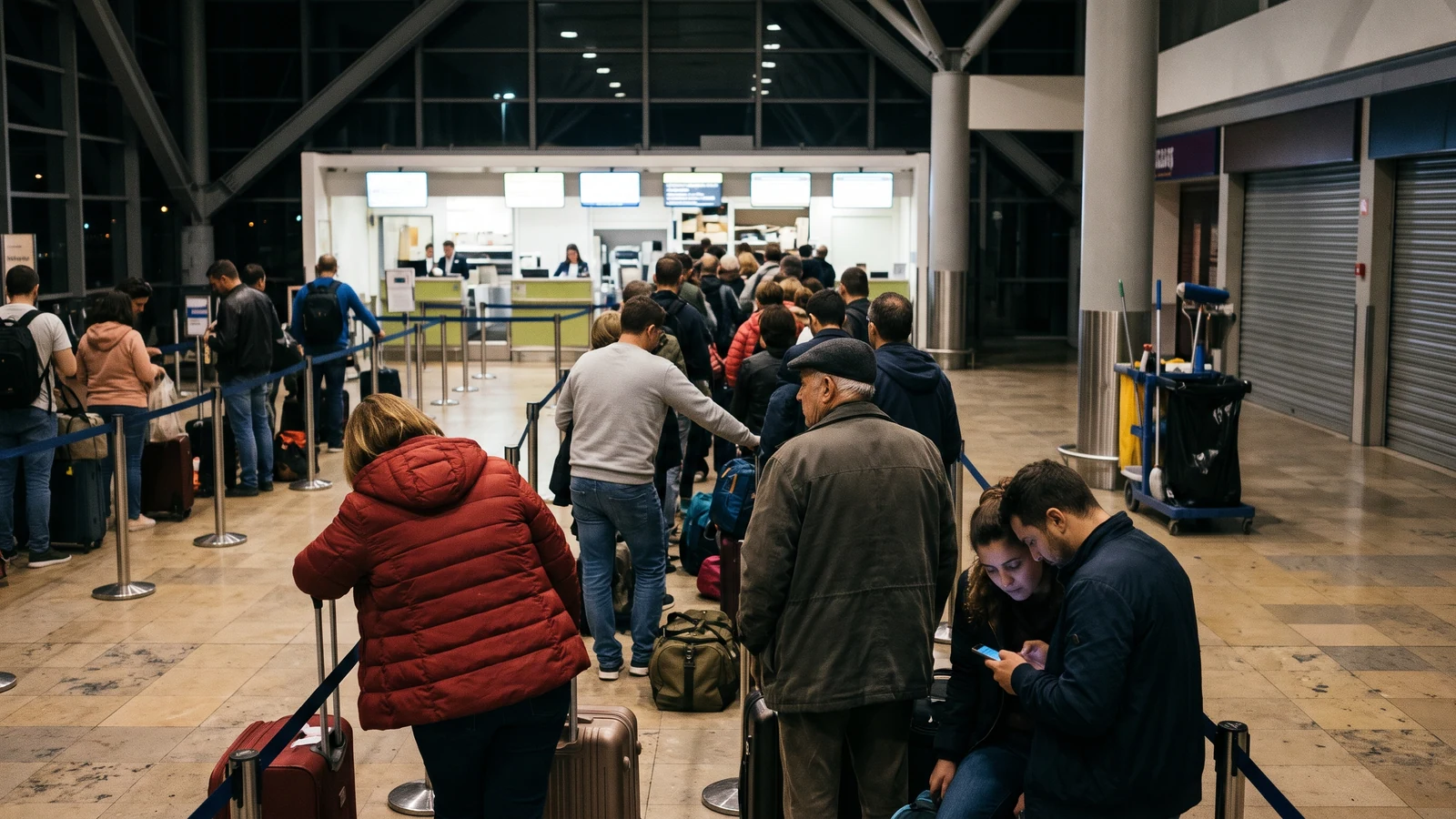
When you book online by yourself, a midnight cancellation in Zurich or Frankfurt means waiting in a 90-minute airport service desk queue or sitting on hold while every remaining Business Class seat on the next morning's departure disappears from GDS inventory.
Book on your own and a midnight cancellation can mean a 90-minute service desk queue, while the remaining Business Class seats on the next morning's departure disappear.
When you book through a legitimate consolidator like CEOFLIGHTS, your ticket is issued on the airline's official 13-digit IATA ticket stock—meaning every single U.S. DOT, EU261, and Montreal Convention protection applies identically. The difference is operational speed: while 40 passengers in the lounge are still refreshing the airline app after a cancellation alert, a dedicated travel manager sitting at a live GDS terminal can protect a backup lie-flat seat on a joint-venture partner carrier (for example, shifting a canceled British Airways JFK–LHR booking onto an American Airlines departure 45 minutes later, or moving a Lufthansa flight onto SWISS via Zurich) and reissue the ticket under airline irregular-operations (IRROPS) waivers in minutes.
Insider Strategy
Before booking any premium international fare through an agency, ask whether your ticket is issued on standard IATA airline ticket stock with live 24/7 GDS rebooking support. Having a human travel desk that can hold a backup seat in Amadeus or Sabre the moment a flight goes mechanical is worth more than any post-trip compensation check.
Step-by-Step: How to File and Win the Claim
Knowing the rules matters less than knowing the sequence. Here's the exact order that resolves claims fastest:
Step one: The moment you learn of a cancellation, delay, or downgrade, screenshot the airline app notification, the airport departure board, and the exact reason code (for example, ask the gate agent or lounge concierge to check the flight's operational delay code in the GDS).
Step two: Decide immediately whether you want re-routing in Business Class (including on a partner carrier under EU261 Article 8) or a full cash refund. Remember: if you accept and fly on the rebooked flight, you waive the DOT ticket refund, though you keep your right to €600 EU261 delay compensation and Montreal Convention expense reimbursement.
Step three: If an equipment swap downgrades your seat, do not sign or click any waiver accepting a minor travel voucher as "full and final settlement." State clearly that you are traveling under protest and will claim your statutory 75% EU261 Article 10 reimbursement (or DOT fare-difference refund).
Step four: Keep every itemized receipt for hotels, meals, ground transport, and replacement toiletries if your bag is delayed. Submit EU261 and Montreal Convention claims directly through the operating carrier's online compensation portal first—never hand 25% to 35% of your €600 payout to a third-party claim-shark website for filling out a two-page web form.
File directly through the operating carrier's portal with itemized receipts attached. EU261 pays €250, €400 or €600 by distance, or €300 for a long-haul arrival 3 to 4 hours late.
Step five: Track the statutory clock. If a U.S.-touching refund isn't back on your credit card within 7 business days, file a two-minute complaint with the U.S. DOT Aviation Consumer Protection portal—airlines have a dedicated regulatory compliance team that clears DOT-docketed complaints rapidly.
Don't let this happen to you
Never accept an expiring "future travel credit" for a canceled flight unless it includes a substantial bonus (20%+ above your cash fare) that you are certain you will use within 90 days. Under U.S. DOT and EU261 law, cash back to your original payment method is your baseline legal right.
The Bottom Line for Premium Flyers
Paying $7,000 for Business Class doesn't change the statutory refund formulas, but it dramatically increases the dollar value of knowing them—especially EU261's 75% long-haul downgrade reimbursement, the €600 controllable delay payout, the Montreal Convention's updated 1,519 SDR baggage / 6,303 SDR delay caps, and the U.S. DOT's automatic cash refund rule (7 business days on a card).
More importantly, the best disruption strategy is never having to file a claim in the first place because you made the meeting on another flight. That's what a CEOFLIGHTS personal travel manager does on unpublished Business and First Class fares: monitoring connections, grabbing the last lie-flat seat on an alliance partner the moment an aircraft goes mechanical, and handling any refund or downgrade paperwork on your behalf. Talk to our team before your next critical international trip.
Content creator and business travel specialist at CEOFLIGHTS, bringing you the latest insights, tips, and trends in premium business and first-class travel.
Become the CEO of Your Journey
You take the lead. Your dedicated Personal Travel Manager handles every detail.