Quick summary
To experience the true charm of the Amalfi Coast without crushing summer crowds, visit during April (17–19°C) and base yourself in quieter hubs like Praiano or Ravello. Transatlantic business class flights into Rome or Naples typically run $4,800 to $9,500 retail, but consolidator contracts can reduce these fares substantially. We recommend bypassing gridlocked roads with €80–€200 water taxis and flying lie-flat cabins on carriers like Qatar Airways or Lufthansa.
The Amalfi Coast doesn't need an introduction. Positano's stacked pastel houses, the switchback road that connects Sorrento to Salerno, Ravello's impossibly quiet terraces — you've seen it all before you've ever stood there. That's part of the problem.
Familiarity has made it predictable. And predictability, at scale, produces crowds. In July and August, the Amalfi Coast stops being a destination and becomes an event. The roads aren't just slow — they're stationary. The restaurants that once felt like discoveries are now ticketed experiences. Even the Belmond Hotel Caruso, perched above Ravello with one of the most arresting infinity pools in Europe, can feel like it's fighting against the noise below.
But here's the real insight that separates experienced travelers from everyone else: the coast itself hasn't changed. The approach has.
This article is about doing both things right — getting there in a seat that doesn't wreck you before you arrive, and then moving through one of Europe's most demanding destinations with some intelligence and a little restraint.
Getting there: the flight question nobody asks carefully enough
Most travelers heading to the Amalfi Coast fly into Rome Fiumicino (FCO) or Naples (NAP), then continue overland or by private transfer. Naples is the sharper choice — roughly 60–70 kilometers from Sorrento, compared to Rome's 280. But Naples has limited premium transatlantic service, which means routing matters.
From the US East Coast, the cleanest options are:
-
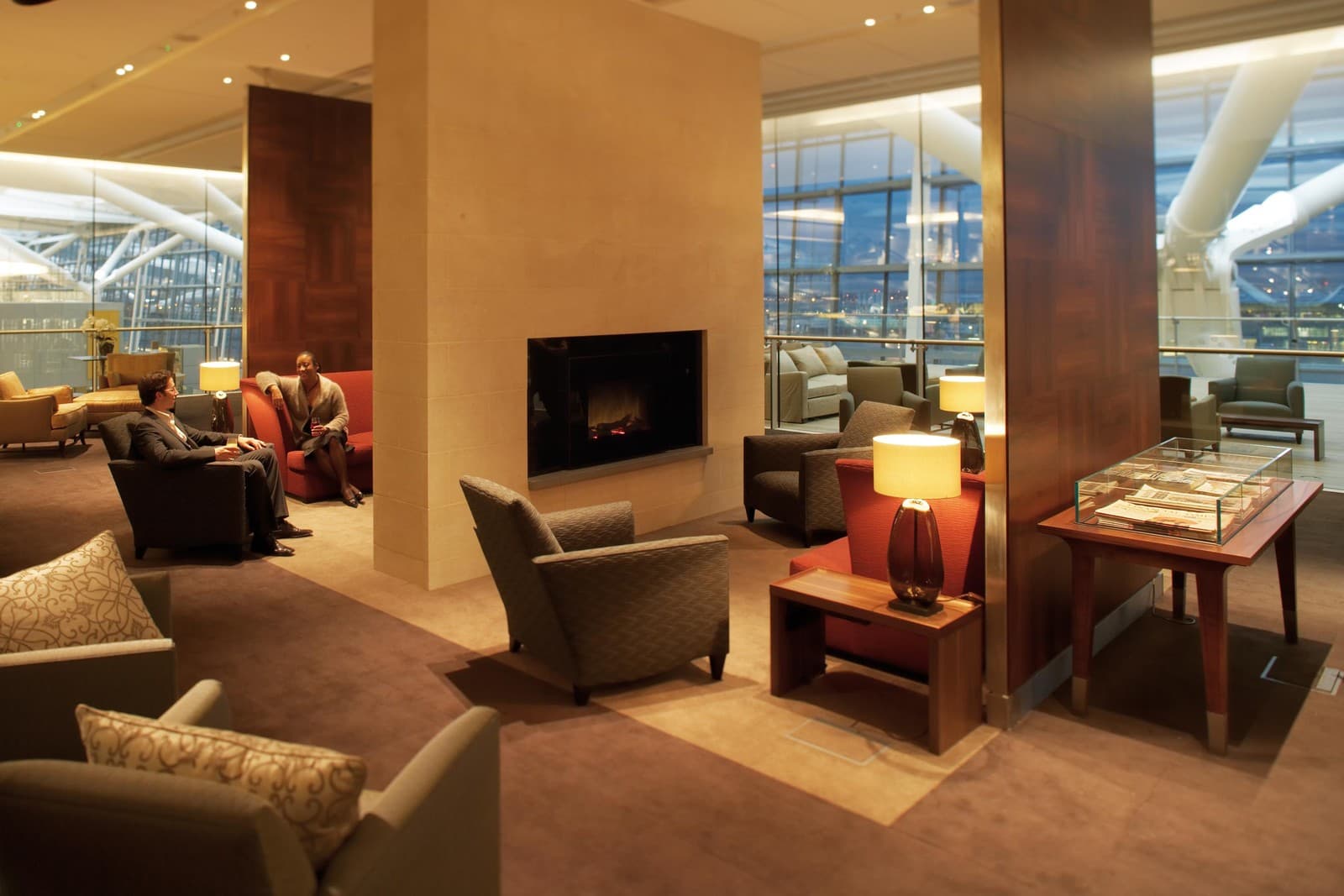
Qatar Airways via Doha (DOH) — QR flights from JFK, IAD, BOS, and MIA connect through Hamad International to either FCO or NAP. The QSuite product on the JFK–DOH leg (typically operated by a 777-300ER or A350) is, without argument, the best business class seat flying to this region. Direct aisle access from every seat, full-suite privacy doors, and double beds that actually work. Hamad International's Al Mourjan Business Lounge is worth the connection on its own.
-
Lufthansa via Frankfurt (FRA) — LH 400 out of JFK connects through FRA to Naples (NAP) on regional equipment. The long-haul leg features the new Allegris business class on select aircraft, which finally brings Lufthansa's product into competition with the Gulf carriers. The FRA lounge access — specifically the First Class Terminal if you've secured an upgrade or first class booking — is a genuine differentiator.
-
ITA Airways — the rebranded Alitalia operates direct Rome service from JFK and FCO, with onward connections to Naples. The business class product is acceptable, not exceptional. Seats are comfortable, service is warm, and the Volare frequent flyer program has improved. It's the most direct routing, not the most luxurious one.
-
American Airlines via London or direct to FCO — AA's 777-300ER Flagship Business product is solid on transatlantic routes, with direct aisle access and decent bedding. Connecting through LHR gives you access to the Concorde Room if you've positioned for a first class booking.
Retail business class fares from major US gateways to Rome or Naples run $4,800–$9,500 depending on season and carrier. Through our airline contracts at CEOFLIGHTS, we regularly place clients on Qatar Airways QSuites to FCO for meaningfully less — call (888) 851-6897 to get a current quote for your travel window. We're top rated on Trustpilot and ASTA-accredited (member #900292735), so you're not calling a call center — you're talking to people who've flown these routes.
From Europe, the calculus changes. Travelers positioning from London, Frankfurt, or Amsterdam can access Naples directly on short-haul — easyJet and Ryanair dominate that market, but if you're flying business class intercontinentally, a private transfer or train from Rome is a far more civilized finish than a budget airline cattle run into NAP.
Why April is the only honest answer
April sits in a narrow window that experienced Amalfi travelers guard like a trade secret. The weather is genuinely good — highs around 17–19°C, low humidity, and a quality of light that the shoulder months can't replicate. More importantly, the infrastructure hasn't been stressed yet.
Restaurants are staffed and attentive. Hotels are operational but not at capacity. The SP163 coastal road, which becomes a vehicular nightmare by June, is still navigable in reasonable time. This is not off-season. The coast is fully open. It's simply operating at a human scale.
The difference between April and August on the Amalfi Coast is not marginal. It's categorical.
Early May works too, though the window closes fast. By the last week of May, Easter crowds have faded but the Italian school calendar and European holiday patterns begin pushing volumes back up. Book April, and structure the trip around it.
Positano is better from the water
Most first-time visitors make the same mistake: they arrive into Positano by road, try to navigate the steps and alleys, and conclude that the photographs lied. They didn't — the angle was just wrong.
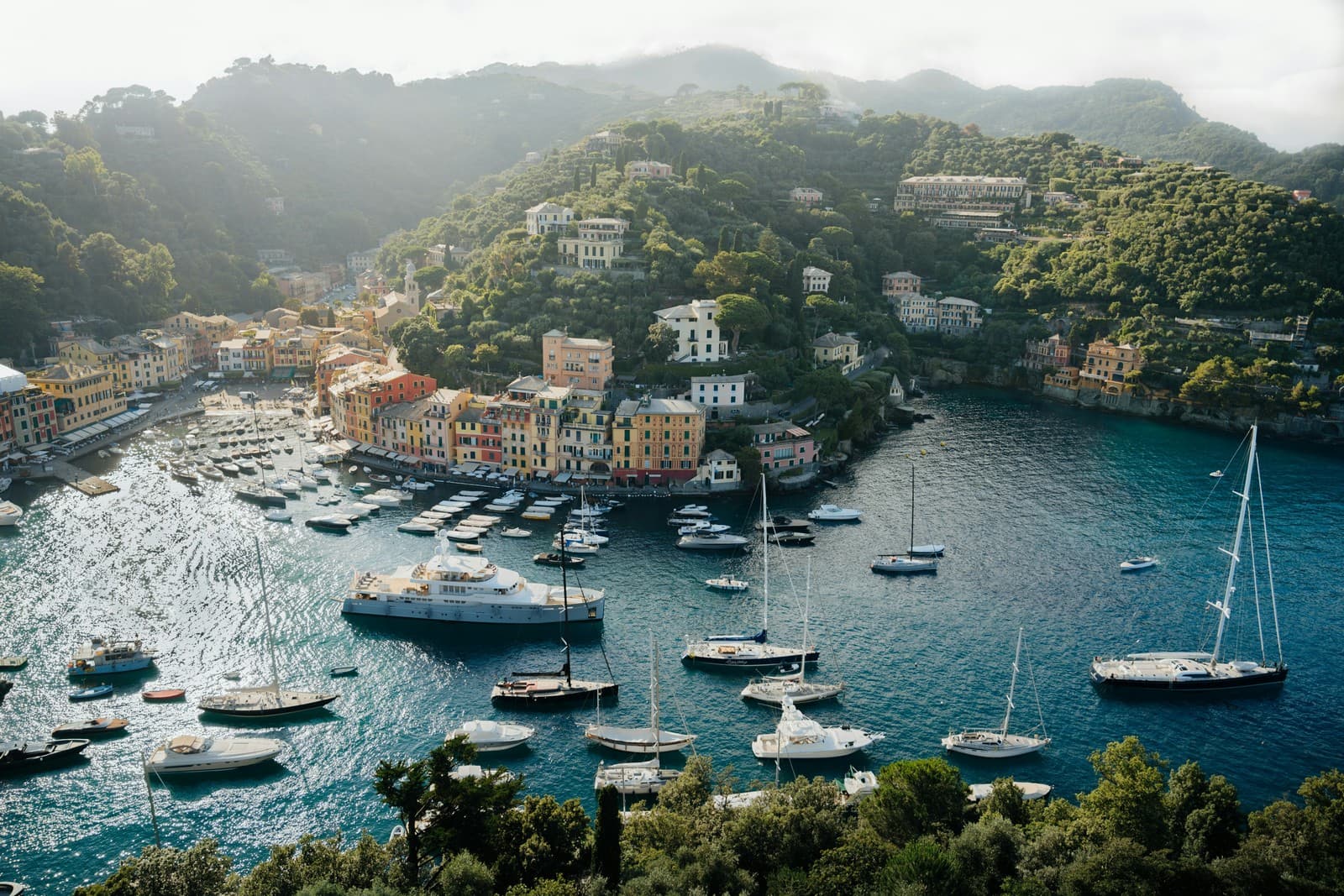
Approaching Positano by private boat is a completely different experience. The town reveals itself gradually, tiered and theatrical, without the compression of someone's luggage hitting your shins on a narrow staircase. Charter a day boat from Sorrento or Capri — expect to pay €500–€1,200 depending on vessel size and duration — and use it to set your own pace along the coast. Stop at the Grotta dello Smeraldo. Anchor off Li Galli, the three private islets that Nureyev once owned. View Positano from 200 meters offshore with a glass of something cold.
Then go into town if you want. But you've already seen it properly.
Several operators run higher-spec charters out of Marina Grande in Sorrento. Gozzo boats are the regional classic — beautiful wooden vessels, slower, more appropriate to the pace. For longer ranges or rougher conditions, a cabin cruiser gives you more flexibility.
Ravello, specifically in the first two hours after dawn
Ravello is where you stay if you understand what the Amalfi Coast is actually offering. It sits 350 meters above sea level, removed from the coastal road and its particular chaos, with views across the Tyrrhenian that shift color throughout the day.
The hotels here operate differently. The Belmond Hotel Caruso is the obvious anchor — a converted 11th-century palazzo with an infinity pool that appears to float above the valley, a restaurant that takes its wine list seriously, and a level of staffing that makes the property feel more like a private house than a hotel. Rates run €800–€2,400 per night depending on season and room category, which is not cheap. It's also not padded with unnecessary amenity fees or resort charges, which puts it ahead of many American luxury hotels at similar price points.
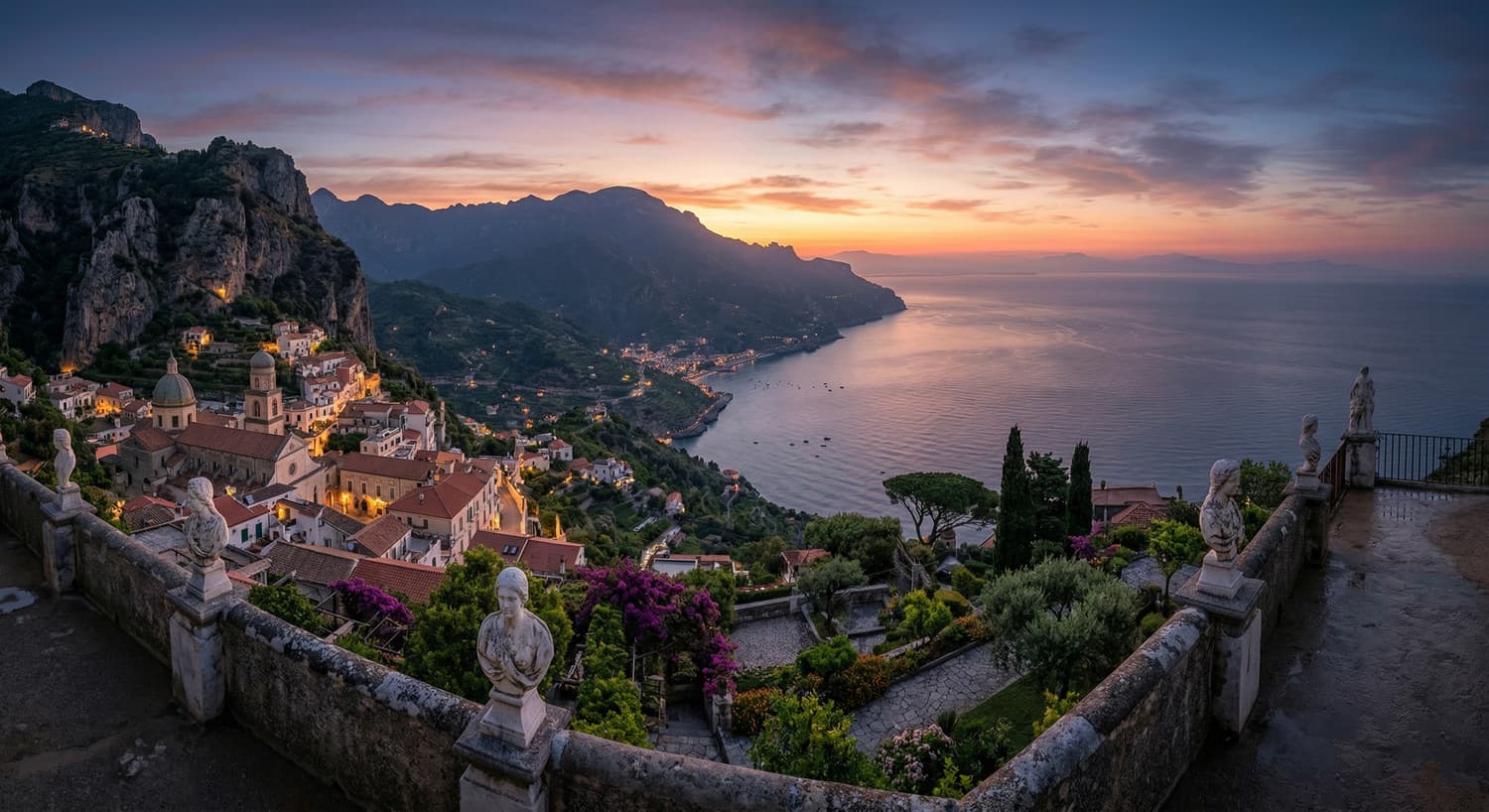
Villa Cimbrone operates as a hotel (Belmond also manages it) and as a public garden. The garden's Terrace of Infinity is one of the genuinely great views in Europe — 16 marble busts looking out over a drop that seems to fall all the way to the water. Visit before 9am, before the day-trippers come up from Amalfi and Ravello's piazza fills. The difference between 7:30am and 10:30am at Villa Cimbrone is not subtle.
Wagner composed part of Parsifal in Ravello. Lawrence wrote here. Gore Vidal had a house on the hillside for decades. The town has always attracted people who wanted proximity to beauty without full immersion in it. That instinct remains correct.
Where to actually stay: the case for Praiano
Positano has the name. Amalfi has the cathedral. Ravello has the elevation. Praiano has none of the above, and that's precisely why it works.
Sitting roughly halfway between Positano and Amalfi on the SP163, Praiano is a functioning town rather than a tourism machine. There's a small beach at Marina di Praia, accessible by a steep staircase cut into the cliff. The restaurants are local. The accommodation options range from simple apartments to the Casa Angelina, a minimalist clifftop hotel with whitewashed interiors, sea-view rooms, and a rooftop pool that sees a fraction of the foot traffic of anything in Positano. Rates at Casa Angelina start around €350–€600 per night, making it genuinely competitive with the larger names.
The strategic advantage is access. From Praiano, Positano is 20 minutes west. Amalfi is 15 minutes east. You're positioned on the coast without being consumed by either anchor town. In peak season, that positioning is worth more than it sounds.
For travelers who want complete separation, private villa rentals in the hills above Praiano and Furore offer the highest level of control. Expect €2,000–€6,000 per week for properties with pools and staff — still below comparable rentals in Positano, with a fraction of the access problems.
Movement: ditch the road when you can
The Amalfi Coast road is spectacular. It is also one of the most frustrating driving experiences in southern Europe. Two lanes, shared by buses, scooters, delivery trucks, and tourists who've never navigated a switchback in their lives, with passing places that require a degree of mutual cooperation that doesn't always materialize.
The smarter solution is water. Boat taxis run between Positano, Amalfi, and Salerno on a semi-regular schedule, and private water taxi transfers are readily available for €80–€200 per leg. For a trip that might take 45 minutes by road in shoulder season and two hours in peak, a 25-minute boat transfer is an easy calculation.
Hire a private driver for the overland movements you can't avoid — airport transfers, Ravello access (boats don't reach Ravello, obviously), or early morning departures. A reliable English-speaking driver from Naples to the coast runs €150–€250 depending on the service level. Book in advance through your hotel concierge or a local agency. Don't rely on apps that may not have coverage in the hills.
The evenings everyone overlooks
Day visitors leave the Amalfi Coast by late afternoon. Buses back to Naples, boats to Capri, rental cars grinding back toward Sorrento. By 7pm, the towns exhale.
This is when the Amalfi Coast becomes the place the photographs promised. Streets that were impassable at noon are suddenly walkable. The restaurants that were chaotic at 1pm become attentive by 8pm. The light is extraordinary — that particular gold-to-violet transition that the Mediterranean does better than anywhere else.
Build your days around this reality. Sleep late, take the morning boat, be back at your hotel or villa by 2pm when the midday crowds peak, and return to whatever town interests you after 6pm. It sounds counterintuitive. It works completely.
Dinner reservations should be made well in advance for the obvious names — Lo Scoglio in Marina del Cantone, Il Flauto di Pan at Villa Cimbrone, Da Adolfo in Positano (accessible only by the restaurant's own red-and-white striped boat from the main beach). These are not Instagram-chasing recommendations. They're places that have maintained standards across decades because the fundamentals — product, location, consistency — are right.
The flight home: don't waste it
After a week on the Amalfi Coast, you're rested. Protect that on the return.
A private transfer from Sorrento or Ravello to Naples Capodichino (NAP) takes 60–90 minutes. From Naples, you can position to Rome FCO for intercontinental departures, or look at whether your routing allows a direct connection. The Trenitalia high-speed from Naples Centrale to Roma Termini runs in about 70 minutes and drops you close enough to FCO connections that it's worth considering over road transfers in peak traffic months.
Qatar Airways' return routing through Doha works well — the DOH lounge is worth the layover, and the QSuite on the second leg home is a genuinely comfortable way to process a week of switchbacks and sea views.
If you're on a single-carrier booking and the return dates are flexible, we can often find better cabin availability on alternate dates. That's the kind of adjustment that's obvious when you're working with a consolidator rather than booking direct. CEOFLIGHTS clients on this route have saved $1,200–$3,000 per person on round-trip business class by letting us work the pricing. Call (888) 851-6897 and tell us your window — we'll tell you what's realistically available.
The Amalfi Coast rewards patience in every dimension. Patience about when to visit. Patience about where to position yourself. And patience, honestly, in finding the right way to get there in the first place.