Quick summary
Skip public search engines and use consolidators with access to unpublished wholesale inventory to bypass price parity agreements, routinely dropping $6,500 retail business class fares down to as low as $3,800.
The points game is rigged. You spend two years optimizing spending across five different credit cards, meticulously transferring Chase Ultimate Rewards to Virgin Atlantic during a 30% bonus window, only to discover that the single ANA First Class seat you wanted was booked by a bot seven milliseconds after the schedule opened. Then you get slammed with $850 in fuel surcharges.
If you value your time, churning credit cards is a losing proposition.
Paying retail pricing on Expedia isn't much better. A standard round-trip business class ticket from New York (JFK) to London (LHR) on British Airways currently prices out around $6,500 for a mid-week departure in October. That same seat—specifically, 15A in the Club Suite cabin, where the sliding door sometimes sticks and the IFE screen occasionally needs a hard reset—frequently sells through private channels for $3,800.
The difference isn't magic. It comes down to a structural inefficiency in how airlines price inventory, and the existence of unpublished consolidator fares. You just need to know how the system operates to stop overpaying for lie-flat seats.
The mechanics of unpublished fares
Airlines have a math problem. They operate aircraft with a fixed number of seats, and a flight taking off with an empty business class seat represents permanent lost revenue. A Boeing 777-300ER might have 40 to 60 premium cabin seats. Business travelers booking last-minute flexible fares will pay top dollar for some of them, but relying entirely on full-fare retail bookings is financially reckless.
To guarantee a baseline of revenue, airlines quietly sell off large blocks of premium inventory to wholesalers and consolidators.
They do this under strict conditions. The airlines explicitly forbid consolidators from advertising these discounted prices publicly. If an airline is selling a $7,000 ticket to a corporate client on their main website, they cannot have a third-party site displaying that exact same seat for $4,200. It would destroy their direct pricing power.
This is why searching Google Flights yields identical pricing across Kayak, Expedia, and Orbitz. Those online travel agencies are bound by parity agreements to display the published retail fare. They are essentially just slightly different user interfaces pulling from the same Global Distribution System (GDS) pricing feed.
Consolidators bypass this entirely. By keeping the fares hidden from public search engines, they fulfill the airline's requirement for discretion while passing the massive wholesale discount directly to the flyer.

Why online booking engines fail premium travelers
Booking a $150 basic economy ticket on Spirit Airlines is a straightforward transaction best handled by an algorithm. Booking complex international business class itineraries requires human intervention.
Algorithms don't know that the transit security line at Frankfurt Airport (FRA) Concourse Z frequently stretches past 45 minutes on Tuesday mornings, making a 55-minute layover mathematically impossible. An algorithm will happily sell you that ticket.
When you book through an OTA, you are purchasing a commodity. If there is a weather delay in Chicago, you join a queue of three thousand other stranded passengers waiting on hold with an overseas call center. You are a reservation number.
Our approach at CEOFLIGHTS is fundamentally different. Our travel advisors build relationships with clients. If your flight is cancelled while you are asleep in your hotel in Milan, we rebook you on the next available routing before you even wake up. Our clients have direct access to us by calling (888) 851-6897. We don't hide behind chatbots. We are top rated on Trustpilot, with hundreds of reviews from thousands of happy customers because we treat our clients like human beings.
We are fully ASTA accredited (#900292735), which provides an additional layer of financial protection and industry oversight that faceless booking apps simply do not offer.
The reality of modern business class products
The gap between a good business class product and a mediocre one is massive. Airlines market them identically, but the physical reality of the seat varies wildly even within the same carrier's fleet. When you pay a premium fare, you should know exactly what you are getting.
Emirates A380
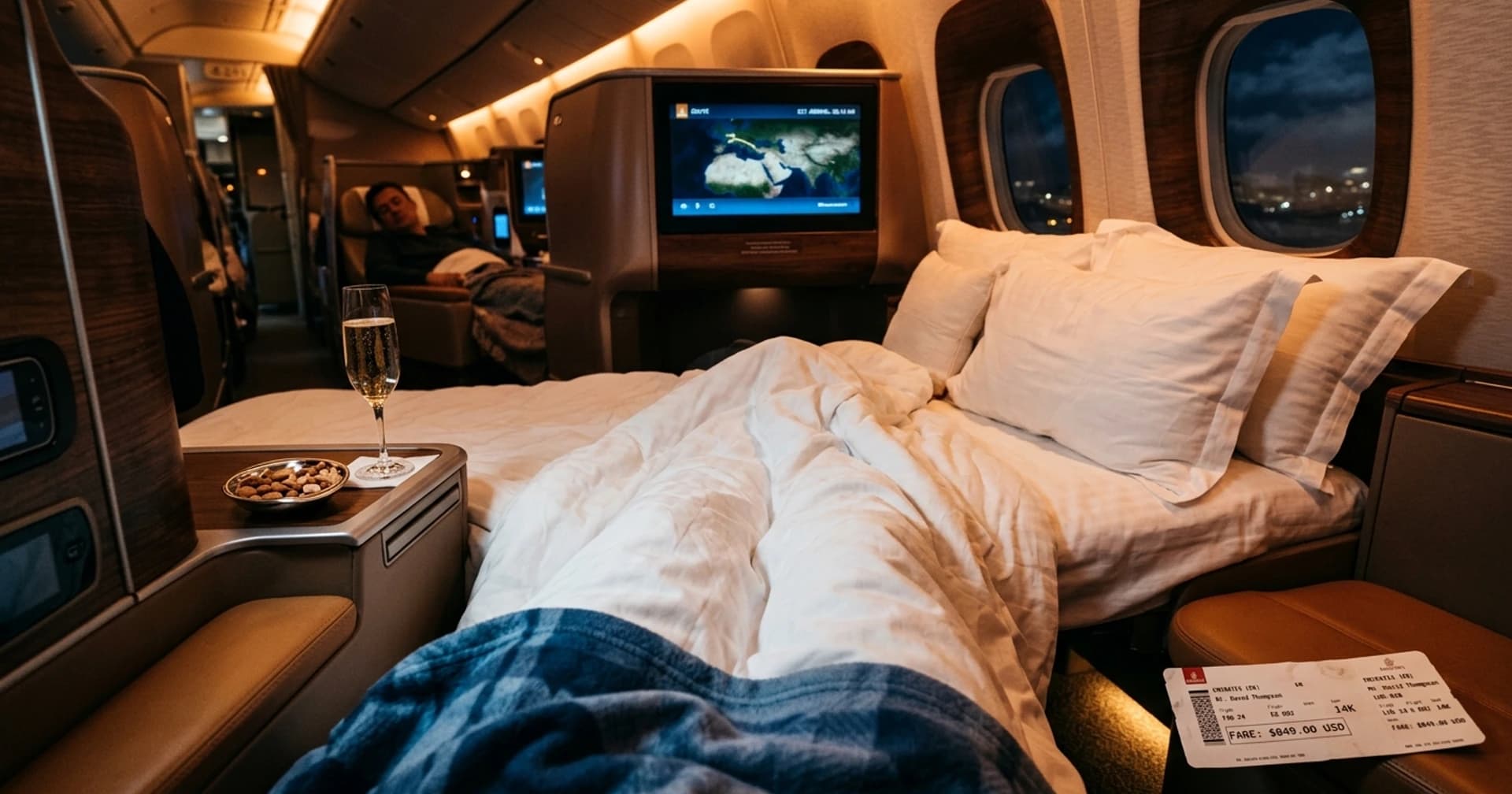
The Emirates A380 remains the gold standard for sheer spectacle, though the seat itself is beginning to show its age. The staggered 1-2-1 layout means you must actively select a true window seat (A or K) rather than the aisle-exposed B or J seats. The burled walnut finish feels slightly dated, and the 18.5-inch seat width is outclassed by newer competitors.
The onboard lounge at the rear of the upper deck is what justifies the price. Having a physical space to walk to, stretch your legs, and order a freshly mixed espresso martini from a bartender at 38,000 feet completely alters the psychology of a long-haul flight. The WiFi is universally terrible across the A380 fleet, dropping constantly over the polar routes. If you need to work, fly another carrier. If you want to arrive rested and entertained, it remains excellent.
Qatar Airways Qsuite
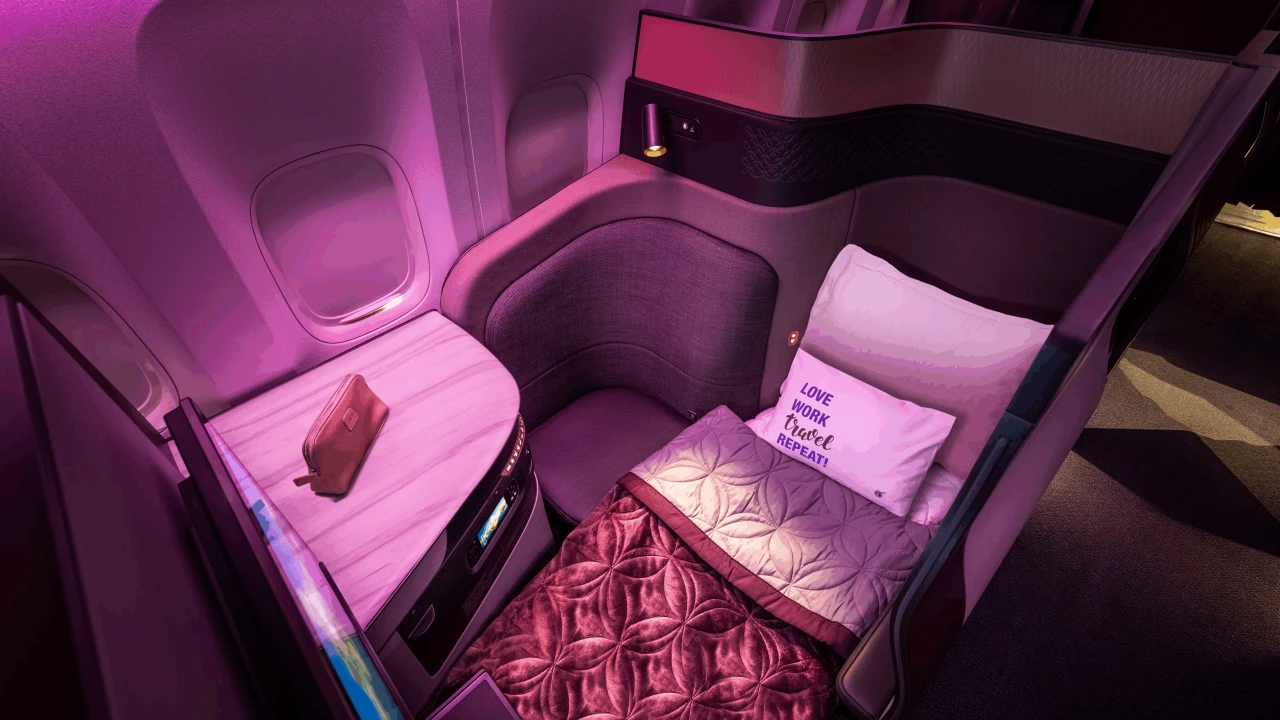
Qatar's Qsuite is undeniably the best business class product in the sky. The physical dimensions are staggering. The suite doors slide shut with a satisfying click, creating absolute privacy. The seat itself is incredibly firm—some find it too firm for lounging, but it provides excellent support for sleeping once the crew applies the mattress pad.
The soft product is where Qatar dominates. You can order the lobster thermidor at 3:00 AM if you want, as dining is entirely on demand. The Al Mourjan lounge in Doha is overwhelming in scale. Finding a quiet corner requires a ten-minute walk past the reflecting pool. We frequently route clients from the US to Asia through Doha specifically to secure Qsuites, pricing it out at a significant discount compared to direct flights on US carriers.
Singapore Airlines A350
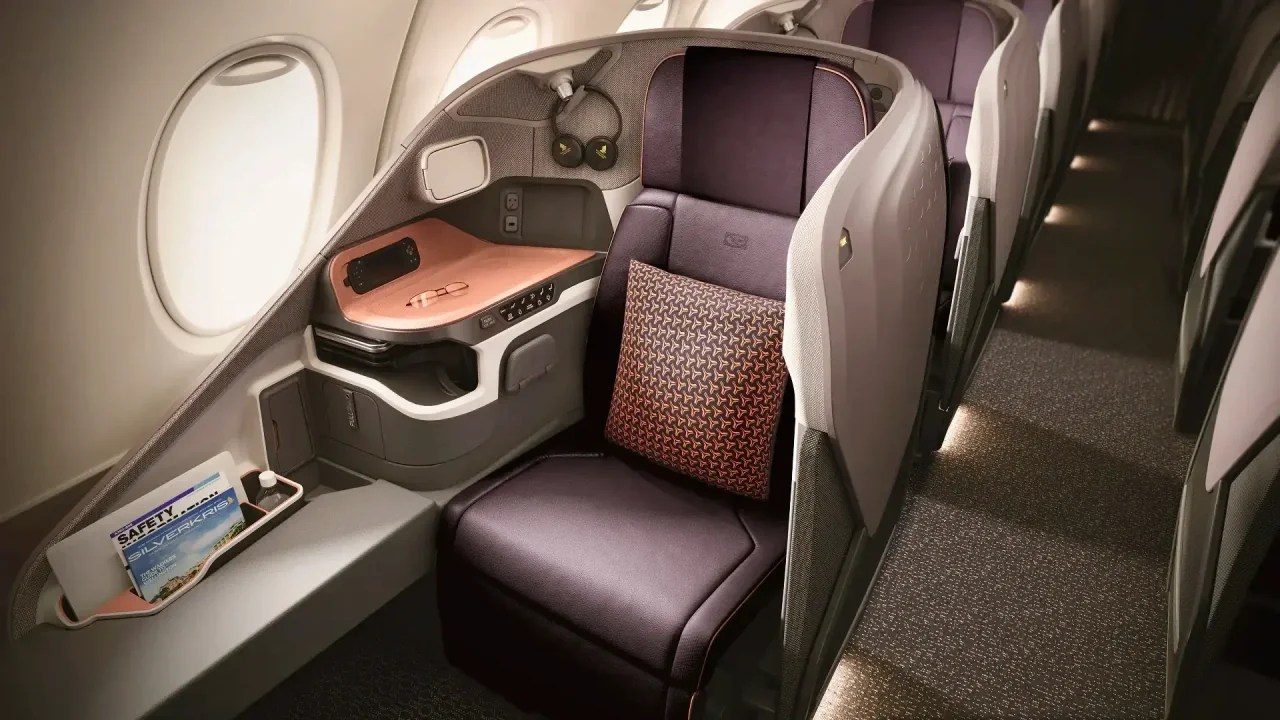
Singapore Airlines does things differently. Their long-haul business class seats are incredibly wide—up to 28 inches—but you must sleep at an angle. The footwell is off to the side, which frustrates taller passengers who cannot sleep diagonally.
The service is flawless. The flight attendants seem to anticipate requests before you make them. The SilverKris lounge at Changi Terminal 3 is heavily trafficked and lacks the quiet exclusivity of some Middle Eastern lounges, but the hawker-style food stations compensate for the crowds. The A350 cabin is whisper-quiet, and the cabin pressure is kept lower than older aircraft, noticeably reducing jet lag.
ANA The Room
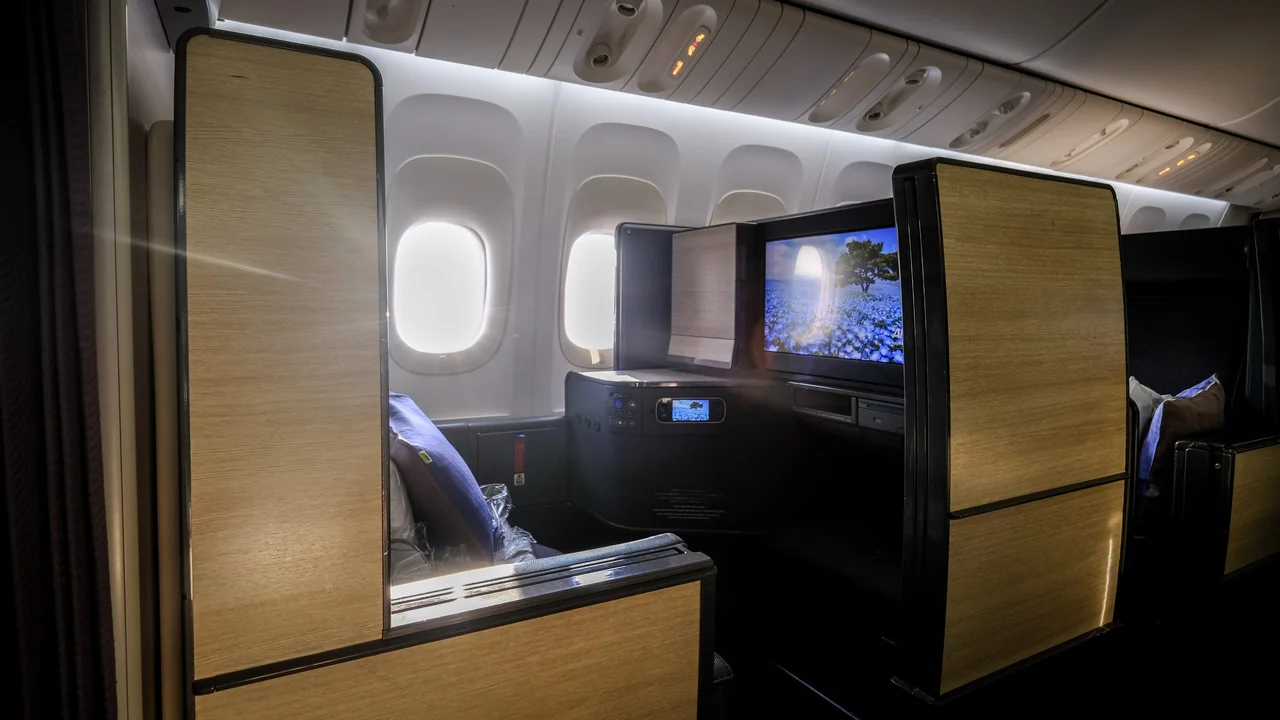
Flying out of JFK or LHR on ANA's newer 777-300ERs grants you access to "The Room." It is essentially a first-class seat marketed as business class. The seat is so wide you can sit cross-legged next to a child. The sliding doors are substantial and provide genuine privacy.
The IFE screen is a massive 4K monitor. The Japanese catering is exceptional, though the Western options are frequently bland. The major drawback is cabin temperature. ANA keeps their cabins notoriously hot—often exceeding 78 degrees—and there are no individual air nozzles. Dress in layers.
Delta One Suites
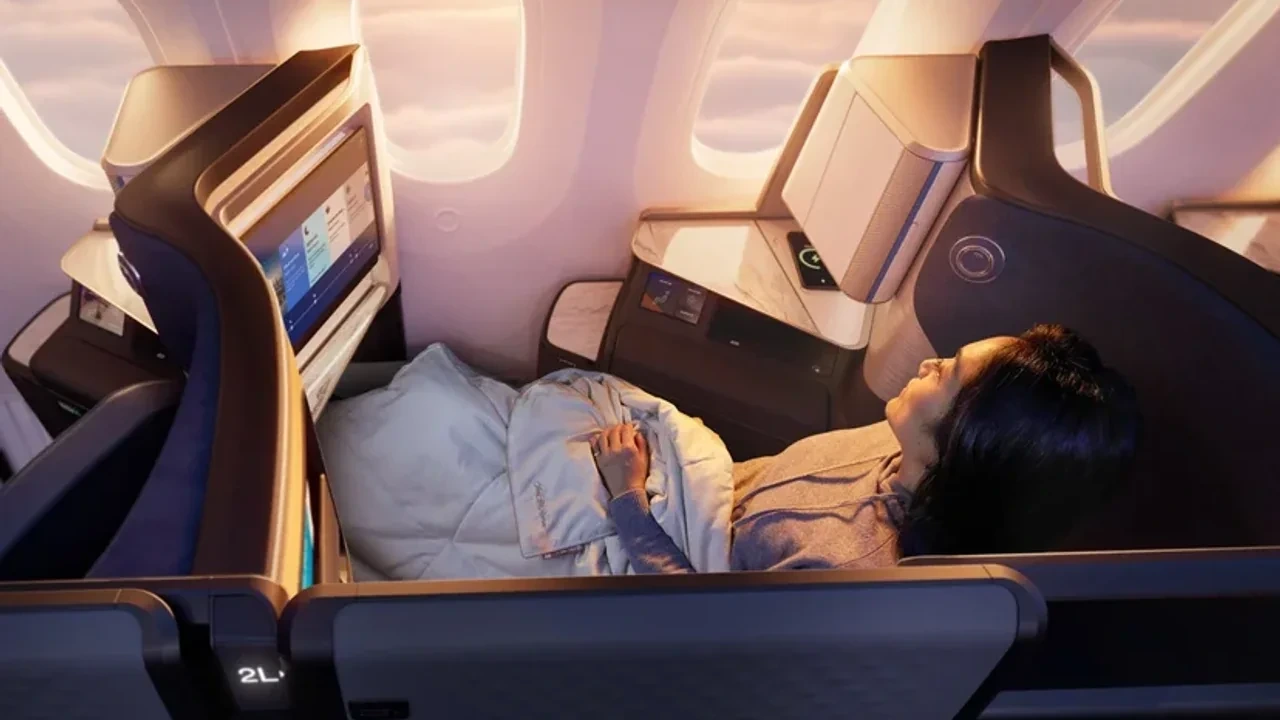
Delta's A350s and A330-900neos feature the Delta One Suite. The door is lower than Qatar's, so anyone walking down the aisle can see straight in, negating some of the privacy. The seat materials feel high quality, but the footwell is restrictive.
The Sky Club network is severely overcrowded. Even with premium access, finding a seat in Atlanta's Concourse E lounge during the evening departure bank is difficult. We often source Delta One inventory at substantial markdowns for trans-Atlantic routes, especially during the shoulder season.
United Polaris
Polaris is consistent. The bedding, designed by Saks Fifth Avenue, is the best in the industry. The cooling gel pillow is a game changer for hot sleepers. The seats are arranged in a 1-2-1 configuration, but you must avoid the seats angled toward the aisle, as they lack privacy.
The Polaris Lounges in Newark and Chicago are superb, offering proper sit-down dining that rivals good restaurants. The onboard catering, however, is atrocious. The short rib is universally overcooked. Eat in the lounge and go straight to sleep once onboard.
Air France
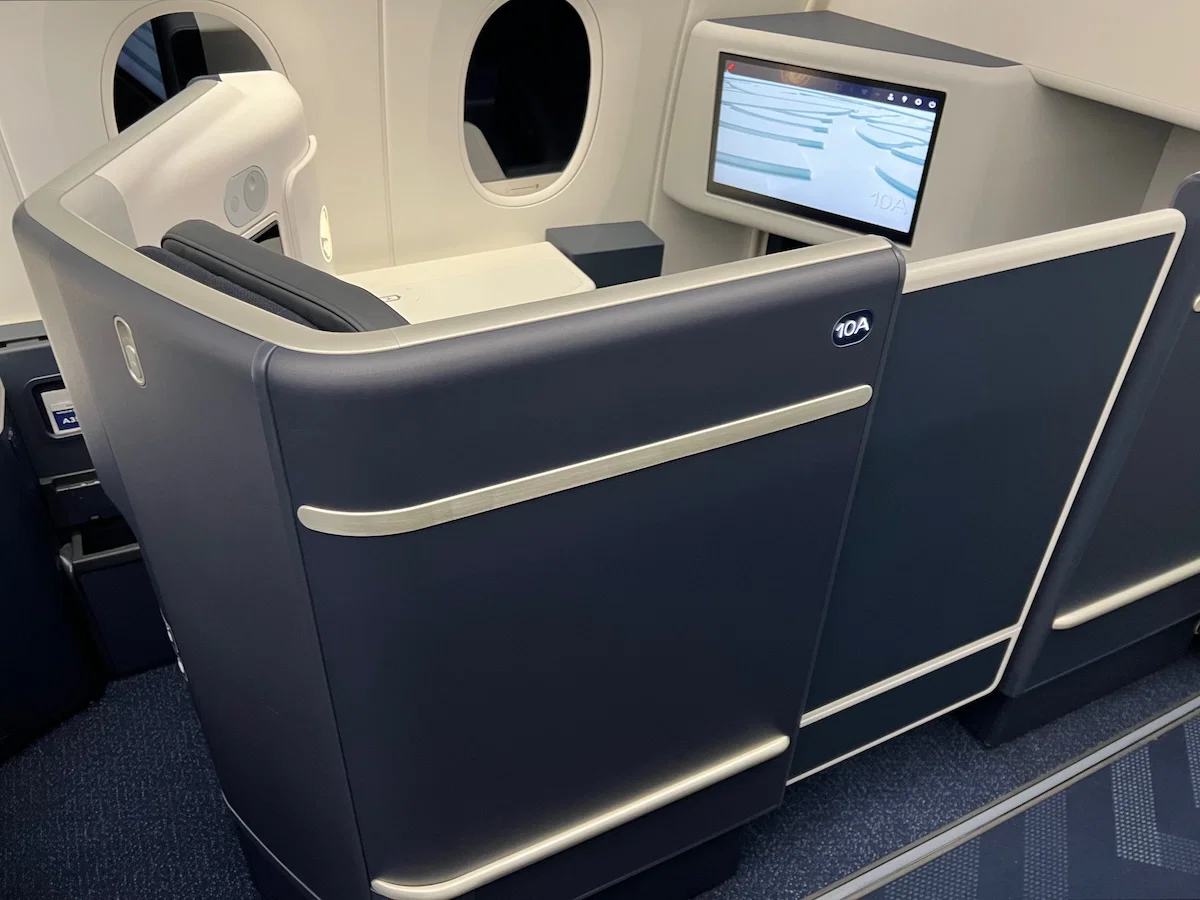
Air France offers a masterclass in soft product delivery. Their Boeing 777-300ERs with the new reverse herringbone seats feature sliding doors, but they feel more elegant than imposing. The color palette of navy blue, white, and red stitching is distinctly Parisian.
The true differentiator is the food and beverage program. The champagne flows generously before takeoff, and the wine list is curated by Paolo Basso, a former World's Best Sommelier. The warm baguettes served from the bread basket are shockingly crisp for airplane food. If you connect through Paris Charles de Gaulle (CDG), the Terminal 2E Hall K lounge is expansive. The complimentary Clarins facial treatments available in the lounge are a brilliant touch for tired travelers. We constantly source Air France inventory because their pricing algorithm frequently misprices connections to secondary European cities.
Cathay Pacific
Cathay Pacific business class on the A350-1000 remains a favorite for transpacific routes, even without sliding doors. The reverse herringbone seats are angled steeply toward the windows, providing excellent views and profound privacy. The seat extends into a fully flat bed that is wide at the shoulders and lacks the restrictive footwells found on many European carriers.
The Pier Business Class lounge in Hong Kong is arguably the best business class lounge globally. It feels like an underground luxury apartment, complete with a dedicated teahouse and noodle bar. Cathay's soft product has suffered slightly since the pandemic, but the physical hardware and the sheer efficiency of transiting through Hong Kong International Airport make it a top recommendation. We often find Cathay inventory hidden within complex Oneworld alliance routings.
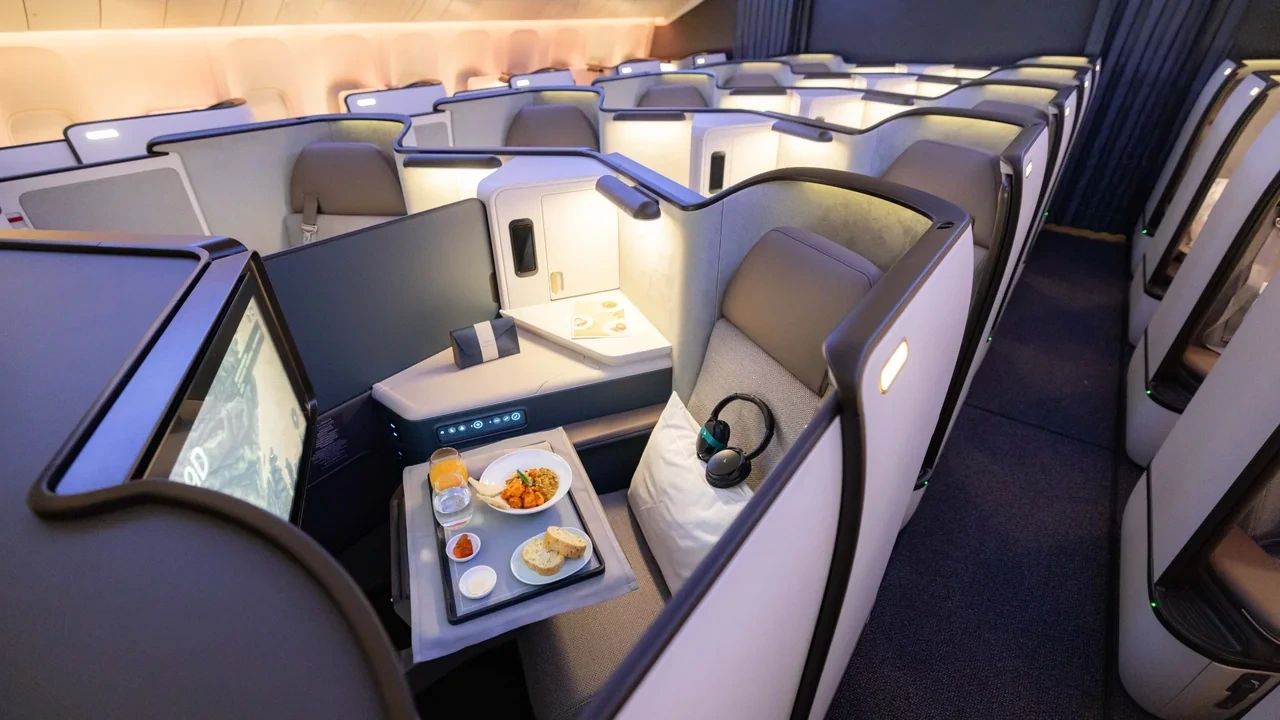
Turkish Airlines
Flying Turkish Airlines business class is an exercise in culinary excess. Their onboard chefs prepare food that puts most ground-based restaurants to shame. The mezze cart rolled down the aisle is a visual feast.
The hard product is a mixed bag. If you fly their older Boeing 777s, you will encounter a 2-3-2 layout. Finding yourself in a middle seat in business class is a jarring experience. We actively track tail numbers to book clients on their newer A350s or 787-9s, which feature a highly private 1-2-1 staggered configuration. The Istanbul airport lounge is massive, featuring indoor golf simulators and live cooking stations, though it can become incredibly crowded during the midnight departure bank.
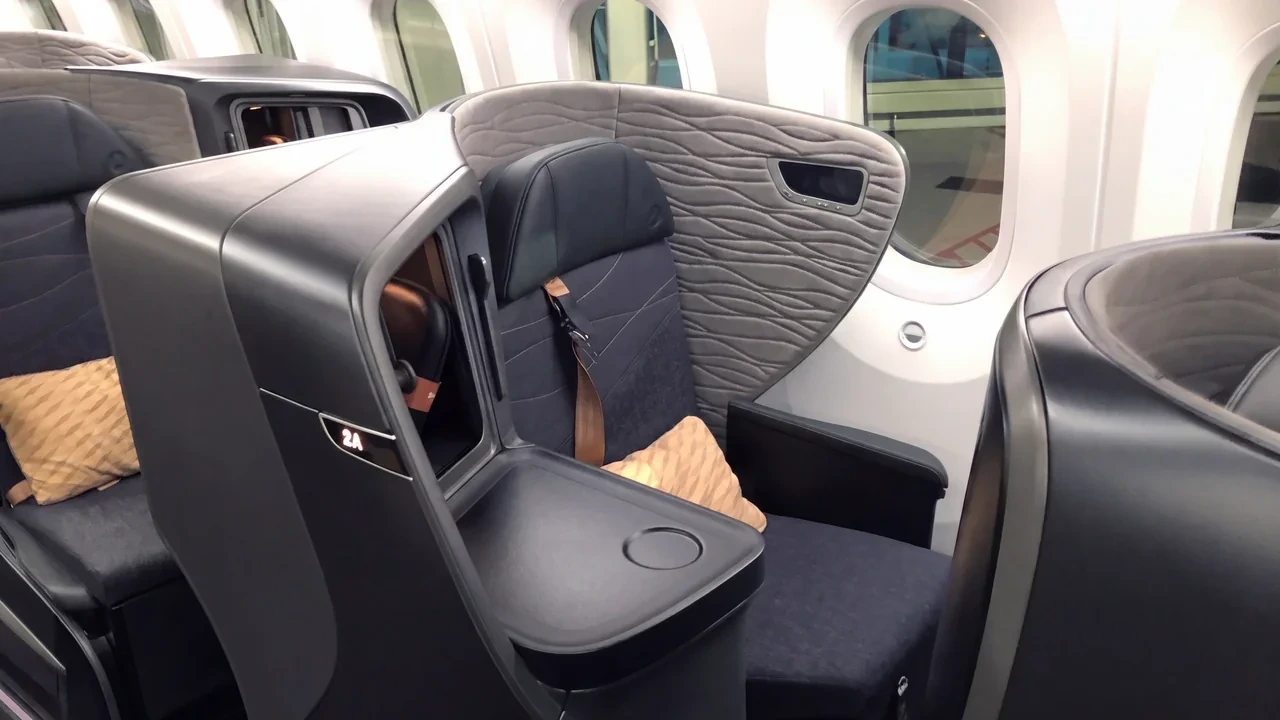
Lufthansa
Lufthansa is currently operating a chaotic mix of business class products. Their older 2-2-2 configuration forces you to angle your feet directly toward your seatmate. It offers zero privacy and is functionally obsolete.
Their new Allegris product, slowly rolling out across the fleet, is overly complicated. They offer five different types of seats within the same business class cabin, including extra-long beds and privacy suites, some of which require additional fees. Decoding this seat map is a nightmare for the uninitiated. We spend hours mapping specific tail numbers to stop our clients from paying thousands of dollars for a decade-old seat when a modern suite was available on a different routing. The First Class Terminal in Frankfurt remains legendary, but their business class lounges are purely functional.
Virgin Atlantic
Virgin Atlantic brings a theatrical flair to aviation. Their A350-1000 Upper Class suites face the window, a massive improvement over their older seats that faced the aisle. The cabin lighting shifts dynamically from deep purples to warm ambers.
The onboard social space is smaller than an Emirates bar but still provides a welcome escape from your seat. The Clubhouse at London Heathrow is exceptional, featuring a peloton studio, a hair salon, and excellent a la carte dining. We frequently book Virgin Atlantic wholesale fares for clients traveling to London, as they often underprice British Airways on direct routes from major US hubs.
The mechanics of booking classes
Airlines don't just sell "business class." They divide the cabin into alphabetical fare buckets. J, C, D, I, and Z are common codes for premium cabins. A J-class fare is fully refundable and costs $9,000. A Z-class fare is heavily restricted, non-refundable, and costs $3,500.
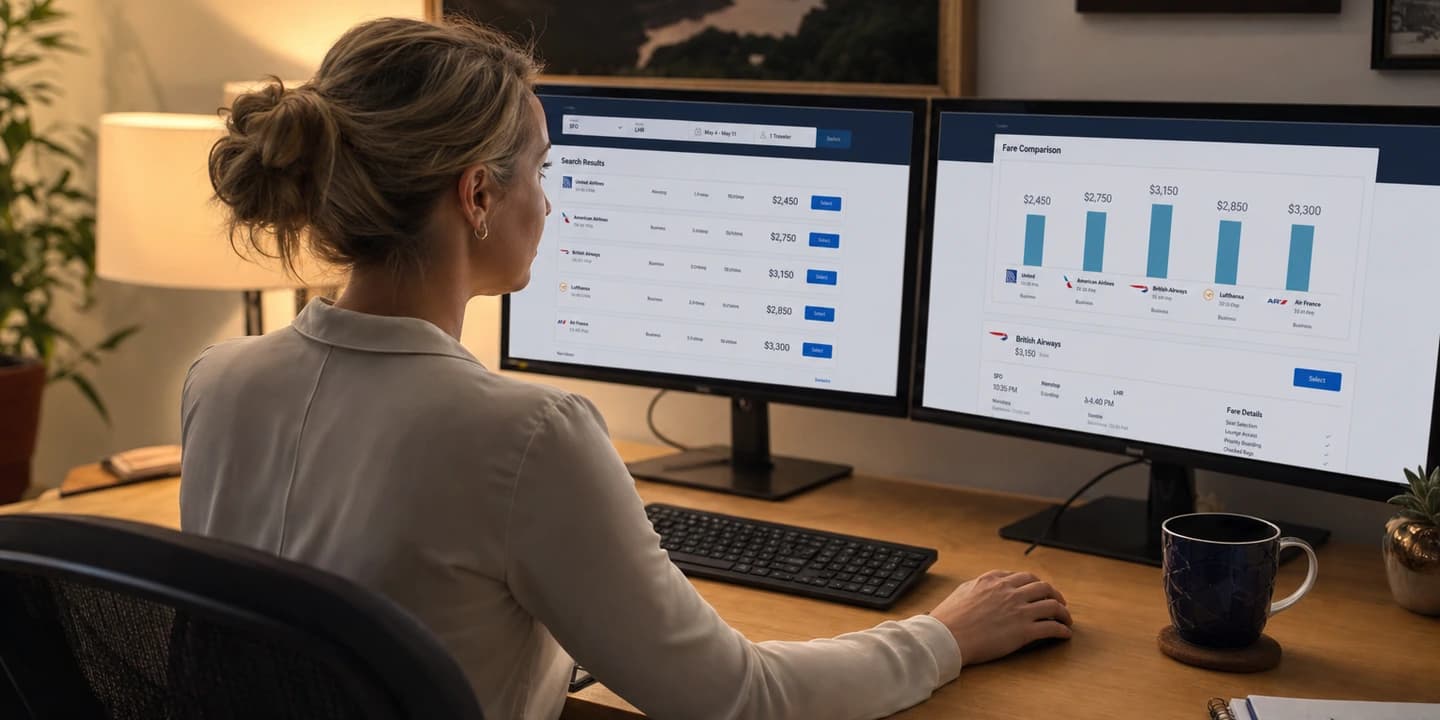
When you search an OTA, the system looks for the lowest available published fare bucket. If the Z-class bucket is empty, the price jumps to the D-class fare, instantly adding $2,000 to the cost.
Consolidator contracts operate parallel to this system. We hold access to private fare buckets that never hit the public GDS. The airline might zero out the public Z-class bucket to force last-minute corporate buyers to pay full price, while quietly leaving our private wholesale buckets open to maintain cash flow.
The problem of hidden fees and surcharges
Airlines have become masters of unbundling. While basic economy is notorious for this, the practice has crept into business class. British Airways charges business class passengers up to $150 simply to select a seat in advance.
Fuel surcharges, often coded as YQ on a ticket receipt, are another opaque pricing mechanism. A $3,000 ticket might consist of a $500 base fare and a $2,500 fuel surcharge. If you try to change that ticket, the airline might calculate penalties based on complex rules tied only to the base fare. We untangle these fee structures for our clients. We calculate the true cost of the ticket, including seat selection, baggage rules, and expected tax burdens, before presenting a final price.
Seasonal pricing dynamics
Timing your purchase is critical when accessing wholesale fares. The retail pricing algorithms are reactive; they spike prices based on search volume and historical booking curves. Consolidator inventory operates differently. We secure blocks of space months in advance.
- September to November: This is the sweet spot for European travel. The summer tourist rush has ended, but business travel hasn't fully ramped up for the end-of-year sprint. We routinely secure lie-flat seats to Paris or Rome for under $2,500 round trip during this window.
- January to March: Asia pricing collapses after the Lunar New Year. If you can handle the weather in Tokyo or Seoul, the business class pricing during these months drops significantly.
- July and August: Avoid booking close-in during the peak summer months. Airlines know they can sell out the premium cabins to affluent vacationers. We recommend booking summer travel by February at the latest.
- The two-week rule: Airlines occasionally dump unsold premium inventory back into the wholesale market exactly 14 days before departure. If you have extreme flexibility, calling us two weeks out can yield incredible results.

The New York to Tokyo scenario
Consider a two-week trip from JFK to Tokyo Haneda (HND) in mid-November.
A public search on Kayak will show Japan Airlines pricing at $8,200 for a direct flight. An algorithm will also suggest a highly inconvenient routing on Air Canada through Toronto and Vancouver for $5,500.
A corporate travel portal will simply book the $8,200 direct flight.
A traveler trying to optimize on their own might book the $5,500 Air Canada flight, subjecting themselves to two layovers and a massive risk of winter weather delays in Canada.
When that same request comes to CEOFLIGHTS, we look at the private inventory. We might see that Japan Airlines has blocked out their public discount buckets, but our negotiated consolidator rate on that exact same direct flight is pricing at $4,900.
The client saves $3,300 over the retail price, avoids the miserable Air Canada routing, and earns full Oneworld elite qualifying miles. The airline fills a seat they were worried about flying empty. We earn our margin. The math works for everyone involved.
The mechanics of booking with a consolidator
The process of booking an unpublished fare requires a slight adjustment in expectations. You cannot point-and-click your way to a $4,000 discount. It requires communication.
- The Request: You call us at (888) 851-6897 or submit a detailed request through our website. We need exact dates, flexibility windows, preferred airlines, and routing constraints.
- The Search: Our advisors search the private GDS feeds. We look at published retail fares, our negotiated wholesale rates, and complex mixed-carrier routings that algorithms completely ignore.
- The Proposal: We present you with specific flight options. We don't just give you a price; we explain the aircraft type, the seat configuration, and the layover logistics. We tell you if the connection in Charles de Gaulle requires a terminal change that will ruin your morning.
- The Ticket: Once you approve the routing, we issue the ticket. You receive a standard six-character PNR confirmation code.
- The Control: You take that PNR, go directly to the airline's website, and take control of your reservation. You select your seat, input your frequent flyer number, and order your special meal. The airline treats the ticket exactly like one bought directly from them.
Why price parity agreements matter
You might wonder why airlines bother with this two-tiered pricing system. It is entirely about market segmentation.
A corporate client booking a Tuesday morning flight from New York to London for a critical meeting does not care about the price. Their company is paying the $8,000 retail fare. If the airline lowered the published price to $4,000, that corporate client would just pay $4,000, and the airline would instantly lose half their revenue.
But the airline also knows there is a massive segment of affluent leisure travelers who refuse to pay $8,000 but would happily pay $3,500. By keeping the $3,500 price hidden with consolidators, the airline captures the leisure traveler without cannibalizing their lucrative corporate revenue.
It is price discrimination in its purest form.
Protecting your investment
Booking international premium travel is a significant financial transaction. When you deal with online booking engines headquartered overseas, your recourse is limited if things go wrong. If an OTA goes bankrupt, your ticket vanishes.
Working with a US-based, ASTA-accredited agency provides necessary security. We have direct contacts within the airlines' sales departments. When a flight is cancelled due to a strike in Germany, we do not wait on hold with the general public. We contact our dedicated airline liaisons and get our clients rerouted on partner airlines.
This level of service is not an add-on. We make our margin on the spread between the wholesale cost and your discounted price. Our incentive is entirely aligned with getting you to your destination efficiently.
The myth of the frequent flyer program
Points and miles have been heavily financialized. Airlines now make more money selling frequent flyer miles to banks than they do flying airplanes. The banks give those miles to you as signup bonuses, drastically inflating the currency.
This inflation has destroyed availability. Finding two business class award seats on the same flight to Europe in the summer is nearly impossible unless you book exactly 355 days in advance or wait until three days before departure. The airlines restrict award inventory because they would rather sell the seat to us at a wholesale cash rate than give it away for points.
If you have millions of points, use them. If you don't, do not waste years of your life trying to accumulate them through artificial spending patterns. Cash is king. A discounted wholesale cash fare earns you elite qualifying miles, guarantees your seat, and saves you from the anxiety of hunting for phantom award availability.
The specific value of human expertise
We actively discourage clients from certain routings. We will tell you that flying British Airways through London requires paying exorbitant UK Air Passenger Duty taxes, and we will route you through Madrid on Iberia instead to save $400 in fees.
We know that the Boeing 787-8s flown by certain carriers have narrower aisles and slightly smaller seats than their 787-9 variants. We know that the lounge situation at LAX Tom Bradley International Terminal is fantastic, while the domestic terminals are lacking.
These details matter when you are paying thousands of dollars for an experience. You are not just buying transportation; you are buying sleep, productivity, and comfort.
Stop treating airfare like a commodity. It is a highly variable product priced through opaque systems designed to extract maximum revenue from the uninformed. By stepping outside the retail ecosystem and accessing wholesale channels, you reclaim control over your travel budget.
Call us at (888) 851-6897. Tell us where you need to go. Let us show you what the actual market price for a business class seat looks like. Our top rating on Trustpilot, built on hundreds of reviews from thousands of happy customers, is proof that this system works. We have the ASTA accreditation (#900292735) to guarantee our reliability. Stop paying retail.