Emirates A380 First Class Review 2026: Shower Suite, Onboard Bar, and the $20,000 Question
We break down what $20,000 actually buys you in Emirates' A380 first class suite, from the onboard shower to the Dom Pérignon 2013, and why most flyers should book the business class arbitrage instead.
CEOFLIGHTS Team14 min read
Quick summary
Emirates A380 first class holds just 14 suites in a 1-2-1 layout, with retail one-way fares on routes like DXB-JFK regularly clearing $18,000 to $22,000
The onboard shower spa allows five minutes of hot water per booking, with roughly 20 minutes total available across an eight-suite cabin section on a full flight
CEOFLIGHTS books the same aircraft's business class cabin for $3,200 to $4,500 round-trip JFK-DXB, a fraction of one-way first class retail pricing, through a CEOFLIGHTS travel manager
There's a particular kind of silence that happens when you close the door on an Emirates A380 first class suite. Not the ambient hush of a nice hotel room. Something closer to a bank vault clicking shut, if bank vaults came with a snack basket stocked in white chocolate dates.
I've now flown this product on three different Emirates aircraft, including one of the refurbished A380s with the updated cabin finishes, and I want to be upfront about something most reviews gloss over: this is genuinely one of the best products in commercial aviation, and it is also priced like a small used car. Both things are true. This review exists to sort out which parts of that price tag are earning their keep, and which parts you can skip entirely by flying two cabins back for a tenth of the cost.
The Cabin: 14 Suites, One Very Narrow Upper Deck
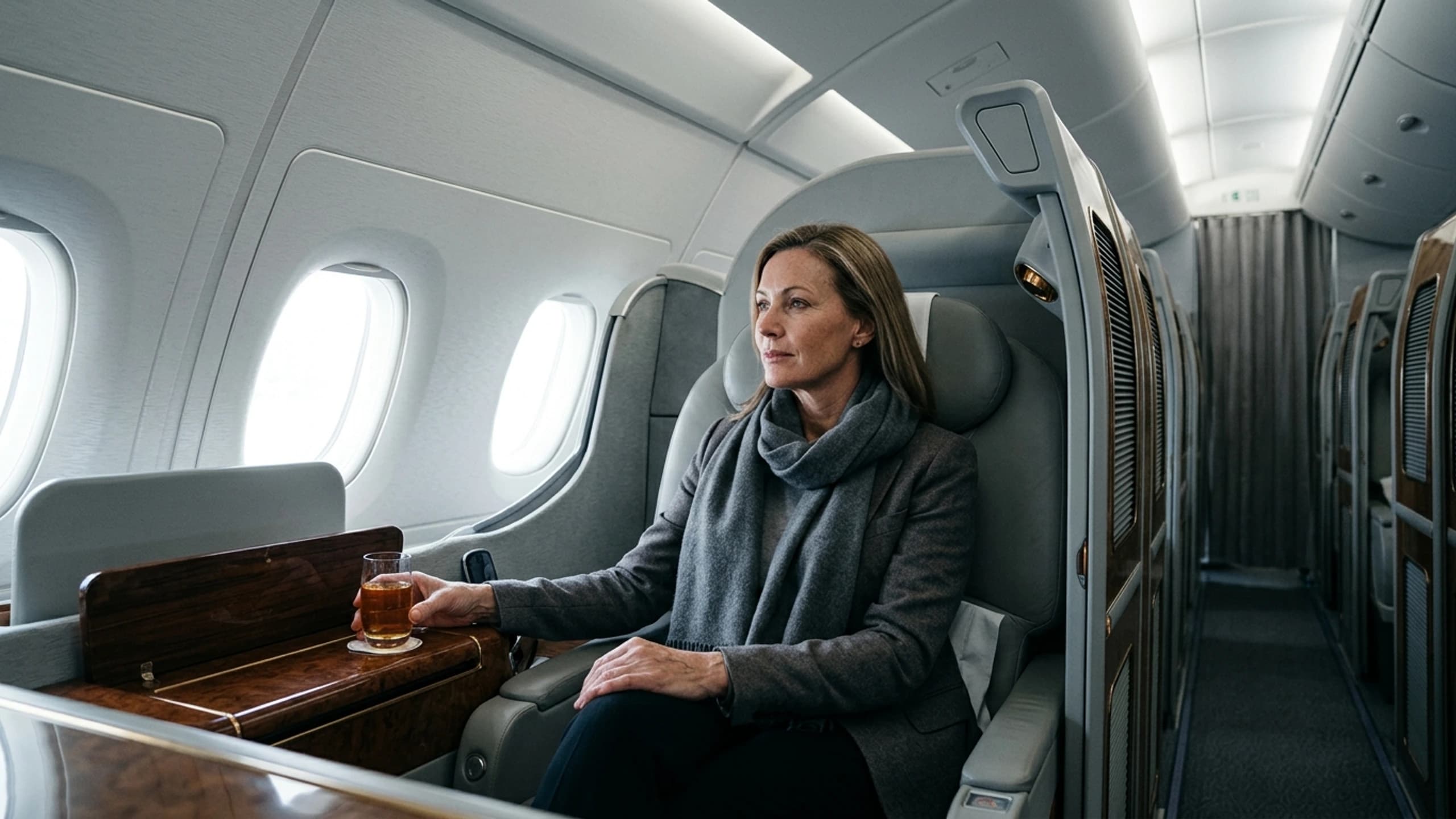
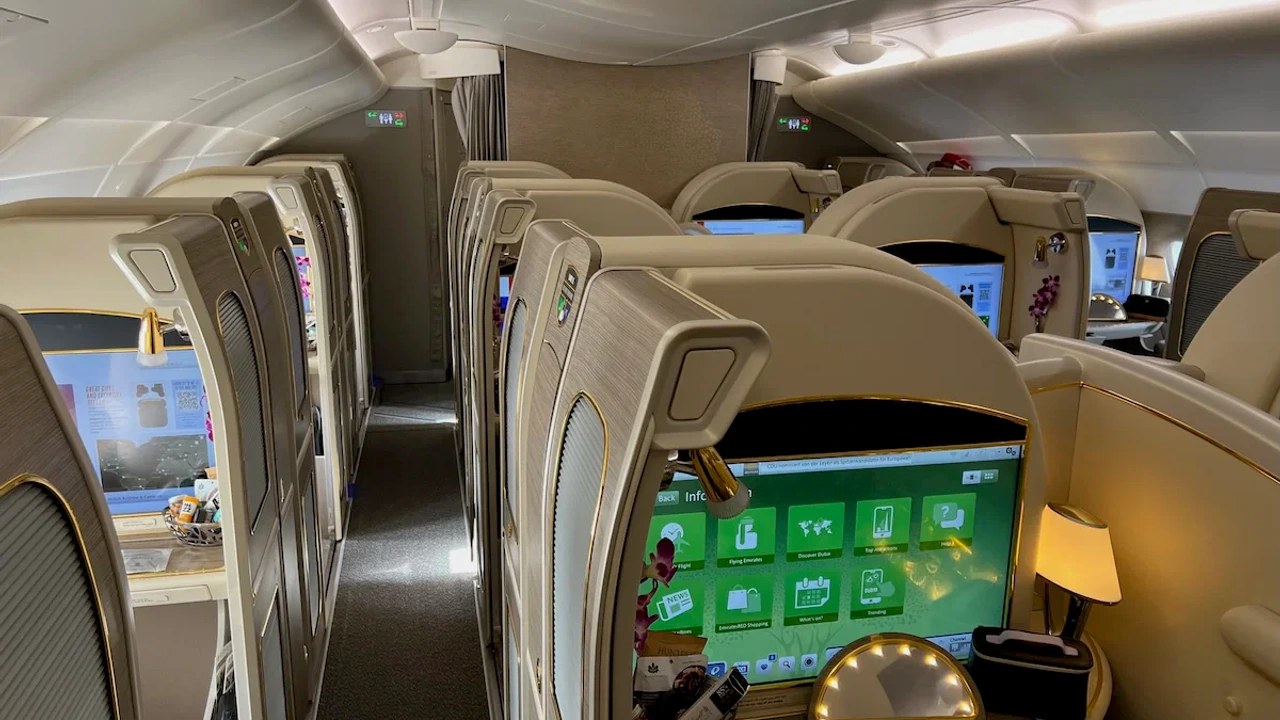
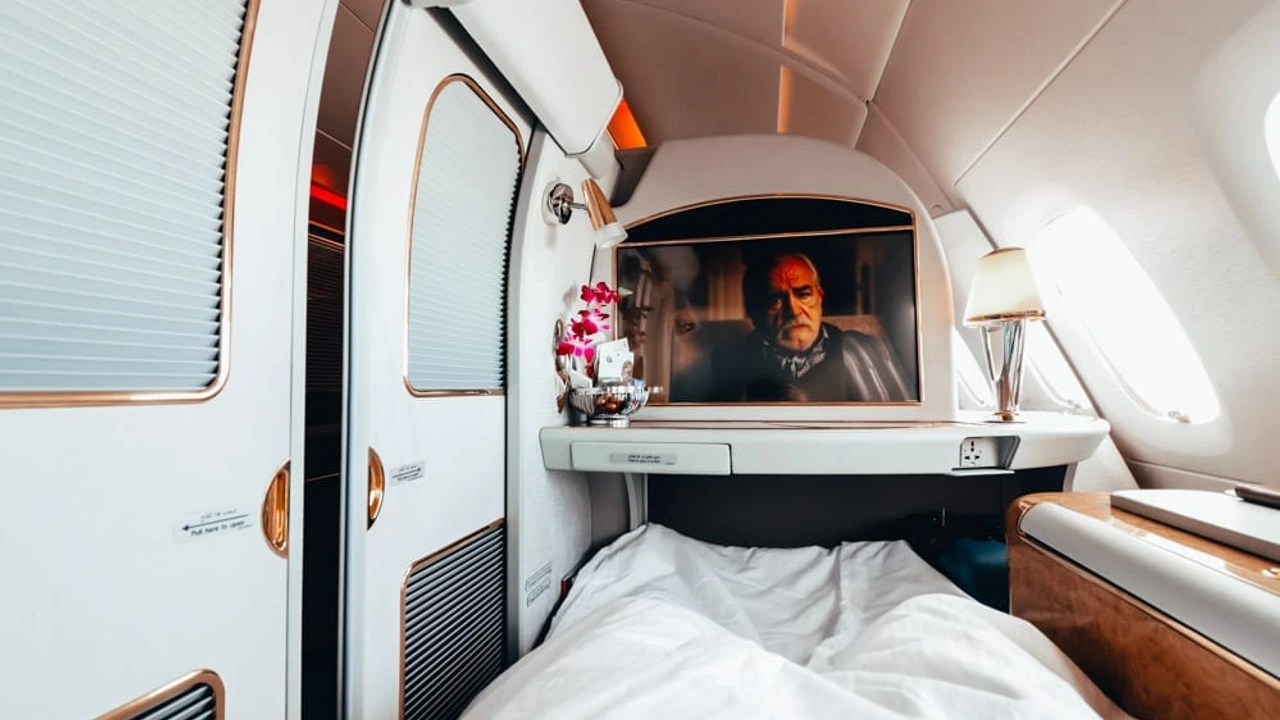
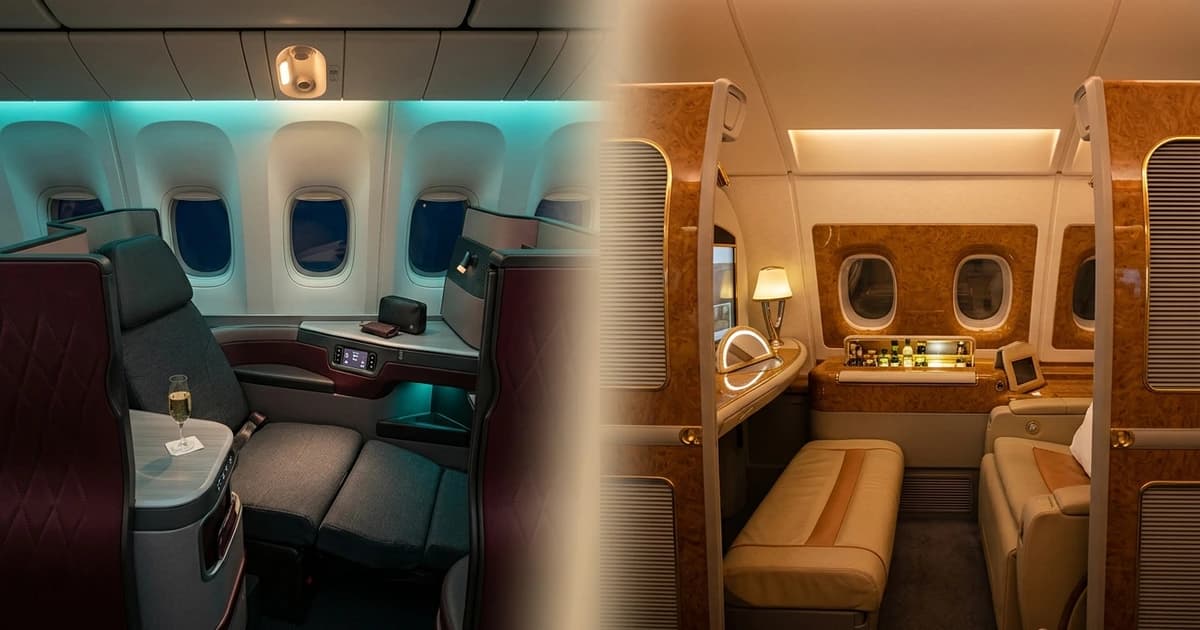
Emirates' A380 first class sits at the front of the upper deck, 14 seats total, laid out 1-2-1. On paper that sounds generous. In practice, the upper deck of an A380 is narrower than most people expect, narrower certainly than a 777, so despite the theatrical doors and privacy screens, this isn't the most spacious first class hard product flying. It's just the most complete.
The 1-2-1 layout gives all 14 passengers direct aisle access, but the upper deck curvature makes overhead bins non-existent.
Eight of the fourteen seats sit at the windows, four per side, and those are the ones to book if you're traveling solo. You get a porthole to stare out of during the inevitable 3am insomnia stretch of a 15-hour sector, and near-total privacy once the door closes. The center pairs, three of them, make more sense for couples, since so many "advanced" first class suites these days wall you off so aggressively that you can't actually see the person you're traveling with. Emirates gets this half right: the center seats let you lower a partition and interact, which more than a few rival first class products (including, oddly, Emirates' own new 777 suite) have quietly engineered away.
One booking note worth flagging: the last row of center seats sits directly beneath a cabin camera. Fine if you don't care. Worth knowing if you do.
The refurbished cabins tone down the gold-and-marble aesthetic Emirates has leaned on for two decades. Less bling, more restraint, some might say it edges toward bland after years of maximalism being the whole point. I liked it. Your mileage on Middle Eastern airline interior design as personal statement may differ.
Seat selection strategy
Solo travelers should book a window suite (rows 1-4, letters A/E on most A380 configurations) for maximum privacy. Couples should target the center-pair seats, but confirm via seat map that you're not directly under the cabin monitoring camera in the rearmost row.
Storage is the one real weakness. There are no overhead bins in the cabin, a design choice meant to make the space feel airier, which means everything goes at your feet or into a small front closet that eats into your legroom anyway. Once the seat converts to a bed, good luck retrieving anything from down there. For a product this expensive, it's a strangely budget-airline oversight.
The Shower Spa: Five Minutes That Everyone Talks About
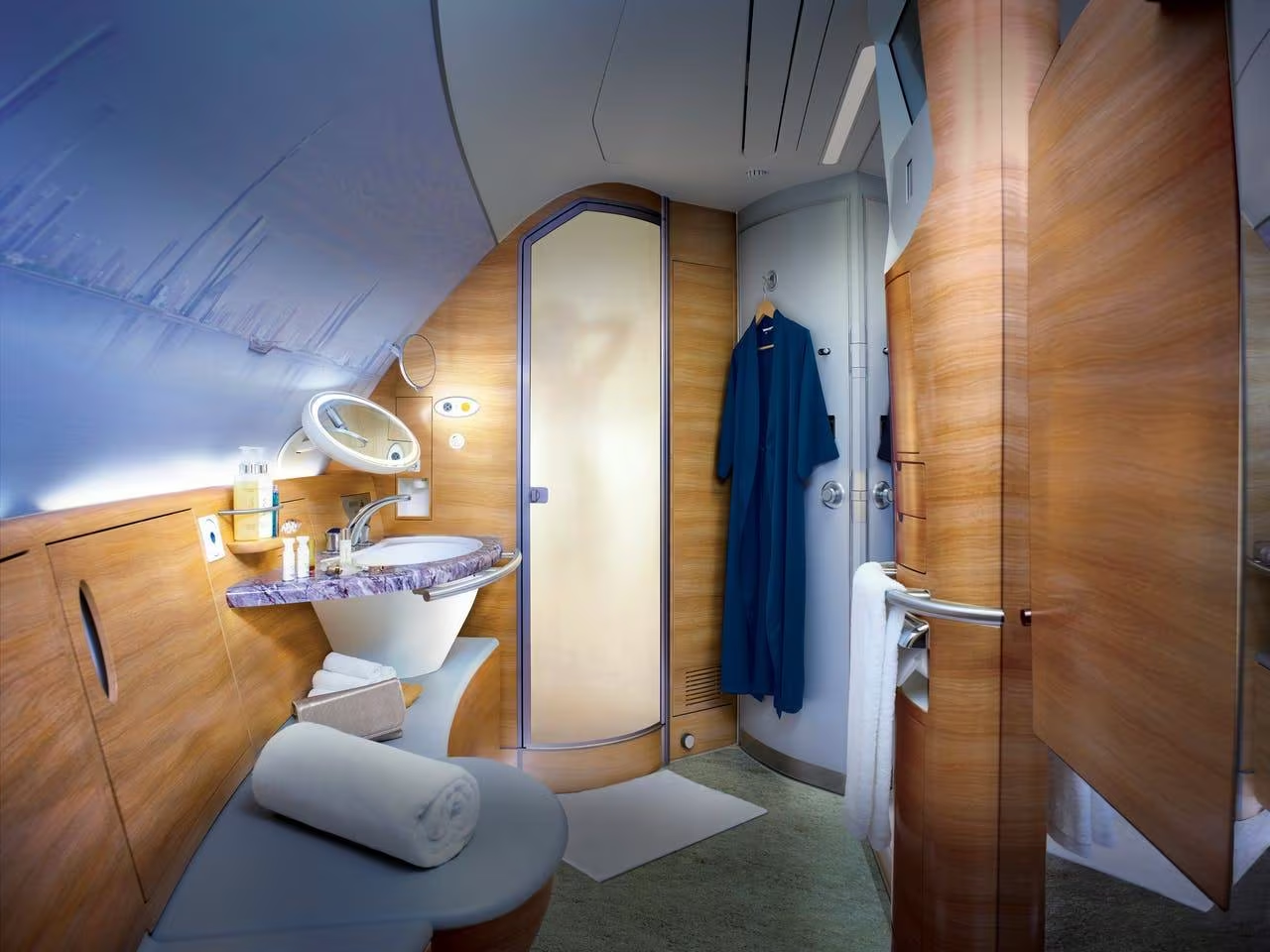
Let's get to the headline feature. Two of the eight window suites feed into a shower spa at the front of the cabin, and it remains the single most photographed, most discussed, most oversold element of the entire Emirates first class experience.
Passengers receive five minutes of hot water tracked by a digital LED timer, with 25-minute slots scheduled by the onboard spa attendant.
Here's how it actually works. You book a slot with the crew, typically in 25 to 30 minute increments to allow for turnover between passengers. You get five minutes of hot water, timed, with a digital display counting down so you know exactly how much you've burned through applying shampoo. On a full first class cabin of 12 to 14 passengers, all wanting a shower on a 16-hour flight, the math gets tight fast; expect to book early or risk missing the window entirely.
5Minutes of hot water per shower booking
Is it worth the hype? Mostly, yes. There's something genuinely disorienting, in a good way, about standing under a real showerhead at 39,000 feet somewhere over the Arabian Sea. The vanity area is well-appointed, the water pressure is better than you'd expect from an aircraft, and Emirates supplies a tote bag specifically for ferrying your things to and from the suite, along with proper Bulgari toiletries rather than the sad travel-size soap you get at most hotels.
The catch nobody mentions in the marketing photos: the room is small, the floor gets slippery, and doing your hair with one hand on a grab bar while a plane experiences light turbulence is not the spa moment Instagram suggests. Book it once for the story. Don't build your entire trip expectation around it.
The Bar: The Only Reason to Actually Leave Your Suite
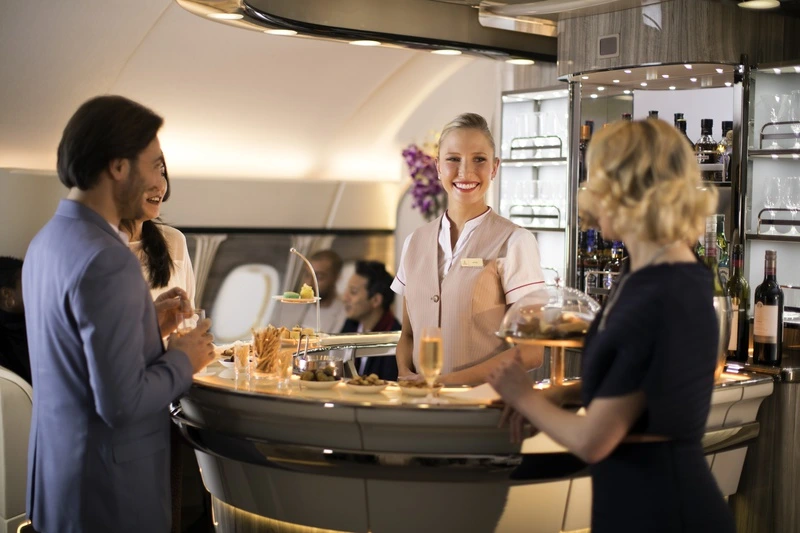
Between the two shower suites sits the onboard bar, arguably the more useful amenity of the two, since it's the one social space on the entire aircraft. Curved seating, a small counter, a dedicated bartender for the sector, and a drinks list that runs deep beyond the obvious champagne pour.
Positioned at the rear of the upper deck, the bar serves both first and business class with premium spirits and open social seating.
This is where first class actually earns its social currency. Solo travelers who'd otherwise spend 16 hours entombed behind a suite door end up here at hour four, comparing notes with the three deadheading pilots seated in row 1 (a genuinely common sight on Emirates long-haul rotations) or trading small talk with whoever else got tired of their own four walls. It's a smart piece of design, frankly smarter than most of the hardware innovations first class marketing tends to obsess over.
Insider Strategy
The bar gets busiest in the first two hours after takeoff and the final two before landing. If you want the counter to yourself for a proper conversation with the bartender about the wine list, aim for the dead middle of the flight, when most of the cabin has retreated to bed.
Catering: Dom Pérignon 2013, Caviar by the Fistful, and Dine-on-Demand
Emirates runs a dine-on-demand model in first class: order what you want, when you want it, across a menu spanning breakfast, lunch, dinner, a light bites section, and even a dedicated "movie snacks" list for the 3am cravings. Crucially, and this is rarer than it should be at the pointy end of the plane, Emirates rarely runs out of items even deep into a 16-hour sector. I've had airlines charge first class prices and then shrug when the lobster's gone by hour six. Not here.
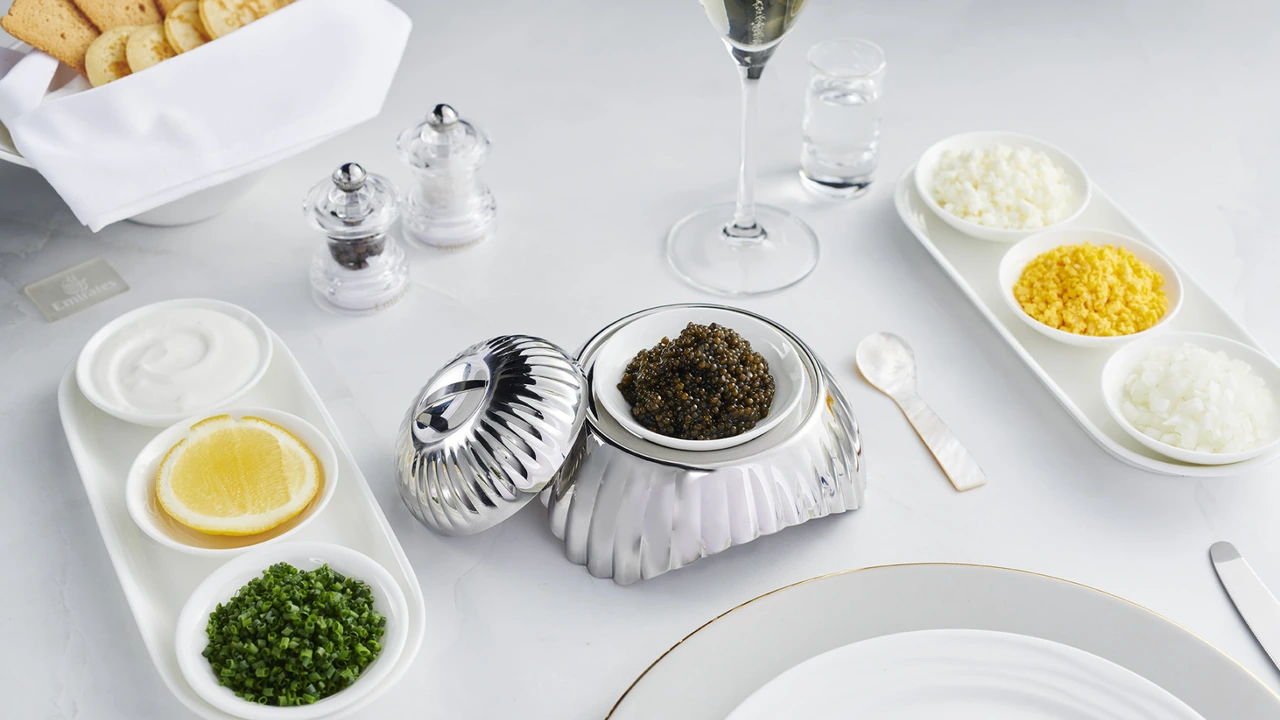
Emirates pours vintage Dom Pérignon alongside unlimited caviar courses on demand, maintaining one of commercial aviation's most generous food programs.
The champagne is Dom Pérignon 2013, poured generously and refilled without prompting. If you're boarding from an outstation rather than Dubai, note that crews sometimes hold the good stuff until after takeoff, a minor logistical quirk worth planning your pre-departure drink order around.
Then there's the caviar. "Unlimited" is the word Emirates uses, and it isn't marketing spin. The portions verge on absurd, more than any single passenger could reasonably finish, which raises the obvious question of waste, though Emirates insists unconsumed catering is returned to Dubai rather than discarded planeside. Whatever the logistics, the sheer volume loaded per first class passenger is the kind of detail that makes this product feel genuinely different from "very good business class," rather than just business class with a closing door.
Arabic coffee and dates arrive early in the flight, unprompted, alongside warm towels, a small ritual touch that costs Emirates almost nothing and does more for the sense of occasion than half the hardware upgrades combined.
Hardware: Bowers & Wilkins, ICE, and a Wi-Fi System That Hasn't Kept Pace
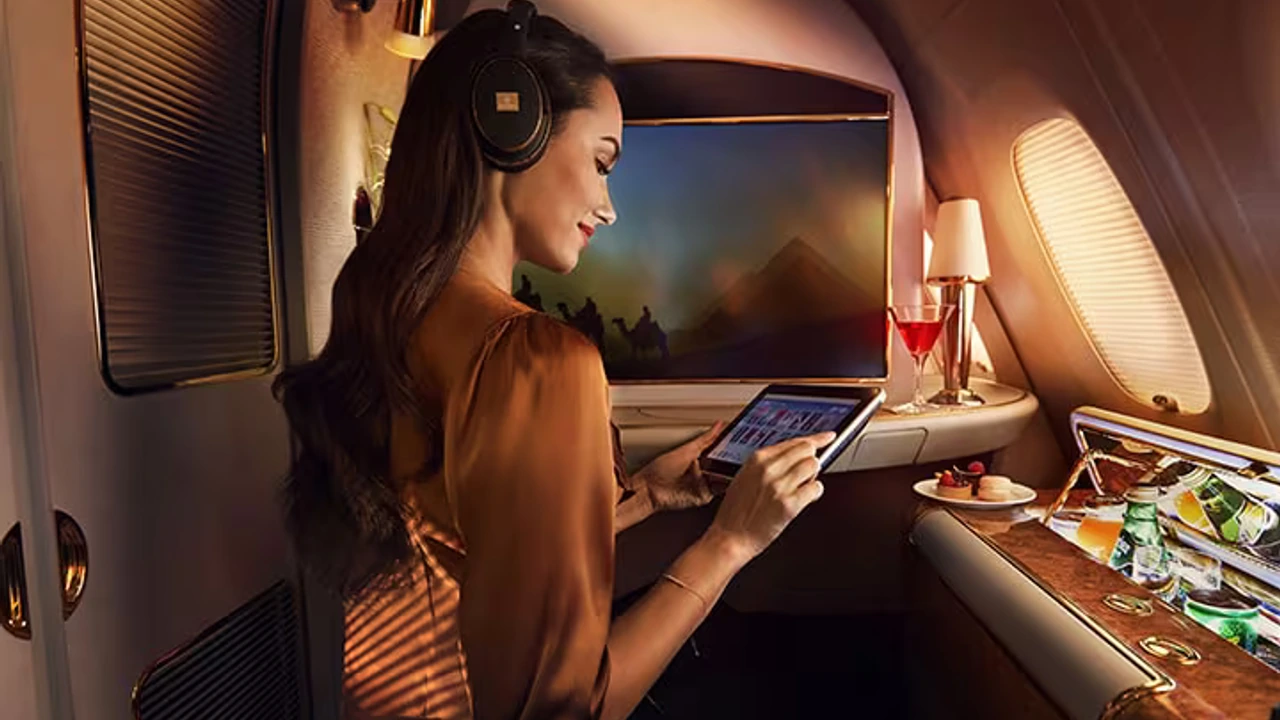
The noise-canceling headphones are genuine Bowers & Wilkins units, a noticeable step up from the generic over-ears most airlines hand out, and they pair well with what remains the deepest inflight entertainment library in commercial aviation. Emirates' ICE system offers thousands of movies, TV box sets, live television, and games, curated with enough range that boredom on a 16-hour sector is entirely a choice.
The 32-inch HD screen and custom Bowers & Wilkins noise-canceling headphones anchor an IFE catalog spanning over 6,500 channels.
The tail camera, a longtime signature feature letting passengers watch takeoff and landing from an external angle, remains a nice touch when it's actually working, which isn't guaranteed. Equipment reliability on an aircraft type this old (many A380s in the Emirates fleet are now well over a decade in service) varies suite by suite and flight by flight.
Wi-Fi is the one genuine letdown. Emirates uses an older satellite connectivity provider on much of its A380 fleet, and speeds lag well behind what you'll find on newer Gulf carrier widebodies or U.S. transcontinental routes. First and business class Emirates Skywards members get it free by logging in with a frequent flyer number; everyone else pays $19.99 for a full-flight pass, reasonable given the sector length, less reasonable given how often the connection simply drops for hours at a time over polar routings.
Coverage gaps on polar routes
On flights routing over the pole (common on Dubai-North America sectors), expect Wi-Fi to disappear entirely for stretches of five to six hours mid-flight, regardless of what the coverage map in the entertainment system suggests. Download content locally rather than relying on streaming.
Also worth flagging for U.S.-bound passengers: security screening at the Dubai first class lounge gate is notably more thorough than at most first class boarding points globally. Expect a bag search and a pat-down as standard procedure, not an anomaly. It doesn't diminish the lounge experience, but it does mean building in slightly more buffer than the boarding time on your pass suggests.
The $20,000 Question
Here's where this review earns its keep, because every travel outlet will tell you the shower is nice and the caviar flows freely. Almost none of them will tell you what this actually costs against the alternative sitting eleven rows back.
CEOFLIGHTS books the same aircraft's business class cabin for $3,200 to $4,500 round-trip JFK-DXB, saving up to 75% compared to retail first class fares.
Retail first class fares on Emirates' marquee A380 routes (Dubai to New York, Dubai to London, Dubai to Los Angeles) routinely price between $18,000 and $22,000 one-way during peak periods, and can push past $25,000 around major holidays. A round-trip in first class on a route like JFK-DXB can clear $40,000 for two passengers without breaking a sweat. Award redemptions aren't the escape hatch they used to be either: Emirates Skywards first class awards now regularly run 150,000 to 190,000 miles one-way plus several hundred dollars in taxes and surcharges, a steep enough number that even frequent flyers with healthy point balances wince.
$20,000Typical one-way retail first class fare, DXB-JFK
Business class on the same aircraft, same crew, same catering kitchen, tells a completely different story.
Through CEOFLIGHTS, round-trip business class fares on this exact JFK-DXB pairing run $3,200 to $4,500 depending on season and availability, booked through our consolidator relationships rather than retail airline pricing. That's not a one-way first class fare divided by six. That's the full round-trip, for less than a quarter of a single one-way first class ticket.
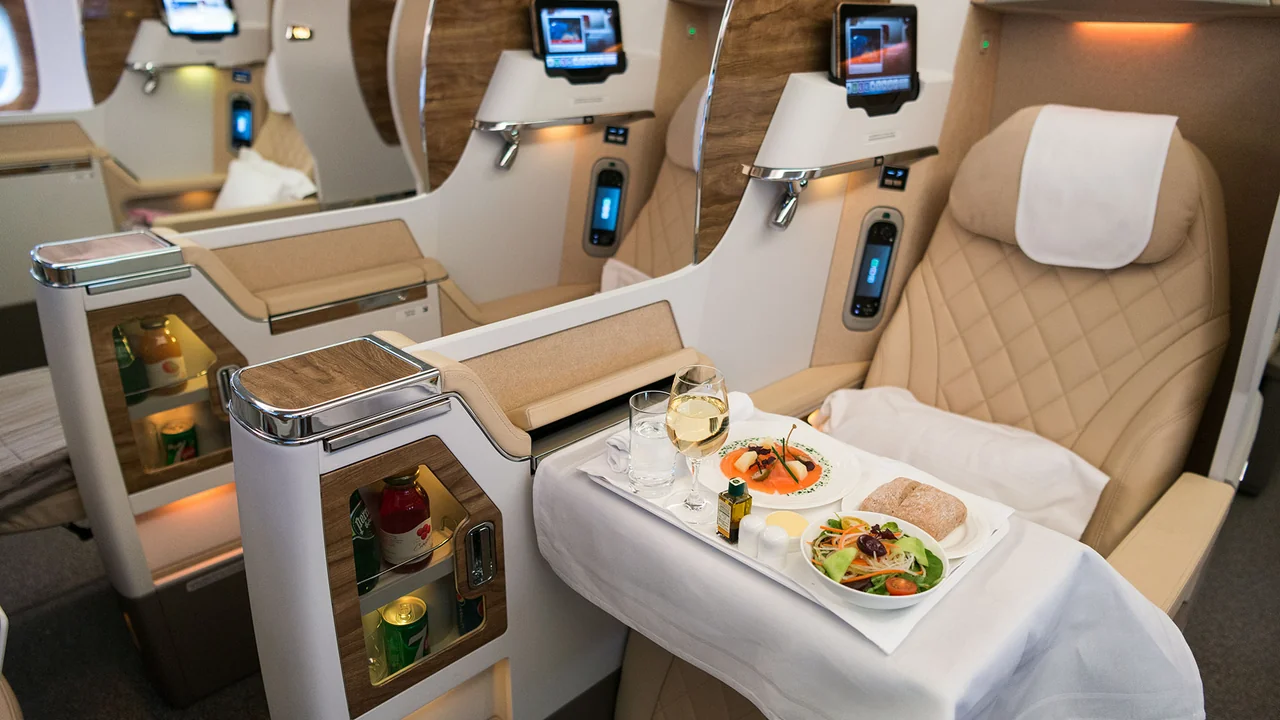
Emirates business class isn't the suite with the shower and the caviar tower, to be clear. It's a lie-flat seat, generally in a 1-2-1 or staggered configuration depending on aircraft, with access to the same onboard bar on A380 routes, a strong (if not first-class-tier) meal service, and lounge access at Dubai that's genuinely excellent in its own right. What you lose is the private suite door, the shower slot, and the unlimited caviar. What you keep is a flat bed, a real dinner service, and roughly $16,000 to $18,000 back in your pocket per one-way segment.
For most executives flying this route for business rather than for the Instagram post, that trade is not close. First class earns its premium as an experience. It does not earn a 5x to 6x markup as a means of transportation, which is, after all, what a plane ticket fundamentally is.
Insider Strategy
If the shower and the private suite genuinely matter for a specific trip (an anniversary, a milestone birthday, a one-time bucket list flight), book it once, deliberately, and treat it as the splurge it is rather than a routine travel decision. For recurring business travel on this route, the arbitrage between retail first class and consolidator-priced business class through CEOFLIGHTS is simply too large to ignore.
Booking Strategy: Miles, Cash, and Where the Leverage Actually Sits
If you're set on first class specifically, timing and flexibility matter enormously. Emirates releases first class award space unevenly, often only on routes and dates with soft cash demand, meaning the miles-based redemption path frequently opens up on exactly the flights retail buyers aren't rushing to book. Paying cash gets you guaranteed access to any date, at the cost described above.
For business class, the calculus shifts almost entirely toward consolidator pricing rather than public fare classes or miles redemptions. Emirates rarely discounts business class publicly the way U.S. carriers do around fare sales, but wholesale and negotiated rates through operators like CEOFLIGHTS regularly beat both the published fare and the effective cash-plus-miles cost of most award redemptions. It's worth asking a CEOFLIGHTS travel manager for a current fare before assuming award space is your best option; on this particular route, it usually isn't.
Where the Product Actually Falls Short
No review this detailed should read like a press release, so a few honest gripes.
In bed mode, the suite provides a 78-inch flat surface, though the mattress pad remains noticeably thinner than Singapore Suites.
The storage problem is real and Emirates hasn't fixed it across multiple cabin refreshes. For a product costing five figures one-way, the absence of a proper overhead bin or in-suite closet that doesn't double as legroom is a genuine design miss.
Wi-Fi reliability lags well behind competitors flying newer aircraft with modern satellite systems. Qatar Airways and Singapore Airlines both offer noticeably faster, more consistent connectivity on comparable long-haul first class products, which makes Emirates' otherwise dominant entertainment and catering package feel slightly dated on the connectivity front.
And the aircraft themselves are aging. Many Emirates A380s are now well past their tenth year in service, and while cabin refreshes address soft goods and finishes, hard equipment like the tail camera and certain seat mechanisms occasionally shows its age in ways a five-figure fare shouldn't tolerate.
None of this sinks the experience. All of it should factor into whether the premium over business class is buying you something proportional to its price, or simply buying you a very nice story to tell.
The Verdict
Emirates A380 first class remains one of the most complete, most genuinely enjoyable ways to spend 16 hours in the sky. The shower works. The bar is a smart, social design choice most competitors haven't matched. The catering, particularly the caviar and the Dom Pérignon service, is generous in a way that feels almost defiantly analog in an era of cost-cutting airline catering.
But the price is the price, and for most business travelers flying this route regularly, business class booked through the right channel closes almost the entire experiential gap at roughly a fifth of the cost. The suite door and the shower slot are real luxuries. They are not, on a pure cost-per-hour-of-improvement basis, five times better than a flat bed eleven rows back.
Fly first class once, for the occasion. Fly business class for everything else, and book it through a CEOFLIGHTS travel manager before assuming the published fare is the only number on the table.
Content creator and business travel specialist at CEOFLIGHTS, bringing you the latest insights, tips, and trends in premium business and first-class travel.
Become the CEO of Your Journey
You take the lead. Your dedicated Personal Travel Manager handles every detail.