American vs United business class in 2026: which airline is actually winning?
Scott Kirby says there's only room for two premium airlines in America, and American isn't one of them. We put Flagship Suite against Polaris Suite, hub against hub, and fare against fare to see if he's right.
CEOFLIGHTS Team16 min read
Quick summary
American's new Adient Ascent Flagship Suite (debuting on the 51-suite Boeing 787-9P, A321XLR, and retrofitted 777-300ERs) adds a sliding door and chaise-lounge mode, while United's new "Elevated" 787-9 Polaris suite counters with a sliding door, 27-inch 4K OLED screen, and eight front-row Polaris Studio suites
Across the broader widebody fleets, United still offers more consistent forward-facing 1-2-1 seating, whereas older American 777-200ER and 787-8 frames still carry door-less seats (including alternating rear-facing rows on select subfleets)
CEOFLIGHTS consolidator fares on transatlantic Flagship and Polaris routes save 15%–60% below published airline retail, often cutting $2,000 to $3,200 off round-trip tickets
United's CEO Scott Kirby went on a podcast recently and said something he's said before, just louder this time. Two airlines matter in America now, he told Scott McCartney on the Airlines Confidential podcast. United and Delta. Everyone else, American included, is "competing for spill traffic." He didn't hedge. He said it flat out, twice, just to make sure nobody thought he'd misspoken.
That's a bold thing to say about a carrier that flies a massive widebody fleet and dominates Latin America and London Heathrow slots. But here's the uncomfortable part for American loyalists: the financial numbers haven't exactly made Kirby look foolish. American posted a third-quarter net loss in a period that is historically one of the strongest quarters of the year for transatlantic yields. United did not.
So we decided to stop arguing about executive soundbites and compare the two products directly: seat by seat, hub by hub, lounge by lounge, and dollar by dollar. If you're deciding whether American Airlines or United Airlines deserves your long-haul fare this year, the answer is much more nuanced than "United won a podcast."
The hardware: Flagship Suite versus Polaris Suite
Start with the seat, because that's what you're actually living and sleeping in for eight to fifteen hours across the ocean.
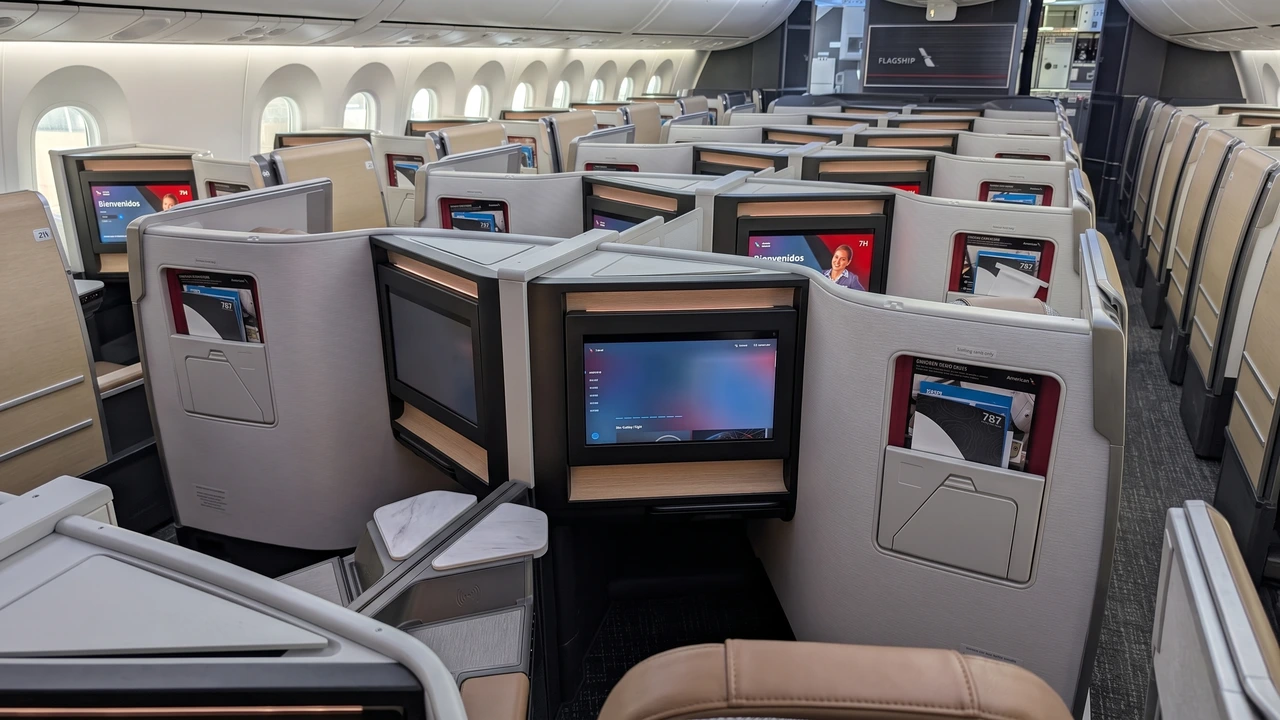
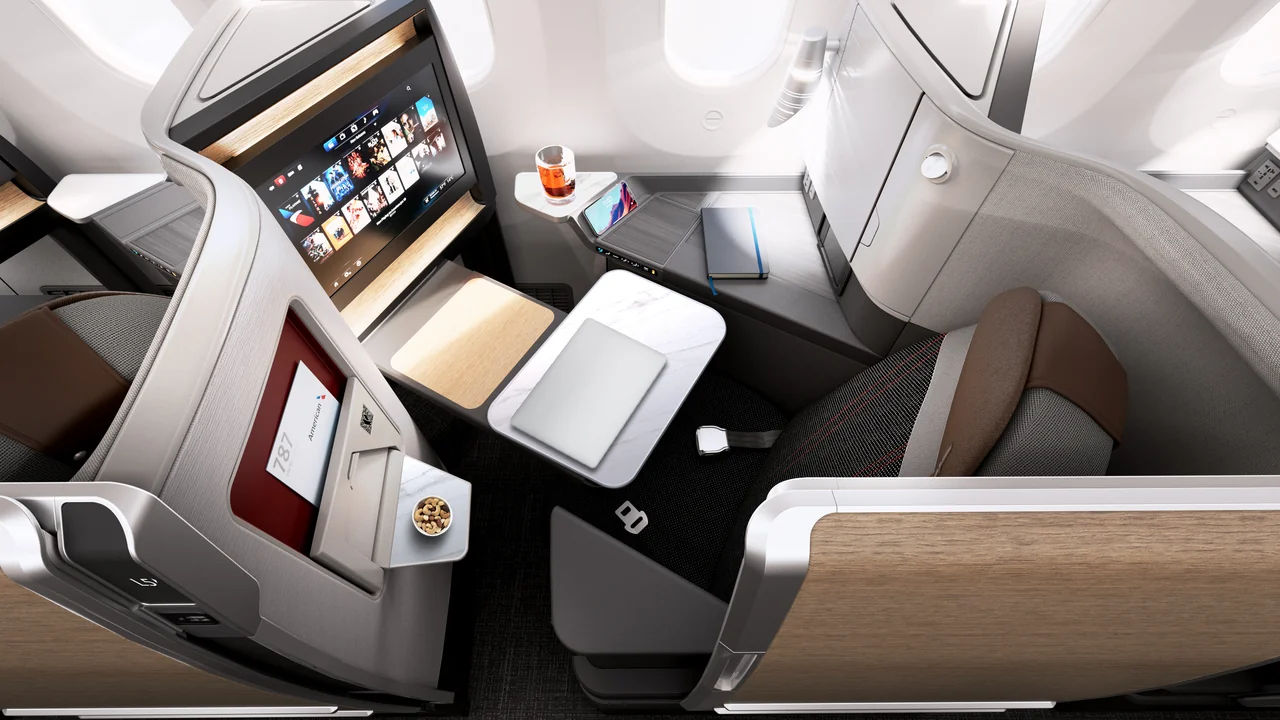
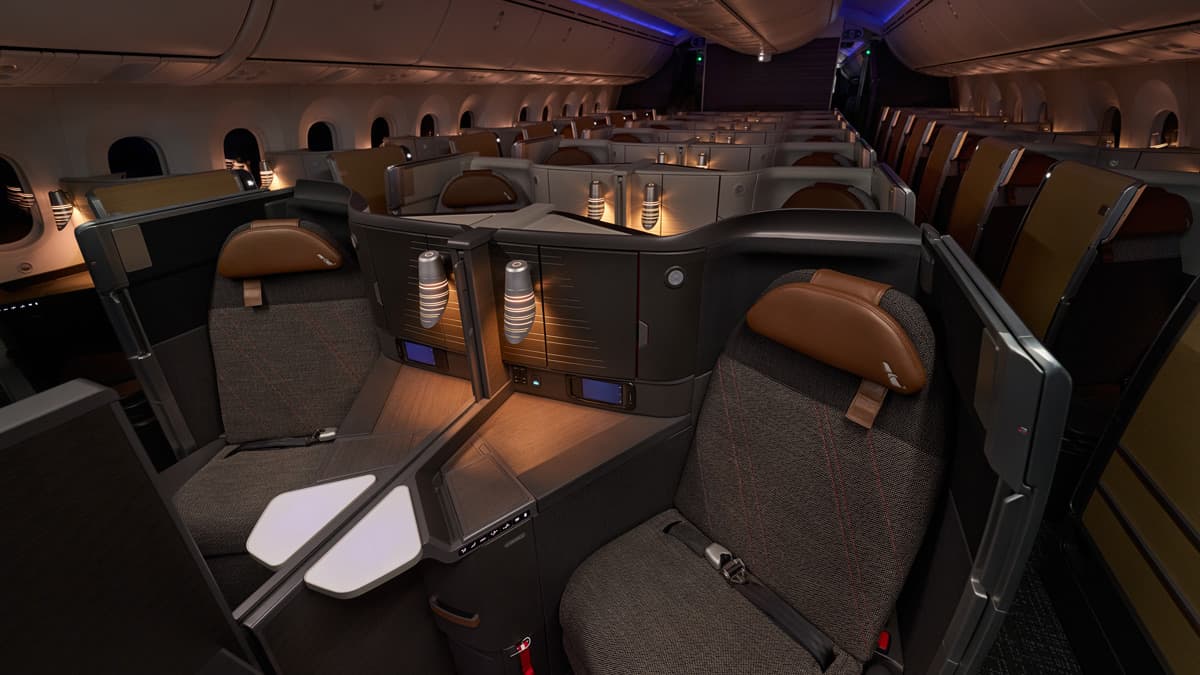
American Airlines' Boeing 787-9P Flagship Suite cabin in a 1-2-1 reverse-herringbone layout with sliding privacy doors, wireless charging pads, and wood-grain trim.
American's new Flagship Suite — built on the Adient Ascent platform and rolling out on the 51-suite Boeing 787-9P (which entered commercial service in mid-2025), the Airbus A321XLR, and retrofitted Boeing 777-300ERs — measures roughly 21.5 inches wide with a sliding privacy door, a chaise-lounge cradle position, a built-in wireless charging pad, and 78 inches of bed length. In a 1-2-1 reverse-herringbone layout angled toward the windows, the suite feels warm, residential, and genuinely competitive with European and Gulf flagships. The catch is fleet consistency: American still operates dozens of Boeing 777-200ER and 787-8 aircraft fitted with older, door-less Flagship Business seats — either the solid Collins Super Diamond or the much-maligned Safran Concept D (Zodiac) subfleet, where alternating rows face backward and rock slightly when your neighbor moves.
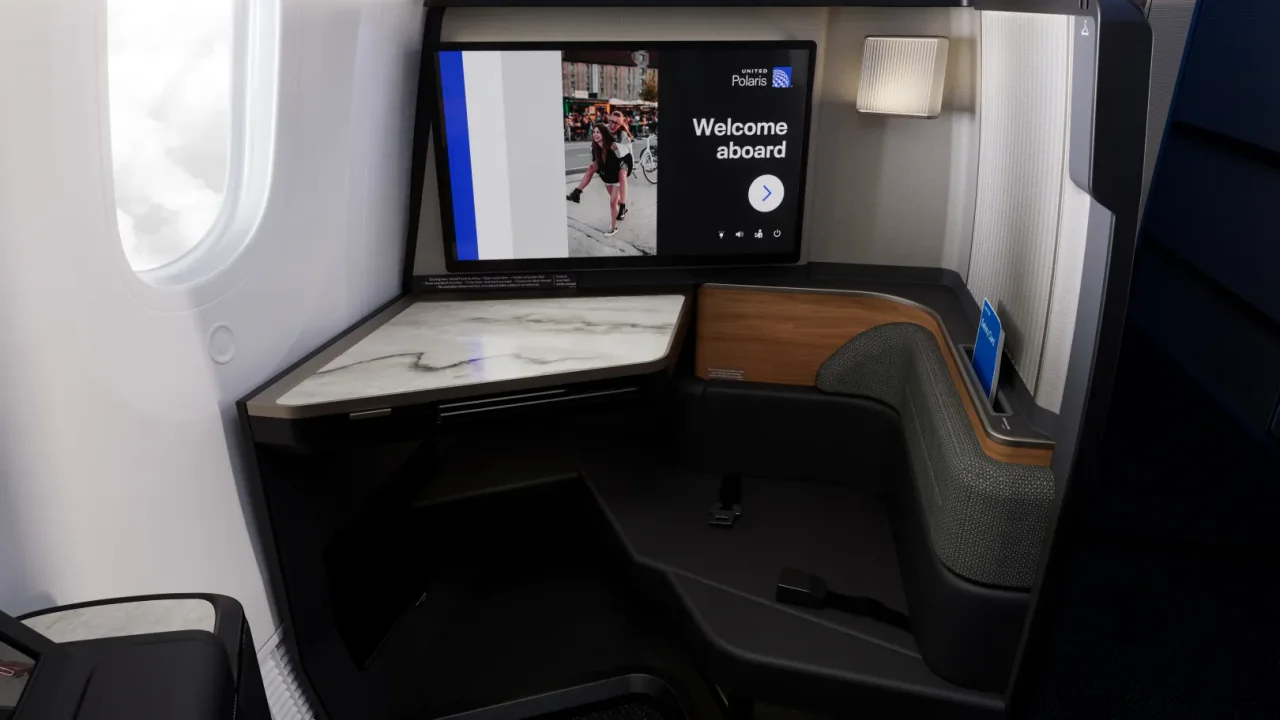
United's next-generation 'Elevated' Boeing 787-9 Polaris suite pairs a sliding door and 27-inch 4K OLED screen with quartzite-style side consoles, while older widebodies retain the classic 2016 Safran Optima pod.
United's Polaris cabin tells the opposite story. For years, United's advantage wasn't having the flashiest seat — it was fleet-wide standardization. Every widebody in United's main international fleet (767-300ER, 767-400ER, 777-200ER, 777-300ER, 787-8, 787-9, and 787-10) received the forward-facing 1-2-1 Safran Optima Polaris pod, where odd-numbered window seats sit straight and flush against the windows for maximum privacy and even-numbered seats angle slightly toward the aisle. In May 2025, United unveiled its next-generation "Elevated" Boeing 787-9 interior (entering service in 2026), upgrading to Adient Ascent Polaris suites with sliding doors and massive 27-inch 4K OLED screens, plus eight oversized front-row Polaris Studio suites with companion ottomans and caviar service. Until those new 787-9 deliveries make up a larger share of the fleet, however, most United flights you board in 2026 will still feature the familiar 2016-era door-less Safran Optima pod.
21.5Flagship Suite seat width (inches) on American's new 787-9P
27"4K OLED screen size (inches) on United's new Elevated 787-9 Polaris Suite
So on pure hardware, when you catch either carrier's newest Boeing 787-9, it's nearly a dead heat: both use customized versions of the Adient Ascent suite with sliding doors and wireless charging. Where they diverge is what happens when you get an older aircraft. On United, the fallback is a reliable, forward-facing Safran Optima pod (just pick an odd-numbered window seat like 3A or 9L). On American, the fallback on a 777-200ER or 787-8 can still mean a door-less seat — or, if you don't check the seat map carefully, a rear-facing Concept D seat.
Insider Strategy
Before booking either airline's business class for a long-haul flight, check the exact aircraft subfleet on ExpertFlyer or the seat map. On American, look for the 51-business-seat 787-9P to guarantee the new Flagship Suite with doors (versus the older 30-business-seat 787-9), and avoid rear-facing rows on 777-200ER/787-8 Concept D maps. On United, always grab an odd-numbered window seat (1A, 3A, 5A, 9A) so your seat is set straight against the fuselage rather than angled toward the aisle.
Route network: the real gap nobody's Instagramming
This is where the conversation gets more honest, and less flattering to American.
United has spent the last five years building out Newark, Chicago O'Hare, Houston, Denver, San Francisco, and Washington Dulles into an aggressive global network. Newark alone runs a massive wave of evening widebody departures to Europe, Africa, India, and the Middle East. Chicago has become a fierce battleground where, as Kirby put it, he "wouldn't want to play American's hand." United has been adding international capacity at O'Hare specifically because American consolidated so much of its transatlantic flying into Dallas-Fort Worth, Charlotte, and Philadelphia.
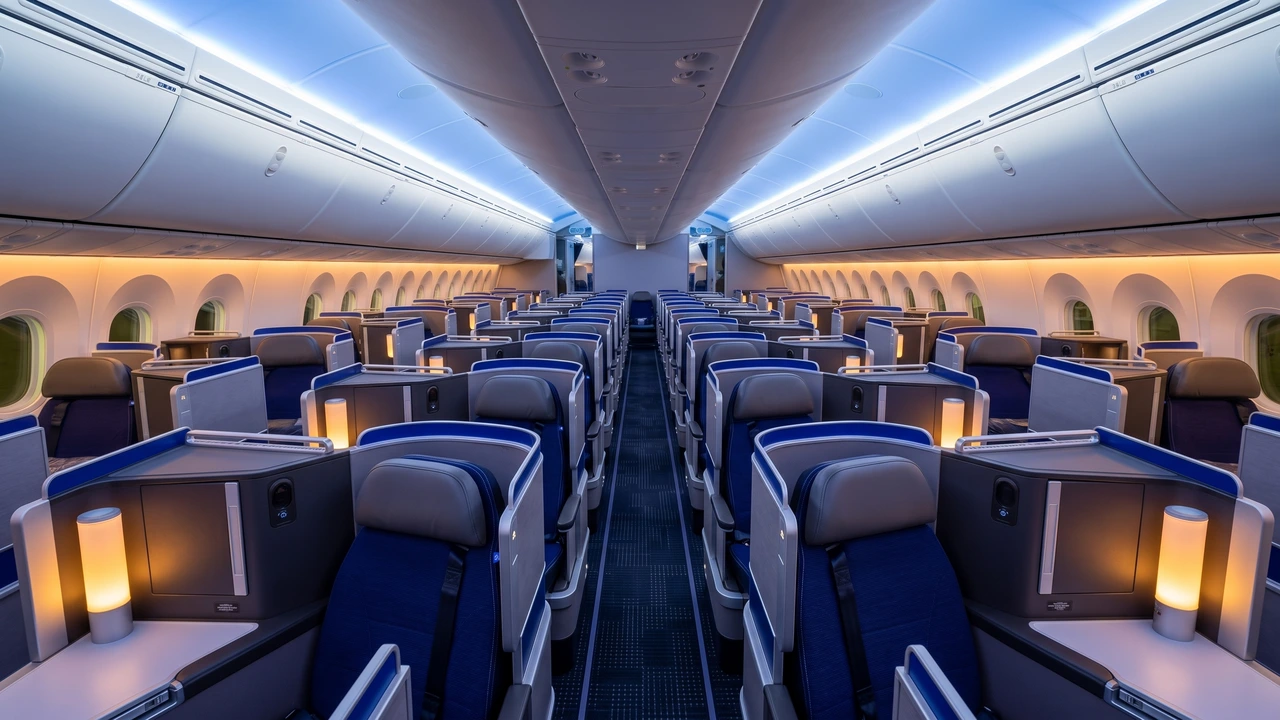
United's standardized 1-2-1 Polaris cabin across its Boeing 787 and 777 fleet: odd-numbered window seats sit straight against the fuselage for maximum privacy on 14-to-16-hour crossings.
American, for its part, still holds genuine structural advantages that get lost in all the Kirby noise. Its joint venture partnerships with British Airways, Iberia, Finnair, Qantas, and Japan Airlines give American customers seamless access to slot-constrained hubs like London Heathrow Terminal 5/3 and Tokyo Haneda. Miami remains an extraordinary Latin America gateway; no U.S. carrier touches American's frequency and network depth into South America from a single hub. And Charlotte and Dallas-Fort Worth run some of the largest domestic connecting banks in the world, which matters enormously if you live in a secondary U.S. market rather than a coastal gateway.
Still, United's international expansion over the past three years — adding secondary European leisure cities like Palma de Mallorca, Faro, Palermo, and Bilbao alongside deep transpacific breadth from San Francisco to Manila, Taipei, and Singapore — gives it a reach on its own metal that American has largely ceded to its oneworld partners.
Same destination, five minutes apart in block time, and two very different operational philosophies behind them.
Hub airport experience: Newark's ghosts versus Charlotte's charm
Nobody who has flown through Newark in the last two years needs a lecture on New York TRACON air traffic control delays, and to be fair to United, much of Newark's operational friction traced back to FAA controller staffing shortages and runway work rather than United's own dispatchers. Even so, plenty of travelers we work with at CEOFLIGHTS deliberately route through Charlotte, Philadelphia, or Dallas-Fort Worth on American — or fly out of JFK Terminal 8 — rather than chancing a tight summer afternoon connection at EWR.
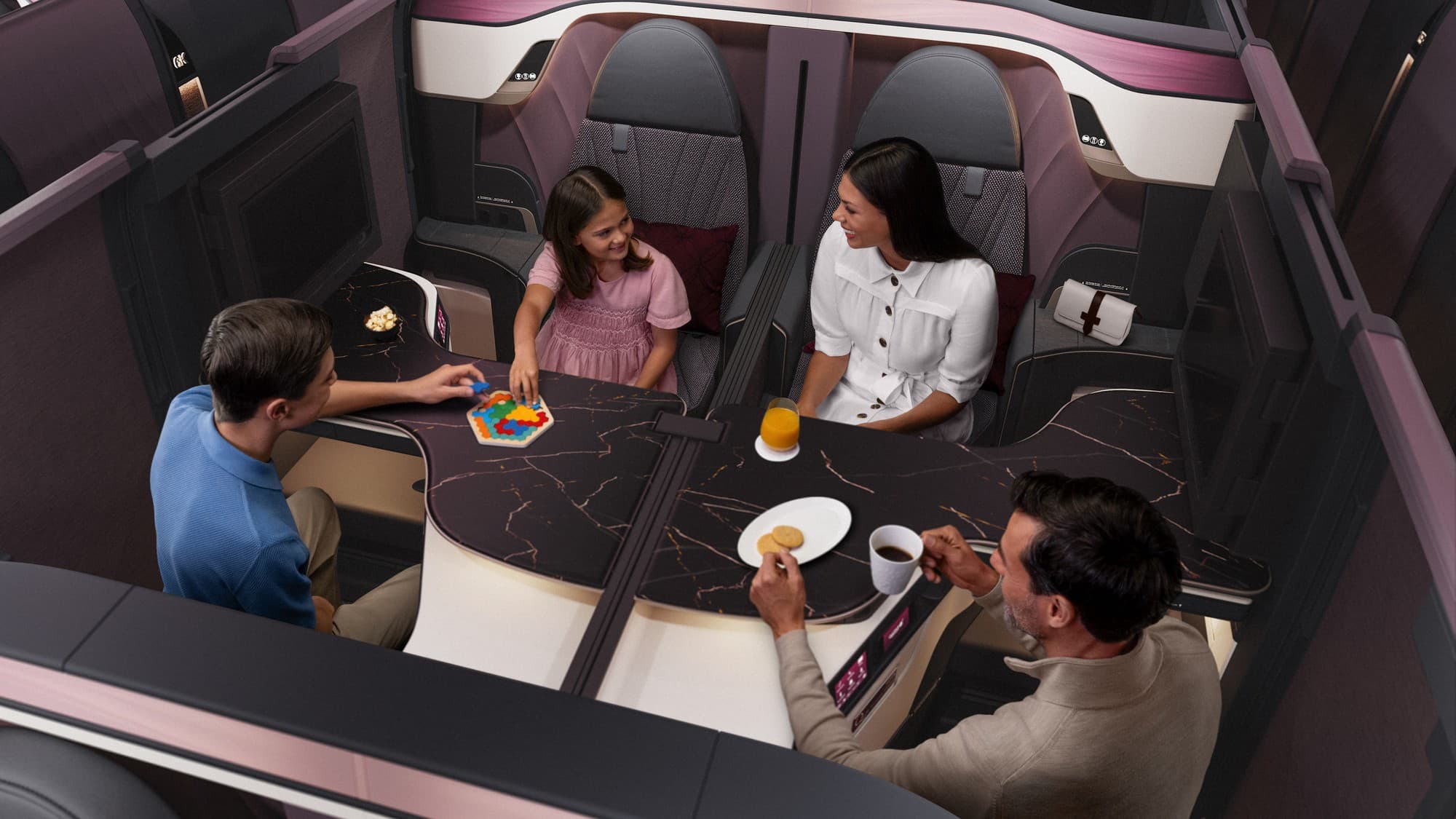
Dual-level side console and dining table inside the Flagship Suite: enough surface area to keep a laptop open alongside a cocktail without juggling trays.
Charlotte doesn't get enough credit as a connecting hub: walk times between concourses are predictable, and winter weather rarely shuts it down. Philadelphia, too, has quietly become a much stronger transatlantic connecting point for American since its new Flagship Lounge opened on Concourse A-West in May 2025.
Chicago O'Hare is the most revealing head-to-head battleground. American's Terminal 3 operation has felt increasingly pinched as United has poured investment into Terminal 1. If you're based in the Midwest and flying nonstop to Europe or Asia, United's schedule depth out of ORD is hard to argue against.
A note on Newark connection buffers
United's Newark operation has stabilized since the FAA moved Newark approach control to Philadelphia TRACON, but summer afternoon thunderstorm banks still trigger ground delay programs quickly. If you are connecting through EWR onto an evening transatlantic departure between May and September, build in at least 2 hours and 15 minutes of buffer.
Lounge quality: Flagship versus Polaris, on the ground
On the ground, both airlines have invested heavily, though their access rules create very different experiences during the 5:00 p.m. to 9:00 p.m. transatlantic departure rush.
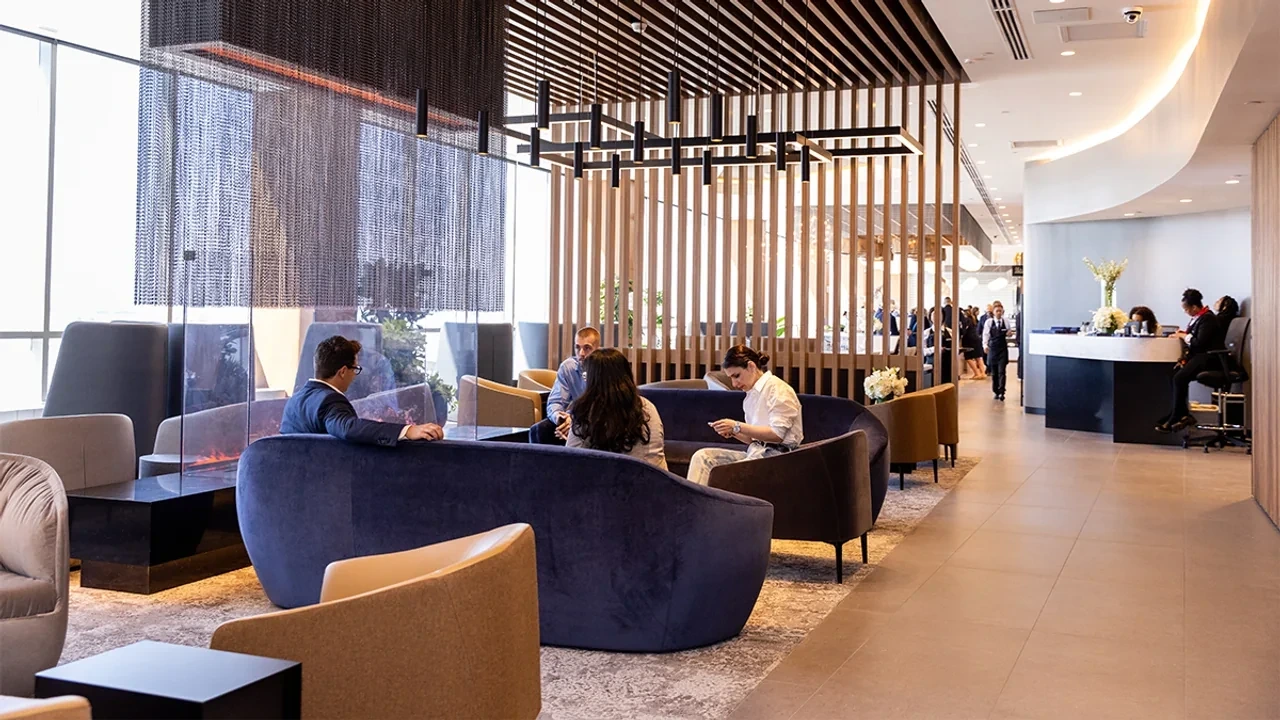
American Airlines Flagship Lounge: bright, expansive seating and self-pour champagne bars, though shared access with oneworld Sapphire and Emerald flyers makes peak evening banks busier than Polaris.
American operates standalone Flagship Lounges at Miami (MIA), Chicago O'Hare (ORD), Dallas-Fort Worth (DFW), Los Angeles (LAX), and Philadelphia (PHL, newly opened in May 2025), while at New York JFK Terminal 8 it operates three joint tiered lounges with British Airways (Greenwich for business class, SoHo for oneworld Emerald, and Chelsea for Flagship First and BA First). The self-pour champagne bars, shower suites, and chef action stations are genuinely strong, and Flagship First Dining at MIA and DFW (plus the Chelsea Lounge at JFK) remains one of the best sit-down pre-flight meals in North America. The downside is crowding: because American grants Flagship Lounge entry to oneworld Sapphire and Emerald elites even on qualifying international economy tickets, peak evening banks can get loud.
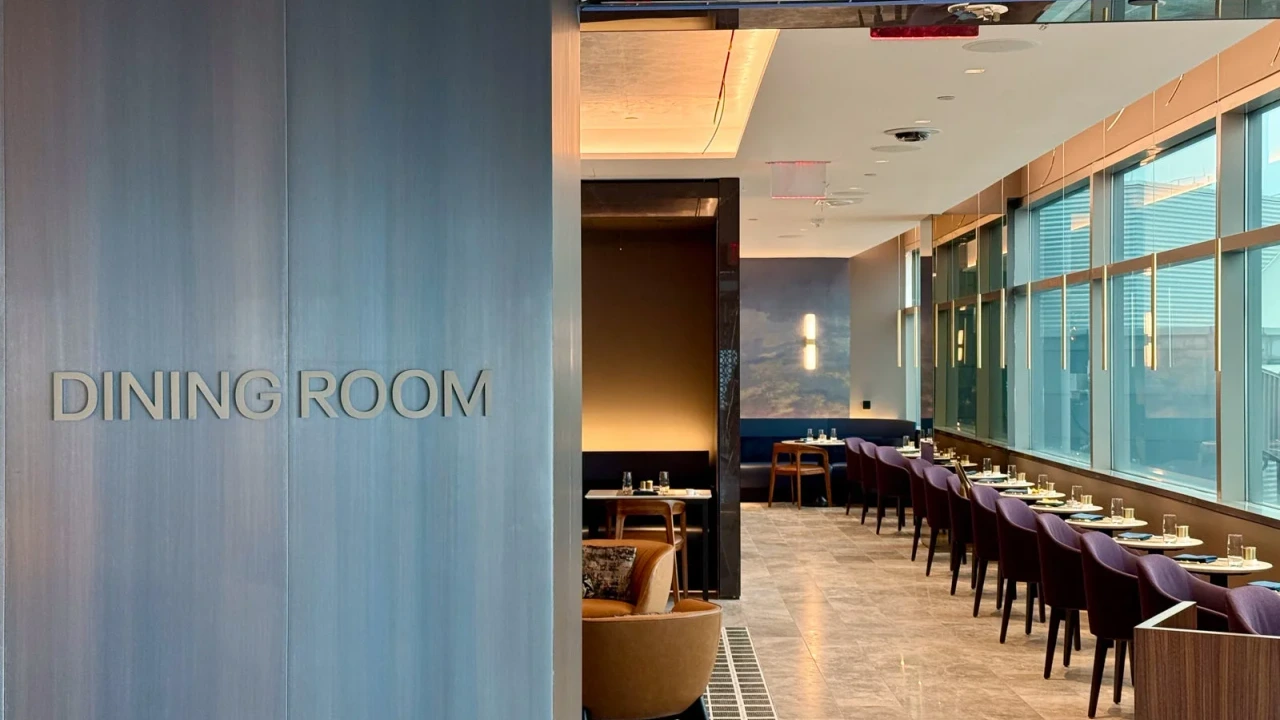
The sit-down dining room inside a United Polaris Lounge: restricting entry strictly to long-haul business and first class ticket holders keeps table-service wait times manageable before overnight departures.
United operates six dedicated Polaris Lounges — at Newark (EWR), Chicago O'Hare (ORD), Houston (IAH), Washington Dulles (IAD), San Francisco (SFO), and Los Angeles (LAX). Because United restricts Polaris Lounge entry strictly to passengers holding a same-day long-haul business or first class boarding pass (pushing Star Alliance Gold flyers in economy over to the standard United Club), Polaris Lounges feel calmer, more exclusive, and much better suited to eating a full sit-down dinner in the dining room before boarding an overnight flight to Europe, so you can go straight to sleep after takeoff.
5Standalone American Flagship Lounges (MIA, ORD, DFW, LAX, PHL) plus 3 joint JFK T8 lounges
6Dedicated United Polaris Lounges (EWR, ORD, IAH, IAD, SFO, LAX)
Catering: where American still, quietly, wins
Here is where I'll happily take the contrarian position. Everyone debates suite doors and lounge square footage, yet on an eight-to-twelve-hour daytime westbound flight back from Europe, onboard catering matters more than almost anything else.
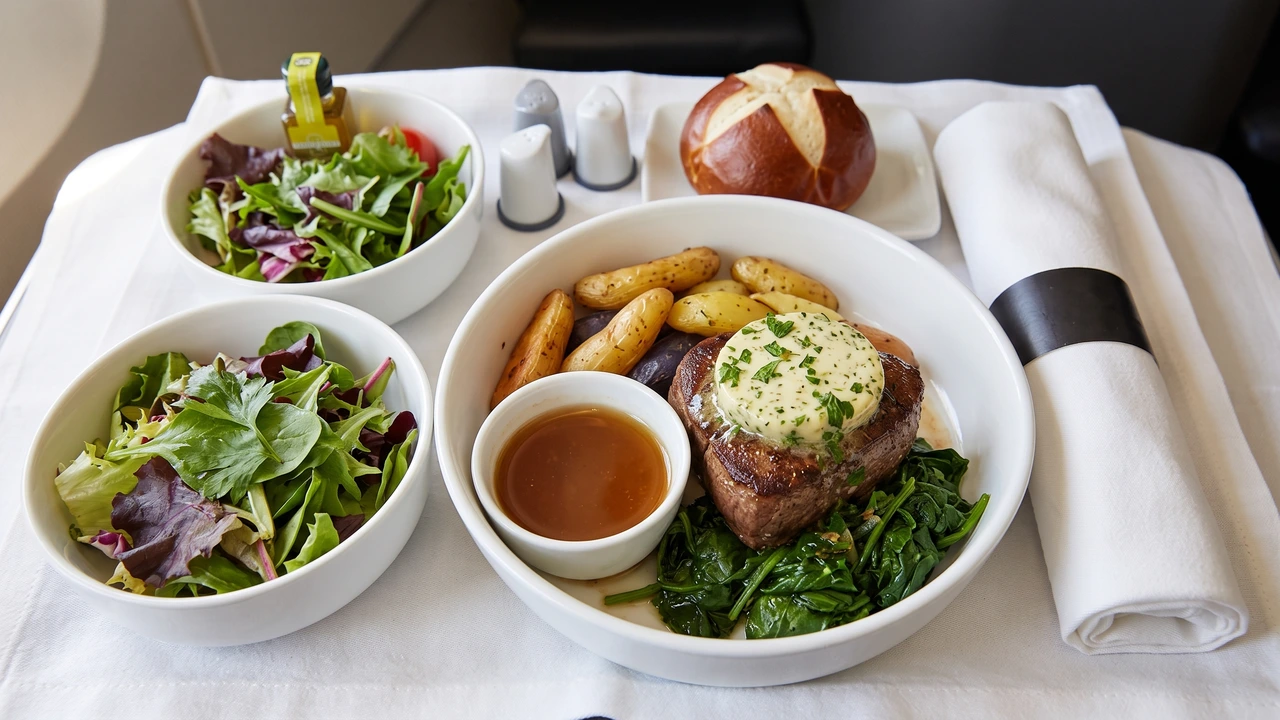
American Airlines Flagship Business inflight table service: linen-draped trays, seared beef filet with herb butter, warm pretzel rolls, and more consistent main-course execution at 37,000 feet.
American's Flagship catering has been noticeably more consistent in the air over the past year, with warm ramekins of mixed nuts, rotating regional menus, a sharper wine list, and protein courses (especially the short rib and seared steak options) that arrive at the right temperature. Plus, American lets you pre-order your main course online up to 24 hours before departure across its long-haul network.
United's Polaris dining has improved since its post-pandemic nadir — the ice cream sundae cart is back in full force and pre-order is available — but main-course execution out of catering kitchens at secondary outstations still fluctuates more than American's does. Neither U.S. carrier will ever be mistaken for Qatar Airways or Singapore Airlines in the galley, yet between the two, United wins dinner on the ground in the Polaris Lounge while American often wins dinner at 37,000 feet.
Reliability and operations: the numbers Kirby doesn't mention on podcasts
Kirby's swagger on the podcast glossed over a real tension in United's own numbers. United added international widebody capacity aggressively across 2023–2025 on the theory that scale would squeeze out rivals. That capacity surge has kept unit revenue growth under pressure outside peak summer months — which is great news for travelers buying through wholesale consolidator channels, because all those extra Polaris seats on 767-300ERs and 777-200ERs still need to be filled between October and April.
American's challenge is the mirror image: it held widebody capacity tighter while waiting on delayed Boeing 787-9 deliveries, leaving it less exposed to off-peak seat dumping on new niche routes, but more reliant on discounting core hubs like Chicago and Philadelphia when corporate demand softens.
On day-to-day operational reliability, both carriers hover in the high-70% to low-80% on-time arrival band across a full calendar year, with United posting cleaner numbers out of San Francisco and Denver and American holding the edge across its southern hubs in winter.
What this means for your booking strategy
Do not pick American or United based on airline-wide averages. A United 787-9 with the new Elevated Polaris cabin out of SFO is a completely different product from an older United 777-200ER out of IAD — and an American 787-9P Flagship Suite out of ORD or PHL is light-years ahead of an unretrofitted American 777-200ER with rear-facing seats.
The loyalty program angle Kirby is really arguing about
When Kirby claims there is only room for two premium airlines in the United States, what he is really talking about is co-branded credit card and hub captive economics. United (with Chase) and Delta (with American Express) have turned hub dominance in coastal wealth centers into massive financial engines.
American's AAdvantage miles are actually easier to redeem for outsized partner value (like 70,000 miles for Qatar Airways Qsuite or 60,000–80,000 miles for Japan Airlines and British Airways), which makes AAdvantage arguably more rewarding for savvy leisure travelers than United's dynamically priced MileagePlus chart. For Wall Street,United's higher award prices look like margin discipline; for a traveler sitting in seat 3A, American's oneworld partner sweet spots are still a major asset.
Transatlantic pricing: what you'll actually pay in 2026
Retail business class pricing on both carriers has drifted further and further away from underlying wholesale cost — and that gap is where consolidator contracts make the biggest difference.
On New York to London, published retail round-trip fares in American Flagship Business and United Polaris routinely list between $5,600 and $7,900 when booked inside three weeks of departure. Through CEOFLIGHTS private Category 35 consolidator inventory, travelers save 15%–60% below airline retail, with round-trip net rates on JFK–LHR and EWR–LHR frequently pricing between $2,450 and $3,600 depending on advance-purchase window and seasonality.
On Chicago to Frankfurt and Chicago to London — the exact O'Hare corridors where United and American go head-to-head — competition between the two carriers creates some of the sharpest unpublished consolidator pricing in the Midwest, regularly saving $2,000 to $3,100 per ticket off the public fare.
CEOFLIGHTS consolidator access
Retail business class fares rarely reflect what these seats cost through private wholesale channels. CEOFLIGHTS holds direct consolidator access across both American and United international inventory, letting you save 15%–60% below published retail rates while earning mileage on eligible revenue buckets. Before paying retail for your next crossing, talk to a CEOFLIGHTS travel manager to compare both carriers side by side.
So which airline is actually winning?
It comes down to your departure airport and which specific aircraft tail is assigned to your flight:
Choose United Airlines if you are flying out of Newark, San Francisco, Denver, Houston, or Washington Dulles, if you value a calm, business-class-only Polaris Lounge with sit-down dining before an overnight flight, or if you are flying to Asia, Australia, or secondary European cities where United flies nonstop on its own metal.
Choose American Airlines if you can lock in the new Boeing 787-9P, A321XLR, or 777-300ER Flagship Suite, if you are departing from Miami, Dallas-Fort Worth, Charlotte, or Philadelphia, if you want access to Flagship First Dining or the joint JFK Terminal 8 lounges, or if you value oneworld alliance connectivity through London Heathrow and Tokyo Haneda.
Instead of picking a permanent side in the Kirby-versus-American feud, let the aircraft hardware and the net fare decide each trip. Reach out to a CEOFLIGHTS travel manager with your travel dates: we will check unpublished consolidator buckets on both American and United, verify the exact seat map so you get a forward-facing suite with a door, and lock in the better fare.
Content creator and business travel specialist at CEOFLIGHTS, bringing you the latest insights, tips, and trends in premium business and first-class travel.
Become the CEO of Your Journey
You take the lead. Your dedicated Personal Travel Manager handles every detail.