Quick summary
You can reduce long-haul business class fares by 30–40% by accessing unpublished consolidator inventory and strategically booking midweek departures on Tuesdays or Wednesdays. Bypassing public retail prices—which drop $8,400 tickets to $4,200 through wholesale contracts—delivers identical lie-flat luxury without paying full sticker price.
Insider strategies for business class savings — how professionals cut costs by 40%
There's a moment every frequent flyer remembers: the first time you realize the guy in seat 4A paid a third of what you paid for the identical seat. Same QSuite, same champagne, same lie-flat bed. He just knew something you didn't.
That's not luck. That's the distribution layer talking.
Airlines publish a fare, and most travelers assume that number is fixed — take it or leave it. It isn't. Between the airline and your wallet sits a whole ecosystem of consolidators, corporate contracts, and wholesale fare agreements that most people never see. We've spent years working inside that layer, which is exactly why a published fare of $8,400 on a route like New York to London can drop to $4,200 through the right channel without changing a single thing about the seat, the aircraft, or the service.
This isn't about coupon codes or gimmicks. It's about understanding how business class pricing actually works, then using that knowledge — plus a few tools most travelers ignore — to consistently pay less than the person next to you.
What business class actually gets you
Business class was built for people who fly for a living, and it still shows. You get lounge access, food that doesn't come shrink-wrapped, a seat that reclines flat or close to it, and enough personal space that the eight-hour flight stops feeling like a hostage situation.
But the real value isn't the champagne. It's the boring stuff. Priority boarding means you're not fighting for overhead bin space. Dedicated check-in means you're not standing in a line that wraps around the terminal. Better customer service means when your connection gets scrubbed, you're rebooked before the economy cabin even finds an agent.
First class exists above business class, and it's a different animal entirely — better seats, more privacy, meals that require reservations rather than trolleys. If you want the deeper comparison, our piece on business class versus first class breaks down exactly where the line sits and whether the upgrade is worth the extra spend.
One thing worth knowing before you start hunting for deals: not all business class cabins are equal. A 15-year-old 777 with angled-flat seats is a completely different experience from a new Qatar Airways QSuite or a Singapore Airlines Suites product. Check the aircraft type before you book, not after you board.
When business class fares actually drop
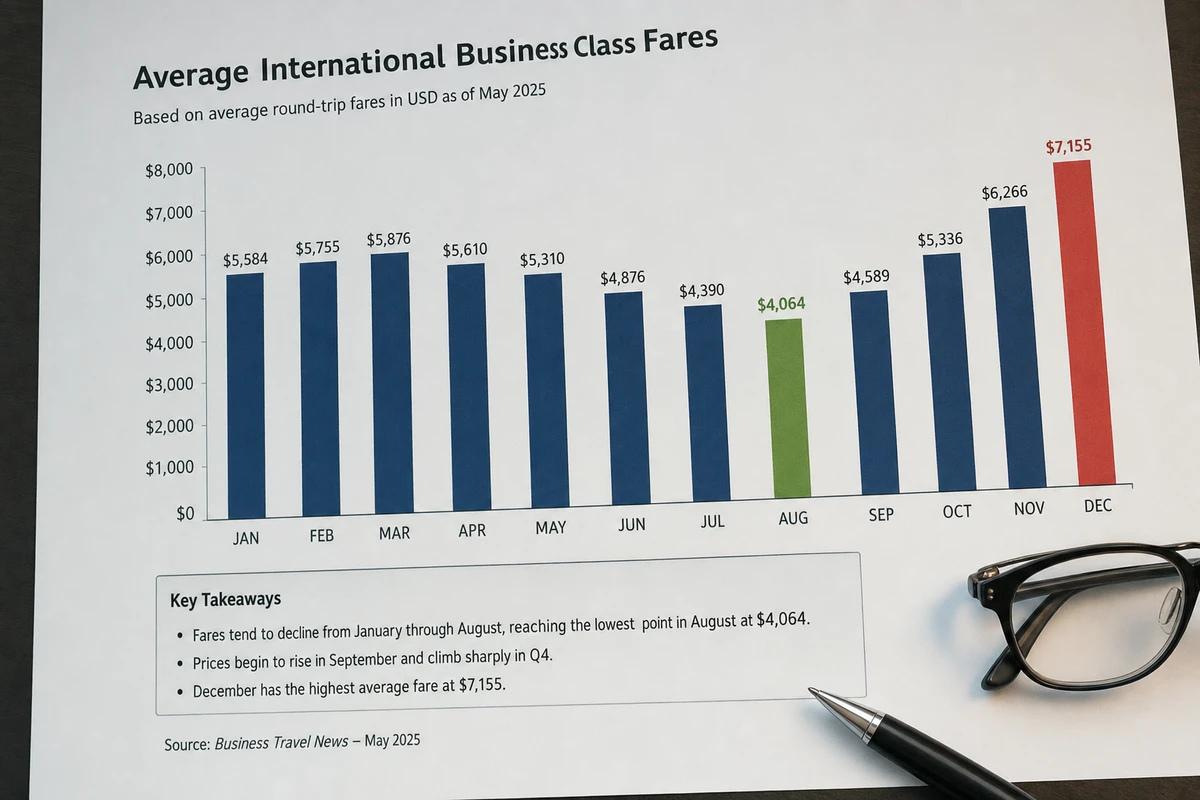
Seasonal data from flight search platforms consistently shows August as the softest month for international business class pricing, with fares averaging around $4,064 round-trip — a few hundred dollars below the yearly average. July and April see smaller dips. December, unsurprisingly, runs the most expensive, though the premium over other months is modest rather than dramatic.
For context on typical spend: domestic business class in the US averages around $1,354 round-trip. International jumps to roughly $4,520. Those are baseline numbers — the strategies below are how you get meaningfully under them.
The consolidator advantage nobody talks about
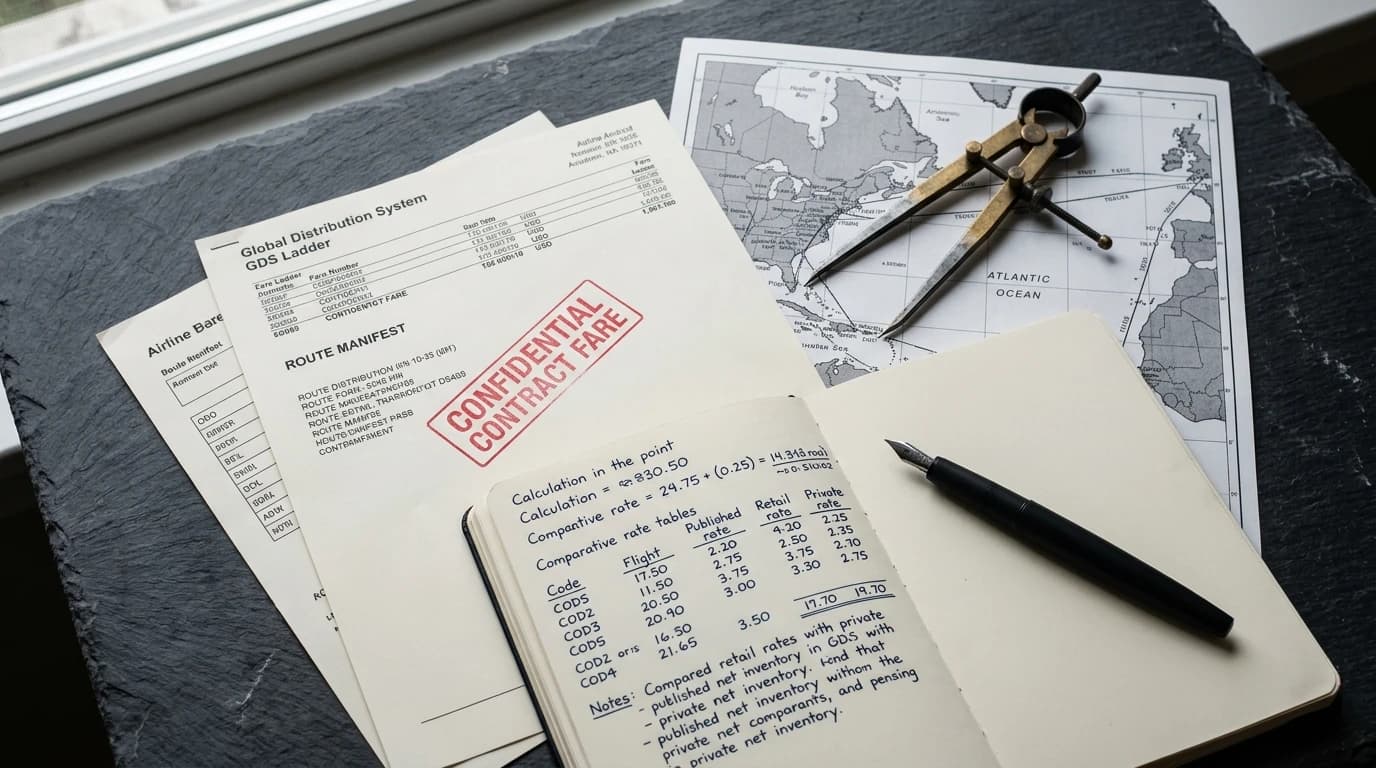
Here's what most articles about "cheap business class" leave out entirely: airlines don't sell every seat at the published fare. They can't. A portion of business class inventory on nearly every long-haul flight moves through consolidators — wholesalers who buy blocks of premium seats at negotiated rates and resell them, often at 30-40% below the airline's public price.
This isn't a loophole or a workaround. It's how the industry has functioned for decades. Corporate travel departments have used consolidator relationships for years to keep executive travel budgets sane. The difference now is that this pricing has become more accessible outside of massive corporate accounts.
We're ASTA-accredited (member #900292735) and are top rated on Trustpilot, which matters more than it sounds like it should — a lot of "discount business class" outfits online are running unlicensed ticket consolidation with zero recourse if something goes wrong. When you're spending $6,000 on a seat, that distinction is not academic.
The mechanics are simple enough. Airlines allocate certain seats to consolidator agreements to fill inventory that would otherwise fly empty or sell at a loss closer to departure. You're not getting a lesser seat, a different fare class restriction, or a downgraded experience — you're getting the same QSuite, the same Polaris seat, the same Club Suite, at a rate the airline negotiated specifically to move that inventory.
Miles and points: the multiplier most people underuse
If you're not paying out of pocket, you're likely paying in miles — and this is where the math gets genuinely interesting. Business class tickets typically cost three to four times what economy costs in cash. They almost never cost three to four times as many miles. That gap is the single most cost-effective lever in the entire loyalty points system.
American Express Membership Rewards remains, in our experience, the strongest card-based path to airline miles. The points transfer widely and the everyday spend categories are generous, but the real trick is staying on top of rotating bonus categories — restaurant promotions, retail partnerships, even utility bill payments through the right portal have quietly padded more than one frequent flyer's mileage balance.
Transferability across alliances is where things compound. United MileagePlus miles work across 26 Star Alliance partners, including Lufthansa, Air Canada, and EVA Air. That means points earned on a hotel stay in Singapore can end up covering an upgrade on a flight to Zurich a year later, provided you understand which partners release award space and when.
One tactic that still works, quietly: if you have status with an airline, call the preferred customer service line immediately after booking an economy ticket and ask whether business class is showing empty seats. The more inventory that's unsold, the fewer miles they'll typically ask for on the upgrade. Airlines would rather fill the cabin than fly it half-empty, and sometimes that works in your favor.
Bidding on upgrade auctions
A handful of airlines — Air New Zealand and Cathay Pacific among them — run upgrade auctions for travelers who've booked an eligible fare. You'll get an email in the days or weeks before departure inviting a bid on the next cabin up. Most carriers restrict it to a single step up; Etihad is more flexible, letting you bid from economy to business or from business to first — though not economy all the way to first in a single jump.
There's a minimum bid threshold, and the smart play is bidding at least 25% above it — auctions with weak competition sometimes clear at surprisingly low numbers, and you won't know unless you're in the running. If the minimum is out of budget, bid what you're actually willing to pay anyway. Worst case, you lose nothing.
Most of these auctions run on cash, though some carriers also accept miles or points for upgrade requests outside the auction system — worth checking your program's specific options if your points balance is healthier than your bank account.
Set alerts and let the fare come to you
Manually checking prices is a losing game — fares shift multiple times a day, and nobody has the patience to refresh a search window at 2am. This is where CEOFLIGHTS' fare monitoring earns its keep. We send real-time notifications when business class fares drop below a threshold you set on specific routes, which means you find out about a fare drop the same afternoon it happens rather than a week later when the seats are gone.
Tools like Business Class Signal take this a step further — continuously scanning routes and scoring each fare against historical pricing data so you know instantly whether a deal is genuinely good or just average. When a JFK–London business class fare drops 45% below the typical range, that's the kind of alert that pays for itself on a single booking.
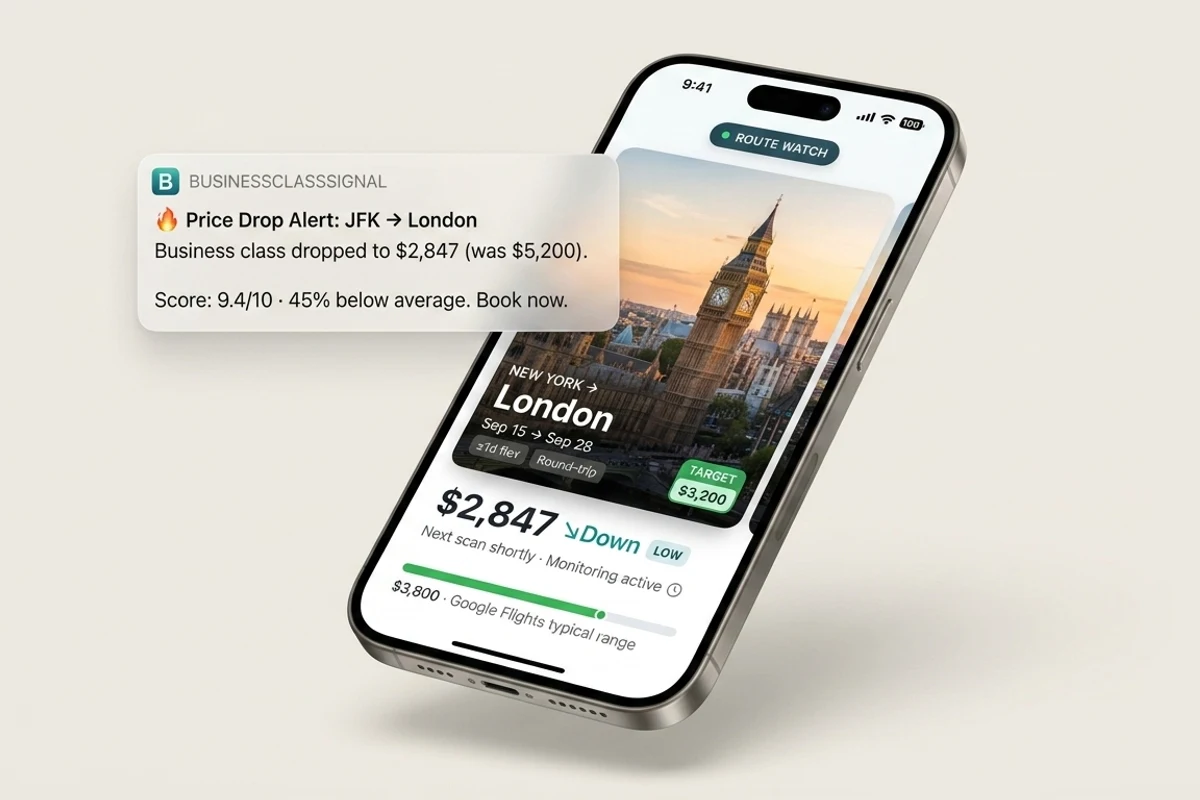
Set your route, choose fixed or flexible dates, and let the alert do the watching. Pair that with a call to a CEOFLIGHTS advisor once a fare moves — because published-price alerts only tell you half the story. The other half is whether that fare can be beaten through a consolidator contract, which is where our desk typically finds another 20-30% off whatever the alert just flagged.
Mix cabin classes on longer itineraries
Say your trip runs Minneapolis to New York to Frankfurt. Paying for business class on the short domestic hop is close to pointless — you'll barely get through the safety demo before descent. But on the transatlantic leg, the upgrade is where the money actually goes to work.
Most airlines allow mixed-cabin itineraries booked under a single reservation, and that single-reservation detail matters: booking everything together typically unlocks better pricing on the premium segment than booking the legs separately would. Economy for the short hop, business class for the long haul, one PNR tying it together.
If you're using miles, look specifically for award tickets that permit mixed cabins — United MileagePlus, for instance, lets you manually select which segment gets upgraded. Check the pricing structure before committing, though. Some programs price the entire itinerary at the highest cabin class booked; others price each segment on its own. That difference can swing the miles required substantially.
Ignore the old advice, embrace flexibility instead
Asking a gate agent for a free upgrade because you're "a nice person" stopped working years ago, if it ever worked at all. Airline staff don't have that discretion anymore. Upgrades today run almost entirely on status tier and check-in timing — not charm.
So check in the second the window opens. Set a phone alarm for 24 hours before departure and beat the mass email blast that goes out to everyone else on the flight. It sounds trivial. It isn't — being first in the upgrade queue when a seat frees up at the gate is often the difference between flying flat and flying cramped.
Day of week matters more than people think, too. Fridays and Mondays are saturated with business travelers protecting their status, which pushes fares up and empties seats out. Tuesdays, Wednesdays, and Saturdays consistently show better business class availability and softer pricing. Build in a few days of flexibility around your target dates and you'll see meaningfully different fares — sometimes hundreds of dollars different on the same route.
Routes worth watching
A few corridors consistently offer the best combination of consolidator availability and fare movement:
- Transatlantic to Paris and Amsterdam — dense competition among Air France, KLM, and legacy US carriers keeps consolidator rates aggressive.
- US to Tokyo on ANA or Japan Airlines — both carriers run excellent hard products and both show up regularly in consolidator inventory.
- Doha and Dubai connections on Qatar Airways and Emirates — long-haul sixth-freedom routing means more capacity, which means more room for negotiated fares.
- New York to Hong Kong or Singapore — ultra-long-haul premium cabins where the gap between published and consolidator fares tends to be widest, sometimes exceeding $3,000 on a single ticket.
FAQs
How do you get upgraded to business class for free?
Free upgrades are rare and getting rarer, but frequent flyer status still moves the needle. Join the loyalty program of whichever airline you fly most, accumulate status, and check whether your credit card has an airline partnership that adds bonus miles on relevant spend categories. Most "free" upgrades today are really miles-funded upgrades in disguise.
Do business class seats get cheaper closer to departure?
Often, yes. Airlines dislike flying empty premium seats more than they dislike discounting them, so last-minute fares can drop — though this is unpredictable and shouldn't be relied on for a trip with fixed dates. This is also exactly where consolidator inventory tends to move, since that's when airlines release blocks they haven't sold through normal channels.
Is first class cheaper than business class?
No — it's the opposite, and it's not close. First class sits above business in seat quality, meal service, and privacy, and it's also considerably harder to book with miles, since inventory is thinner and demand from top-tier elites is higher.
What does business class actually look like?
Think personal pod rather than airplane seat. Lie-flat or near-flat recline, privacy partitions, larger entertainment screens, proper noise-canceling headphones, amenity kits with slippers and sometimes sleepwear on longer routes. The caveat: aircraft age matters enormously. A brand-new cabin and a decade-old refit can carry the same fare class and deliver wildly different experiences. Our breakdown of business class seat types is worth a read before you book anything long-haul.
What we'd actually do
If we were booking a business class ticket tomorrow, we'd set a fare alert through CEOFLIGHTS, wait for a dip, then call our consolidator desk before pulling the trigger on the airline's own site — because the published fare almost never reflects what's actually available underneath it. That one phone call is routinely worth thousands of dollars on international routes.
Call (888) 851-6897 or visit CEOFLIGHTS to have an advisor check consolidator availability on your route before you book anything at the sticker price. We're ASTA-accredited (member #900292735), top rated on Trustpilot, and on most long-haul international routes, we can beat the published business class fare by a meaningful margin — often the difference between a good trip and a great one at a fraction of what you expected to pay.