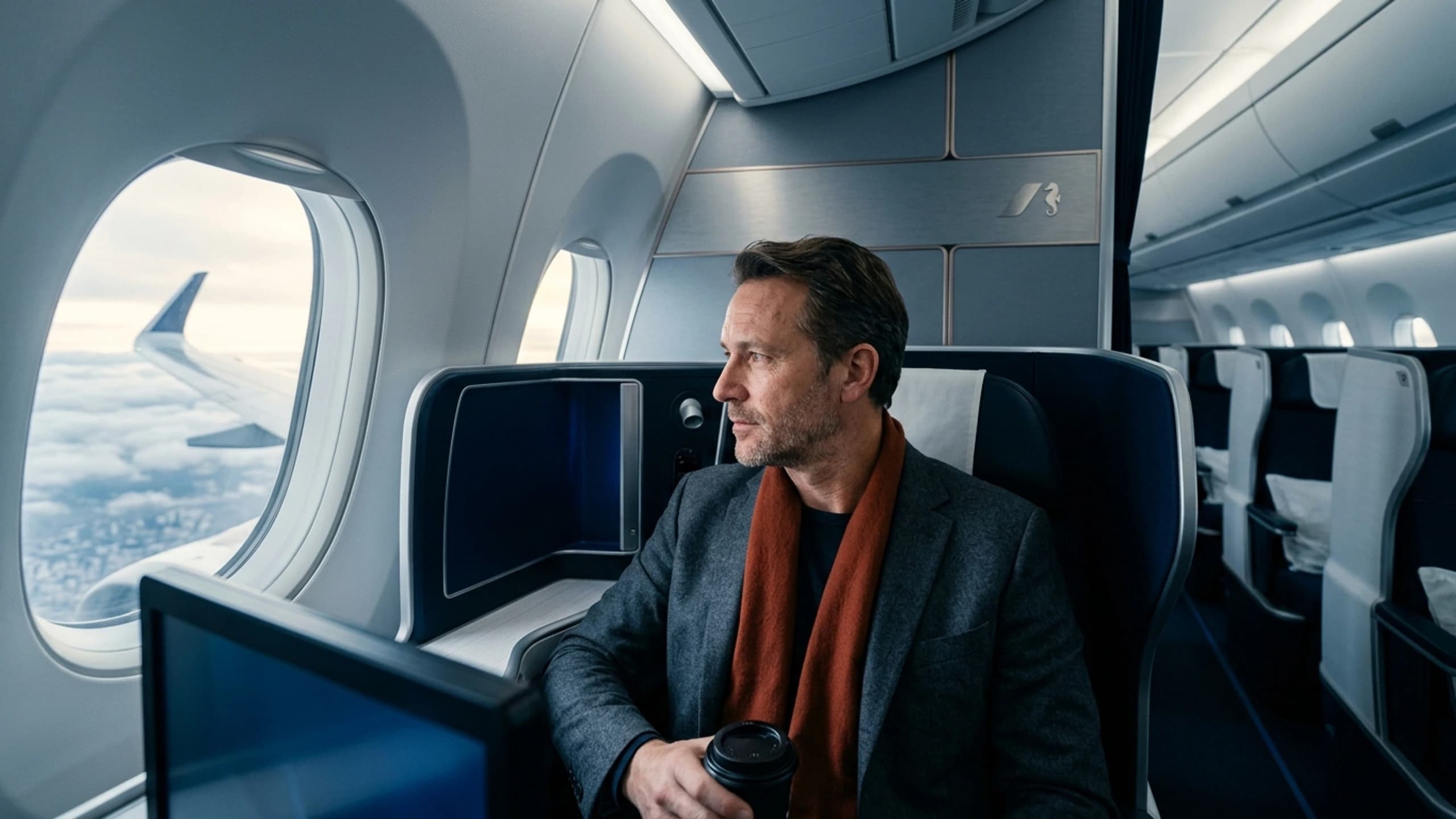
Air France A350 Business Class: Is This Really the Best in Europe?
Sliding doors, a tail camera, and a Bordeaux list that actually means it. We put Air France's new A350 business class up against Lufthansa's Allegris and BA's Club Suite to see who actually wins the European long-haul war.
CEOFLIGHTS Team12 min read
Quick summary
Air France's A350-900 carries 48 business class seats in a 1-2-1 layout, built by STELIA on a customized "Opera WB" frame found on no other airline
Eight bulkhead seats per aircraft swap the footwell for a full ottoman, effectively giving eight passengers a first-class-sized footprint at a business fare
Consolidator fares booked through CEOFLIGHTS on JFK-CDG and ORD-CDG routinely land 20-30% below Air France's published business fares, particularly for last-minute departures
There's a specific kind of overconfidence that creeps into European airline marketing every time a carrier updates a business class seat by more than an inch of recline. Most of it is noise. Air France's new A350 product is not noise.
I've flown this cabin twice now, once on the six-hour JFK-CDG hop and once on a longer haul out of Asia, and I'll say the thing most reviewers hedge on: this is currently the best business class hard product operated by any airline based in Europe. Not "arguably." Not "in some respects." Best. Lufthansa is still finalizing an eight-year-old promise. British Airways just finished a rollout that took nearly a decade. Air France, somewhat quietly, built something better and got it into revenue service first.
That doesn't mean it's flawless. The amenity kit is forgettable for a country that basically invented the concept of luxury retail, and the bedding is a step behind what United puts on its Polaris seats. But on the metrics that actually matter at 39,000 feet: seat privacy, tech, food timing, and that specific bulkhead seat that borders on false advertising, Air France has built something genuinely hard to beat.
The Seat: STELIA's Opera, Customized for Widebodies
Air France selected the STELIA Opera platform for its new A350s, which is notable because Opera was designed primarily for narrow-body aircraft. Air France worked with STELIA on a widebody-specific version, now marketed as "Opera WB," that you won't find installed on any other carrier's fleet. That exclusivity matters. It means the seat isn't a shared commodity part being tweaked slightly by three or four airlines simultaneously (looking at you, Thompson Vantage variants).
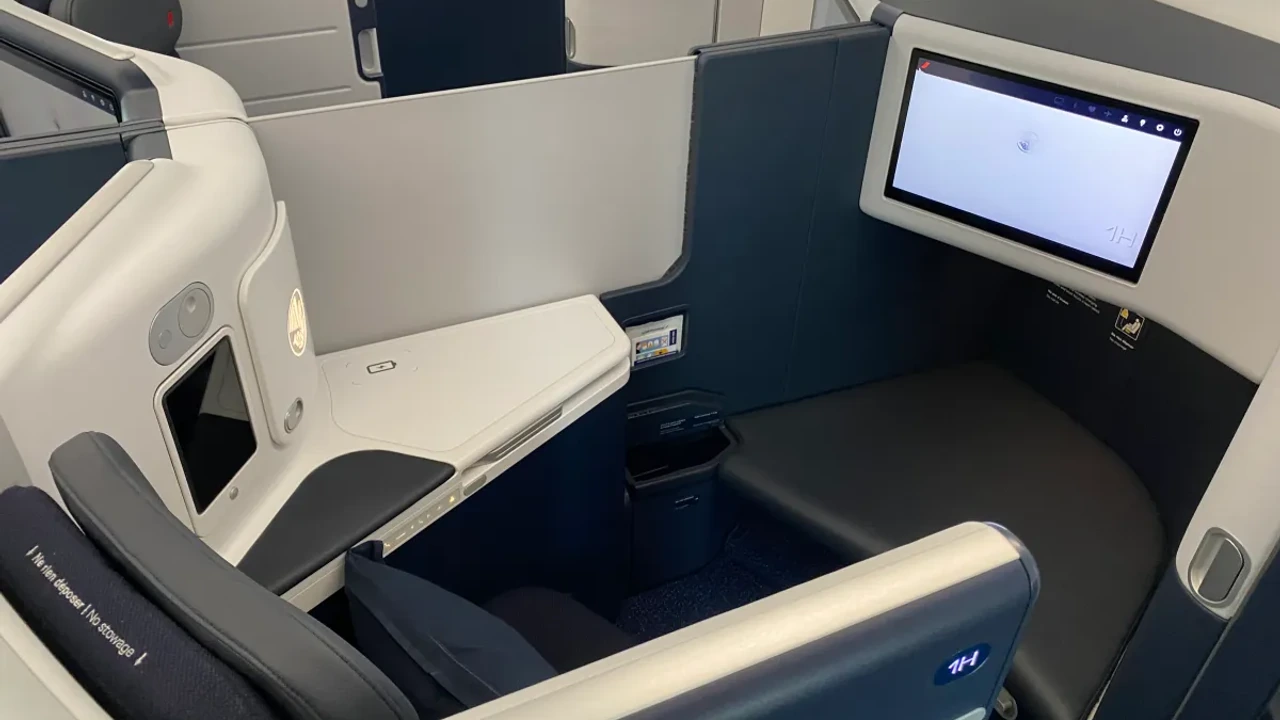
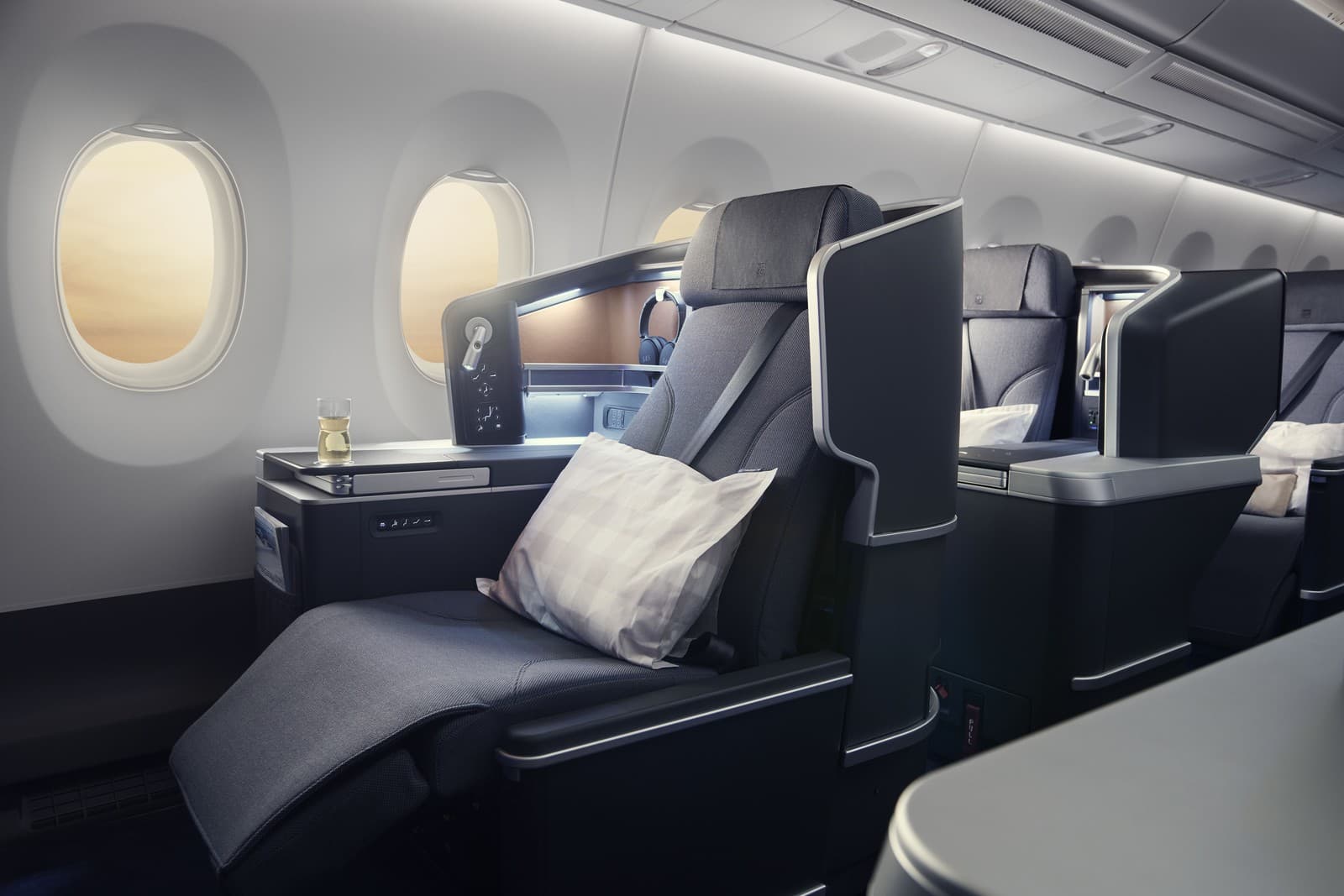
Custom-built for Air France widebodies, the Opera WB seat includes an 80-inch bed length, Bluetooth pairing, and wireless phone charging.
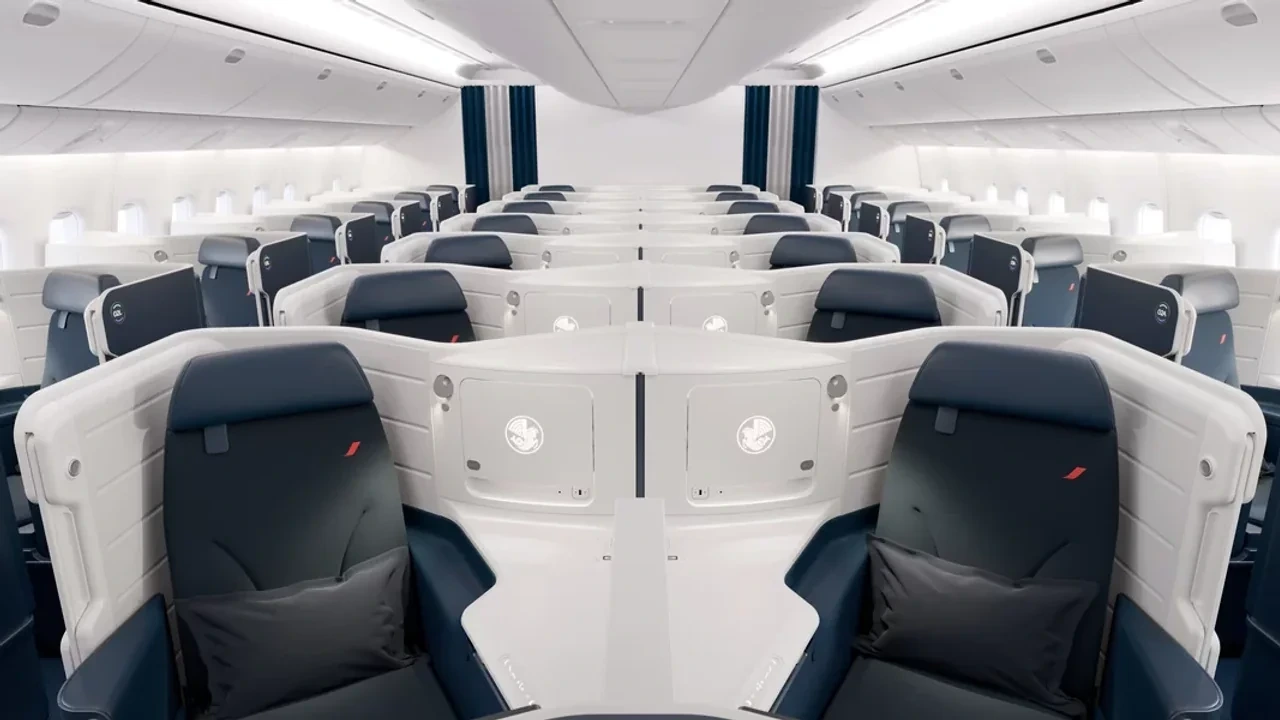
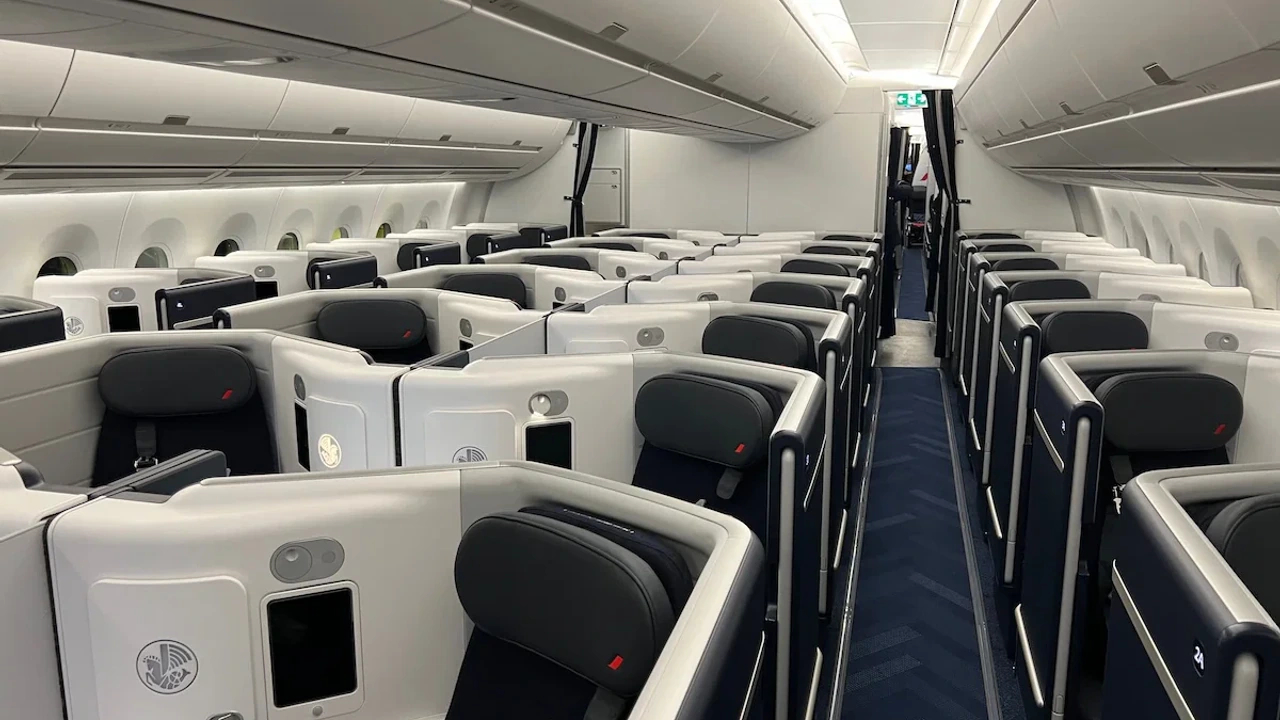
The layout is 1-2-1 reverse herringbone, 48 seats total on the new-generation A350-900. Each seat has a sliding door, a footwell sized generously enough that I could actually stretch fully rather than curl (I'm 6'1", and legroom on herringbone seats has historically been hit-or-miss for anyone over six feet). The seat pitch runs roughly 78-80 inches in bed mode, with a seat width around 21 inches, numbers that sit comfortably ahead of the Club Suite's 78-inch bed and roughly on par with what Lufthansa is promising for Allegris.
48Business class seats on Air France's new A350-900
What actually separates the experience isn't the seat shell, it's the tech stack wrapped around it. A large tablet-style monitor sits beside the seat, controlling everything: seat position, lighting, the entertainment system, and a live map. The entertainment screen itself is crisp, the selection deep, and there's Bluetooth audio pairing so you're not fumbling with the airline's wired headphones every time you want to switch tracks.
Then there's the tail camera. It sounds like a gimmick until you're watching takeoff from Charles de Gaulle from a rear-facing angle at 2 a.m., slightly delirious from a long day, and suddenly the flight feels less like a commute and more like an event. Small thing. Sticks with you anyway.
This is a "new-generation" A350, meaning it has a marginally wider cabin than earlier A350 deliveries and electrochromic dimmable windows rather than physical shades. Air France is fitting this configuration to all future A350 deliveries, so the fleet-wide rollout is a matter of when, not if.
The Bulkhead Seats: Eight Seats That Are Basically First Class
Here's where the review gets interesting, and where most competitor coverage undersells the story.
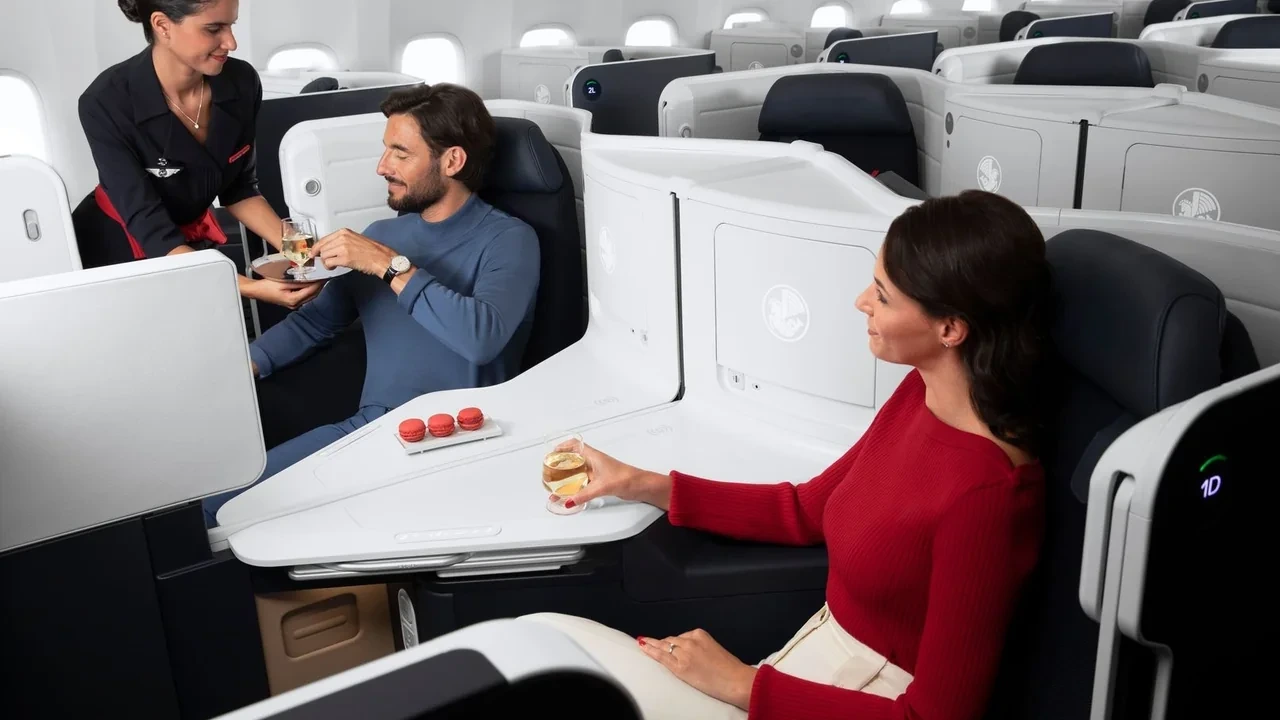
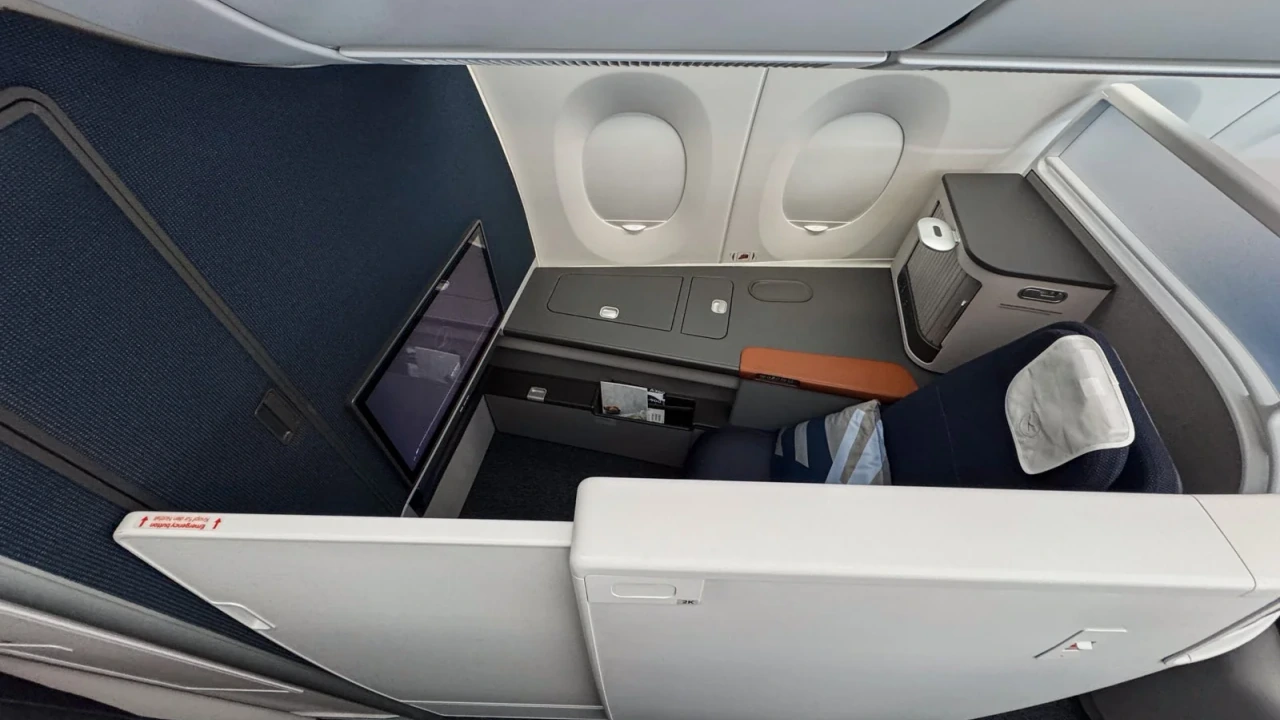
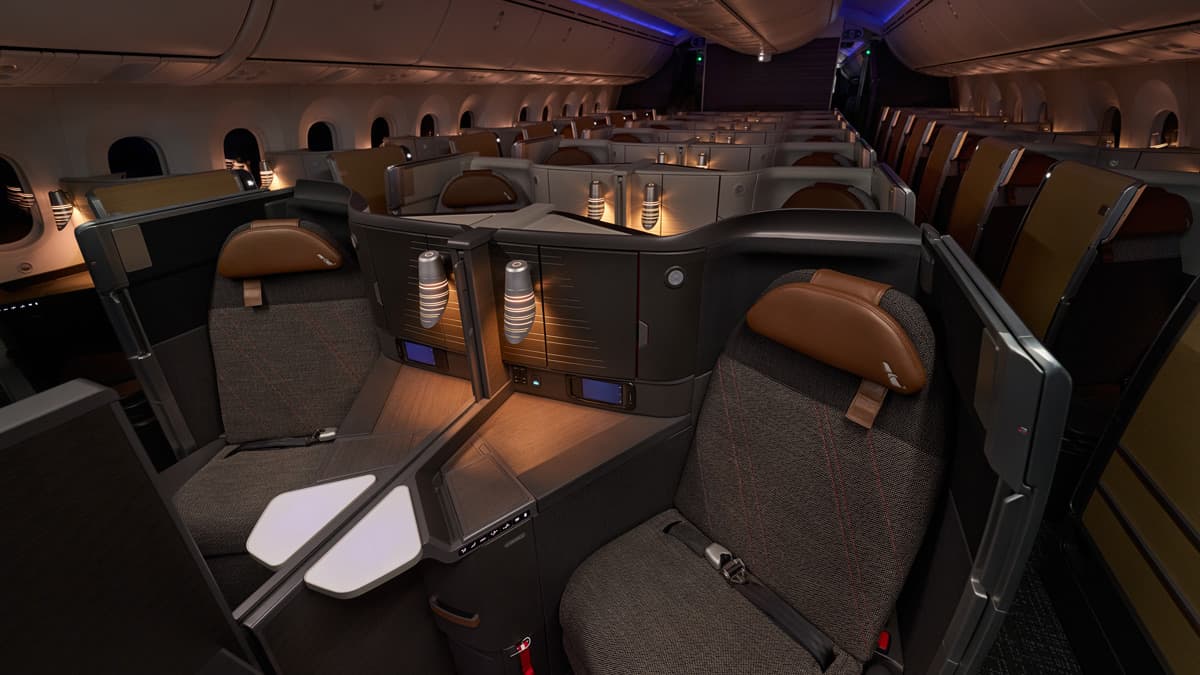
Eight bulkhead seats swap the tapered footwell for an oversized ottoman, effectively offering a first-class footprint at standard business fares.
Eight seats per aircraft, positioned at the bulkhead, replace the standard footwell with a genuinely oversized ottoman. From one angle, the seat looks identical to every other business class seat on the plane. Turn around, though, and you're looking at a private ottoman large enough to seat a second person, with a storage compartment built underneath it. Legroom, footprint, and the general sense of personal real estate jump dramatically. I've sat in seats marketed as "first class" on other carriers with less usable space than these eight bulkhead positions offer.
How to get the bulkhead seat
Flying Blue elite members can pre-assign these eight seats at time of booking. Everyone else has a shot within four hours of departure, when seat restrictions lift and any remaining bulkhead seats become bookable like standard business class inventory. Check back obsessively. They go fast.
If you're booking through CEOFLIGHTS and flexibility on seat selection matters to your itinerary, ask your advisor to flag the flight for bulkhead availability closer to departure. It's a five-minute check that can be the difference between a good flight and an exceptional one.
Not every Air France A350-900 is configured the same way. A smaller number of aircraft still run an older 34-seat Safran Optima business cabin without doors or bulkhead ottomans. Before you book, confirm the aircraft type and cabin configuration for your specific flight number, not just the aircraft model. The difference between the two products is enormous, and Air France's own booking engine doesn't always make the distinction obvious.
Food and Wine: Fast, French, and Actually Good
The hardest logistical puzzle on a short transatlantic overnight (New York to Paris clocks in around 6 hours, 30 minutes on a good routing) is service pacing. Airlines either rush the meal and leave passengers awake and irritated, or drag it out and eat into sleep time. Air France threads this better than most.
The full dinner service wraps within 60 minutes after takeoff, maximizing sleep time on short 6.5-hour JFK to Paris overnight sectors.
Twenty minutes after takeoff, crew were already moving through the cabin with champagne and a savory snack, which is fast by any transatlantic business class standard. The full meal tray, appetizer, salad, cheese, dessert, landed on the table roughly 35 minutes after wheels-up. My main course arrived the moment the appetizer plate cleared: sautéed shrimp in a lobster sauce that was properly seasoned, not the beige, oversalted version of "lobster sauce" you get on half the carriers flying this route.
The entire dinner service, start to finish, wrapped inside about an hour. That's fast. Faster than I've experienced on Lufthansa, faster than BA, faster than most U.S. carriers running the same route. It leaves five-plus hours for actual sleep, which is precisely the point on an overnight flight nobody wants to spend eating a four-course meal at 1 a.m. body-clock time.
Breakfast lands roughly 80 minutes before landing: fruit, yogurt, pastries, an optional egg dish. Nothing groundbreaking, but competently executed and, crucially, not rushed the way some airlines treat pre-arrival service as an afterthought.
On the wine side, Air France has leaned into its home-field advantage. The business class list draws from Bordeaux appellations with actual rotation, not the same three bottles reused across every route for eighteen months (a problem that plagues more airlines than any of them will admit). Ask the crew what's currently pouring rather than defaulting to the printed menu; on both my flights the verbal recommendation beat the card.
Where Air France Falls Short: Amenities and Bedding
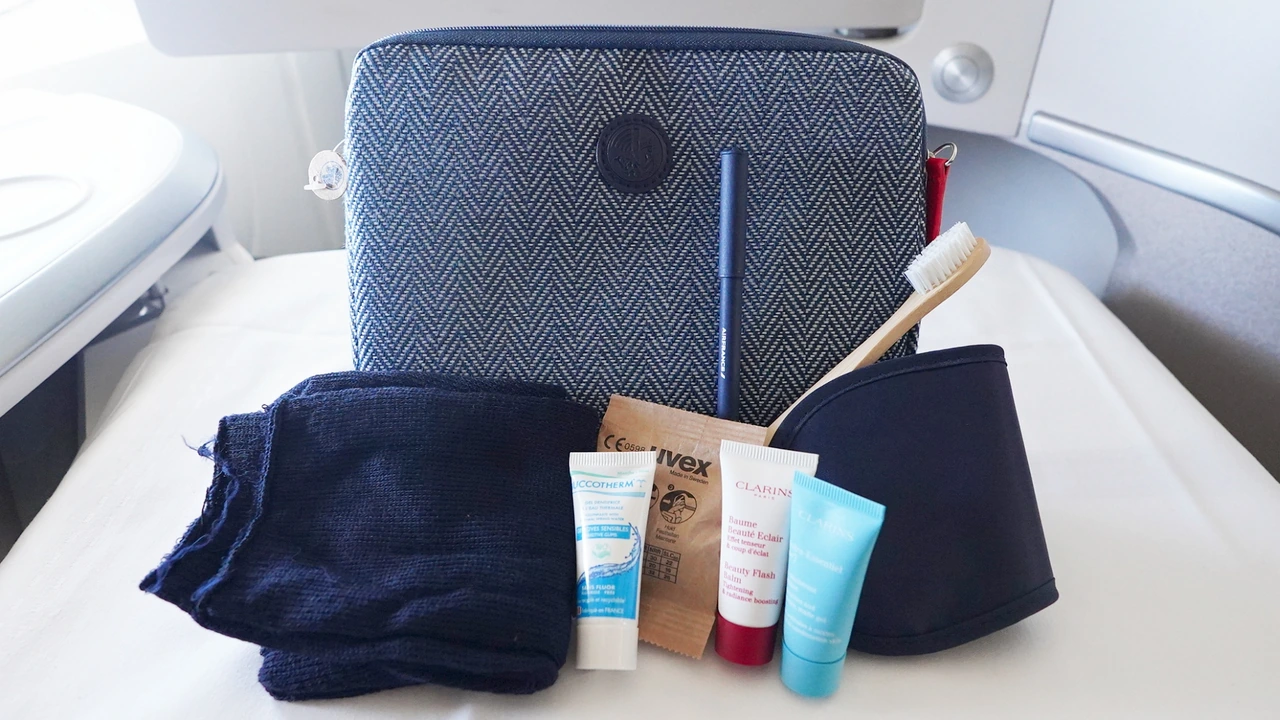
I'll say the quiet part loud: for a country that essentially owns the concept of luxury retail, Air France's amenity kit is underwhelming. Each business class passenger gets a small kit with a couple of Clarins products, competent, mildly above the transatlantic average, but nowhere near what Cathay or Singapore Airlines puts in front of business passengers on comparable routes. It's not a dealbreaker. It's just a missed opportunity from an airline that could be doing something more memorable with essentially zero marginal cost.
The Clarins amenity pouch and standard duvet are functional, but trail the luxury bedding packages offered by United Polaris and Gulf carriers.
Bedding is similarly fine-not-great. Substantial pillow, decent blanket, comfortable enough for a six-hour flight. But United's Polaris bedding is genuinely superior in both material and design, and Air France's blanket blends so completely into the seat upholstery that the cabin loses a bit of visual warmth it could easily have with a contrasting pattern.
None of this changes the overall verdict, but if you're coming in expecting an amenity experience that matches the seat, temper expectations.
Air France vs. Lufthansa Allegris
Lufthansa first announced Allegris in 2017. As of this writing, the rollout has taken most of a decade to reach meaningful scale across its widebody fleet, and the seat itself, while genuinely good in its top-tier "Suite" configuration, comes in multiple sub-tiers that create real booking confusion. Not every Allegris business seat has a door. Not every one has the same width. You can book a Lufthansa business ticket and end up in something meaningfully worse than the seat in the marketing photos, depending entirely on which sub-class you land in.
While Lufthansa Allegris offers comparable door hardware, its complex rollout and multi-tiered seating surcharge make Air France far more predictable.
Air France's product, by contrast, is consistent within each configuration. Every seat on the new A350 cabin has a door. Every seat has the tablet control. The only real variance is the bulkhead upgrade, which is a bonus tier, not a downgrade risk. For a buyer paying business class fares, predictability matters almost as much as peak quality. Lufthansa's rollout complexity works against it here, even though the best version of Allegris is competitive on paper.
Air France vs. British Airways Club Suite
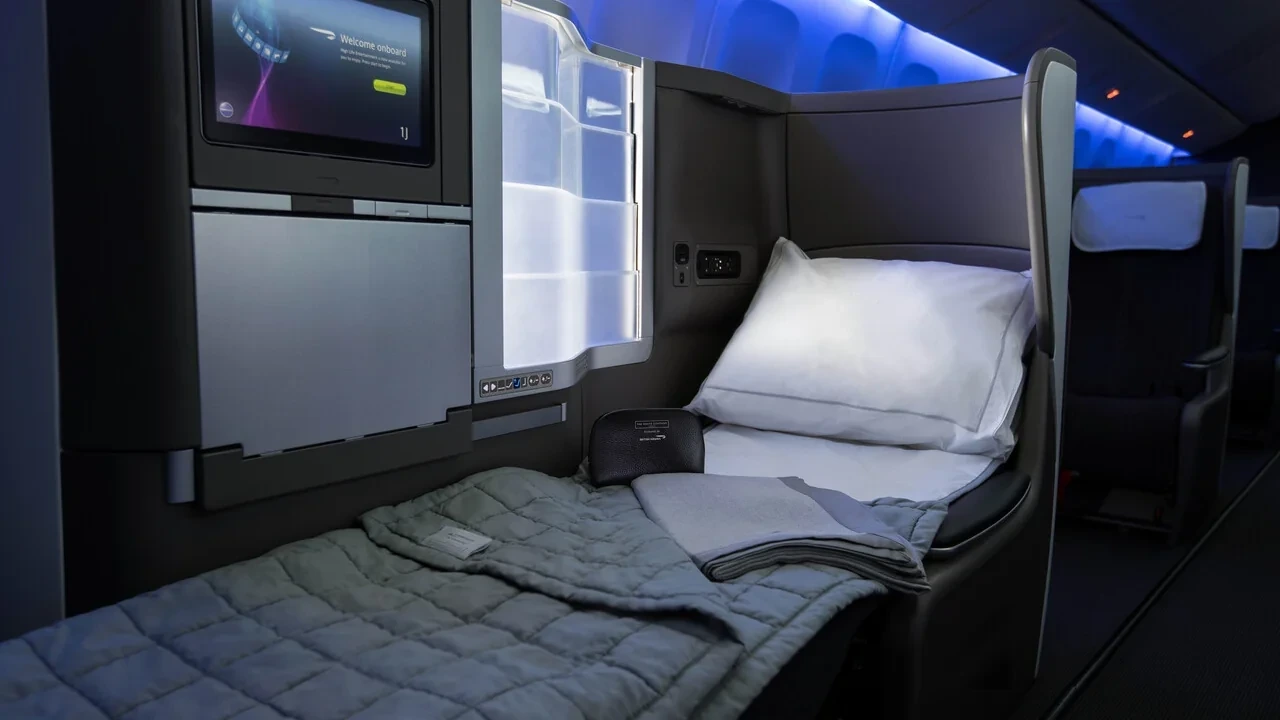
BA's Club Suite, rolled out across its 777 and A350 fleets over the past several years, was a real improvement over BA's previous flat-bed product, no argument there. Doors, direct aisle access, a genuinely private feel.
BA's Club Suite introduced doors across the Atlantic, but Air France edges ahead on footwell clearance and inflight entertainment responsiveness.
But side by side, the Air France cabin wins on tech (BA's entertainment system and remote interface feel a generation behind), on footwell space for taller passengers, and decisively on the bulkhead seats, which have no real BA equivalent. Where BA claws some ground back is consistency of scheduled lounge access at Heathrow's Concorde Room, which remains a genuinely superior ground experience to anything Air France offers at CDG. If ground experience matters more to your trip than the eight hours in the air, that's a legitimate factor. If the flight itself is the priority, Air France wins clearly.
Booking It: JFK-CDG and ORD-CDG Fares Through CEOFLIGHTS
Here's where the analysis gets practical. Air France's published business class fares on JFK-CDG typically list in the $4,200 to $5,800 round-trip range depending on season, with peak summer and holiday travel pushing past $6,500. On ORD-CDG, published fares run similarly, often $4,000 to $5,500 round-trip.
Through CEOFLIGHTS' consolidator relationships, we're regularly seeing JFK-CDG business class fares 20-30% below published rates, with sharper discounts appearing on shoulder-season departures (January through March, and again in November) and on flights with lower forward booking demand. A round-trip fare that Air France's own site lists at $5,400 has, in recent months, come through our desk closer to $3,900 to $4,200 for the identical cabin, on the identical A350 configuration.
ORD-CDG shows similar patterns, with consolidator fares generally running 15-25% under Air France's published business class pricing, and occasionally deeper on flights departing within 21 days when Air France is trying to move unsold premium inventory.
Booking timing matters
Consolidator pricing on this route fluctuates with cabin load, and the sharpest discounts tend to appear either far out (75+ days) or very close in (under 21 days), with a less favorable middle window. If your travel dates are flexible, that gap is worth exploiting.
If your team travels this route with any regularity, JFK-CDG and ORD-CDG business class fares are exactly the kind of routine, high-frequency booking where a fare-monitoring relationship pays for itself within a year. Our team tracks these routes specifically because Air France's new A350 has made the destination cabin worth chasing on price, not just on schedule convenience.
The fare is only half of it. A personal travel manager also confirms the flight is operating the new Opera cabin before ticketing, holds a bulkhead seat where one is available, and handles the reissue when a meeting in Paris moves by a day.
Should You Actually Book This Seat
Yes, with one caveat: confirm the aircraft configuration before you book, not after. Air France operates a mixed A350 fleet right now, and the difference between the new Opera WB cabin and the older 34-seat Optima configuration is the difference between "best in Europe" and "fine, I guess." Check the specific flight number, not just the route.
Air France's new-generation A350 features 48 STELIA Opera suites in a 1-2-1 reverse herringbone configuration with full privacy doors.
Beyond that, this is as close to a straightforward recommendation as this category gets. The seat is genuinely private, the tech doesn't feel like an afterthought bolted onto a decade-old frame, the food service is fast without feeling rushed, and the bulkhead seats are, without much competition, the best value proposition in business class travel right now: a first-class footprint at a business fare, bookable by anyone within four hours of departure.
Lufthansa will eventually finish rolling out Allegris across its fleet, and when it does, this comparison may shift. British Airways will keep refining Club Suite. But right now, on the numbers and on the experience, Air France's new A350 cabin is the one to book, and with the right consolidator fare through CEOFLIGHTS, it's also one of the more attainable premium cabins on the transatlantic map. If you'd like our team to check live availability and fare options for an upcoming JFK-CDG or ORD-CDG trip, talk to a CEOFLIGHTS travel manager and we'll pull current pricing against your dates.
Bottom line
Air France's A350 business class is the strongest hard product currently flying under a European flag. Confirm the aircraft config, aim for a bulkhead seat if you can get one, and let CEOFLIGHTS check consolidator pricing before you pay published fares.
Content creator and business travel specialist at CEOFLIGHTS, bringing you the latest insights, tips, and trends in premium business and first-class travel.
Become the CEO of Your Journey
You take the lead. Your dedicated Personal Travel Manager handles every detail.